HE RISKS EVERYTHING TO CLAIM A FAMILY — THEN DISCOVERS THE WEST OWES HIM NOTHING BUT TESTS

PART 1
The sun had baked the Wyoming plains into a shimmering furnace by mid-June of 1882, and Caleb Mercer felt it pressing down like judgment. The courthouse square in Laramie was a furnace of dust and heat, where men’s faces were carved with worry deeper than any canyon. Caleb clutched a damp, smudged notice—the final demand that spelled ruin for his family ranch. The ink blurred under his thumb, but the truth burned sharp and unyielding: mortgage overdue. Three months ago, a fever had stolen his wife, Margaret, leaving the house silent in a way that made his chest ache with every creak of the floorboards. Caleb hadn’t come to the auction expecting to bid on anything, but grief had a strange way of dragging him toward the misery of others, as if shared suffering could dull the edge of his own loss.
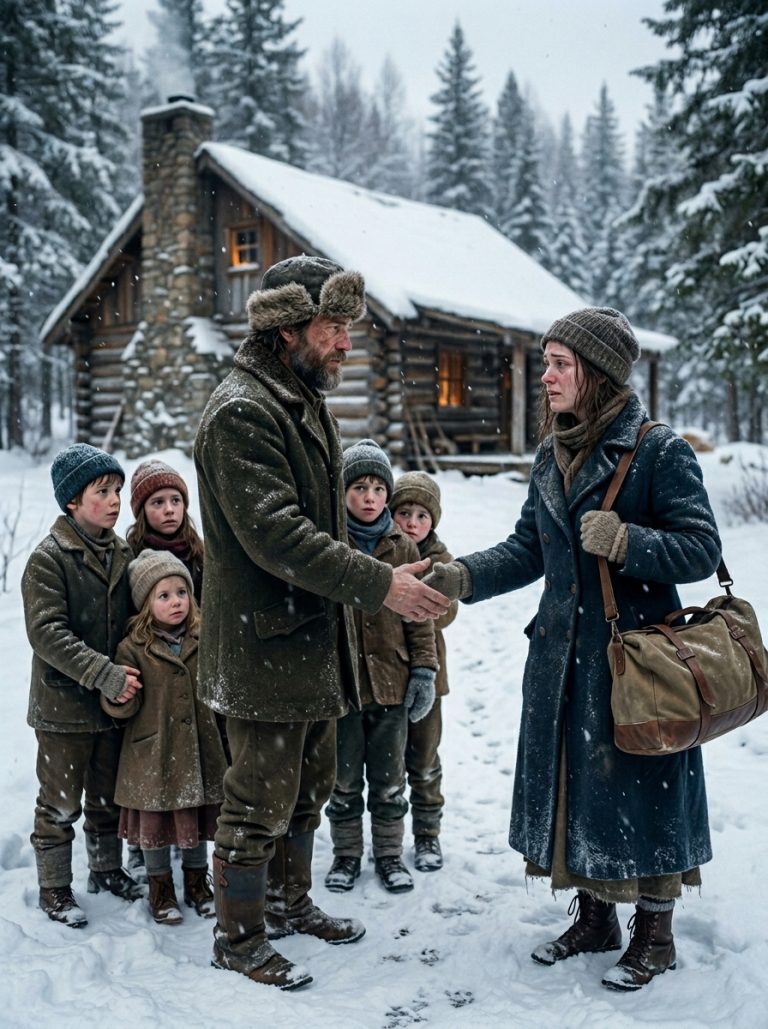
The auctioneer, a man called Dobbins with a voice like rolling thunder, rattled off livestock and wagons with precise cruelty. Caleb’s ears heard numbers, but his mind replayed Margaret’s last whisper: “Don’t become a stone, Caleb. Stones bear nothing.” The crowd’s murmurs, the scent of horse sweat, and the tang of manure swirled into a heavy perfume of human survival. Then came a ripple of hush that cut sharper than the heat: a woman, tall and determined, stood with five children clinging to her skirts. The eldest girl’s eyes held a fierce intelligence, the boys clung to each other like a single shield, and a baby whimpered against the woman’s chest.
“Hart family,” muttered Old Hank Mullins. “Husband owed the bank near two hundred. Land didn’t cover it. She used to teach school—smart as a whip.” Caleb’s heart thumped at the sight of them—so small against the town’s indifferent eyes. Dobbins’s hammer raised. “Final lot of the day: one capable widow, four children for light work, one infant. Opening bid fifty dollars.”
Bids flew. Silas Crowe, a ranch baron with a reputation for crushing men beneath his boot, shouted sixty. Another bidder nudged seventy. Caleb felt his blood tighten. The teenage girl’s jaw set, the boys froze rigid, and the smallest blonde peered out in fear. And then, in that moment, Margaret’s words returned to him. Impulsively, before reason could stop him, Caleb called out, “One hundred!” Heads swiveled. Crowe’s eyes narrowed. “One twenty-five.” Caleb faltered. Counting, praying, heart hammering, he stammered, “One thirty-five.” Crowe sneered. “One forty.”
Caleb’s last hope came from the town itself: Hank Mullins pressed twenty into his hand. Doc Ellison added forty. Hands from strangers, hungry and callused, tossed coins into the pot. Caleb swallowed, lifted his chin, and faced Crowe: “Two hundred.” A hush fell. The hammer slammed: sold to Caleb Mercer. Applause rose, but Caleb felt nothing heroic—only a precarious relief.
The woman approached. “Mr. Mercer,” she said quietly. “I am Eliza Hart. We are not broken. We will work, yes, but not as charity.” Caleb tipped his hat. “I expect you to live. That’s all I can promise.” And together, they left the auction square, the prairie stretching wide ahead, full of both promise and danger.
As they rode to his ranch, the youngest, Maisie, climbed beside him, curls golden in the sunlight. The twins whispered strategy to one another. Eliza hummed a quiet tune with the baby, a thread of life knitting Caleb’s empty house toward warmth again. But at the back of his mind, a shadow lingered—an unspoken question: would the world let them live, or would it demand the price of courage first?
A dark figure watched from a distant ridge, a rifle glinting in the sun, measuring the family as if they were cattle. Caleb felt the chill of awareness prick his spine. Something was coming.
PART 2
The shadow arrived faster than the wind. Two mornings later, hoofbeats thundered along Caleb’s drive, and Ranger barked like the earth itself had erupted. Silas Crowe came, flanked by three men, teeth bared in polished malice. “Granger,” he said smoothly, “I hear you purchased the Hart family. One thousand dollars—cash.”
A thousand dollars—enough to erase the mortgage, rebuild, and buy safety. Yet, temptation carried Margaret’s voice, whispering, safety is not always right. Eliza stepped closer, firm, unwavering: “Don’t you dare.” She understood what Crowe’s offer truly meant—not workers, but control. And Caleb, feeling fear curl like fire in his gut, made a decision that would echo across the territory: “They’re not for sale.”
Crowe left with a threat hanging like smoke behind him. But nightfall brought fire to their barn, flames licking hungrily, swallowing hay, tools, everything Caleb had painstakingly gathered. Eliza moved with decisive grace, commanding the children like a seasoned general. Nora directed the twins; Maisie clung to Ranger. Caleb fought to contain panic, to maintain the line between courage and recklessness.
By dawn, the barn lay in charred ruins. Carved into a plank were the letters S.C. Eliza stared, recognition sharp as a knife. The attack was a message: submission or ruin. Caleb wanted vengeance, but saw the children’s eyes—trusting, waiting. And in that trust, he understood the true measure of manhood.
A lone horse approached from the horizon, bringing men who might either be salvation or another threat. Caleb gripped his rifle, heart pounding.
PART 3
The next weeks were a battlefield of survival, strategy, and community. Sheriff Whitaker offered what little protection he could, but Caleb and Eliza realized defense required more than law—it demanded unity. The bank meeting became another arena, where Eliza’s intelligence turned suspicion into leverage, convincing the banker to grant a six-month extension.
Neighbors, once silent witnesses, began to act. Lumber and nails appeared at the ruins of the barn. Casseroles were left on doorsteps. Caleb watched the twins hammer nails, saw their shoulders grow under praise. Nora organized materials with military precision. Eliza managed all of it, feeding the hungry, nursing Henry, and teaching the family resilience.
Crowe returned, larger and angrier, only to be met by a community united—men and women who refused to let fear dictate action. Shots rang out, but the attackers fled, leaving behind a trail of impotent threats. Evidence from Thomas Hart’s records secured a legal warrant. Crowe’s power crumbled, exposed for the first time.
The Hart-Mercer partnership flourished. The ranch thrived. Eliza’s garden grew wild with life. Children laughed, learned, and lived fully. Caleb still felt Margaret’s absence, but her loss no longer suffocated him. He had learned that grief transforms; it can forge courage, compassion, and action.
By October, the town witnessed an unexpected celebration: Caleb and Eliza married in a ceremony of quiet triumph, children scattering flowers, neighbors witnessing the birth of a family built on choices, not property. Caleb’s vow echoed truth: “I regret nearly becoming stone.” Eliza’s soft repetition of Margaret’s words, “Stones don’t grow anything,” became a promise. And together, they stepped inside their home, laughter mingling with the prairie wind, the West finally recognizing the strength born of courage, unity, and love.
A family is never bought—it is built, one brave choice at a time, until the world acknowledges it as real.