HER STEPFATHER SOLD HER FOR $50 IN FRONT OF THE WHOLE TOWN — THE MOUNTAIN MAN WHO BOUGHT HER DIDN’T KNOW SHE WAS CARRYING A SECRET THAT WOULD CHANGE EVERYTHING

PART 1
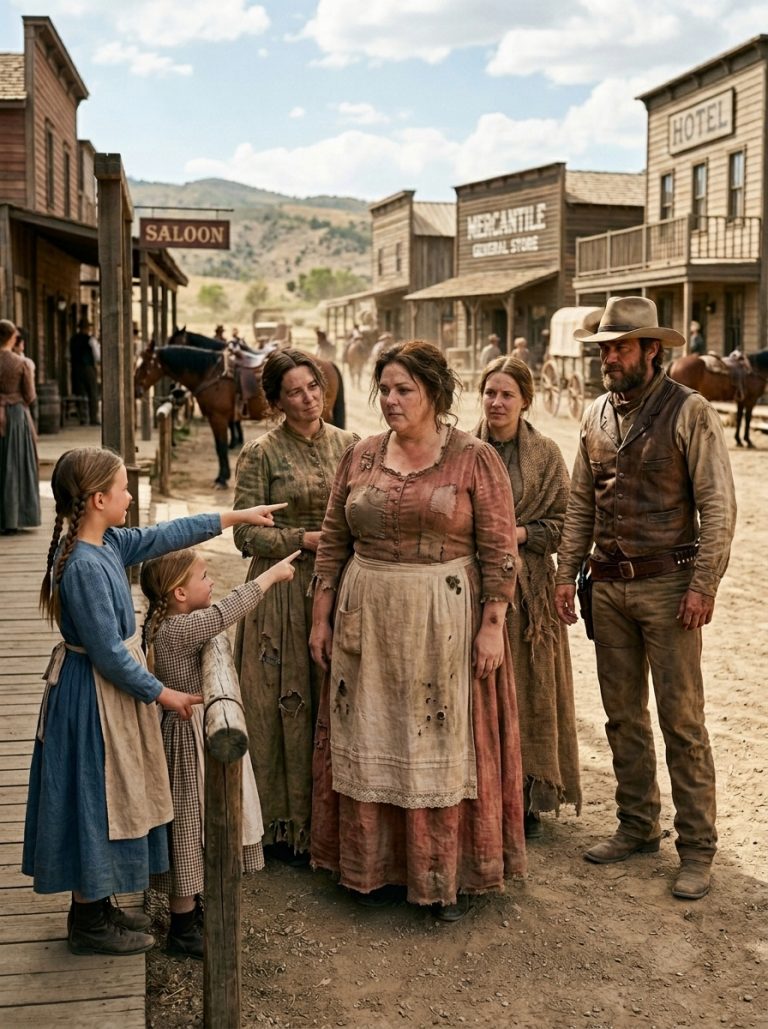
She had counted forty-seven knots in the floorboards by the time the laughter started.
Nora Greer had always been good at finding something small to hold onto when the world got too large and too loud. As a girl it had been the pattern on her mother’s apron. Later, the grain of the kitchen table. Now it was the floorboards of Calloway’s Trading Post, each knot a small brown eye staring up at her, indifferent and useful. She stared back. She focused. She did not look at the men.
The voice of her stepfather, Gerald Stoke, moved through the room like smoke finding its way into every corner.
“Barren,” he said, loud enough to reach the back wall. “Been declared so by the doctor at Laramie. But she cooks clean, she works hard, and she won’t cost you much in the way of trouble. Fifty dollars and she’s yours.”
Someone near the barrel of dry goods made a sound that wasn’t quite a word. Someone else — she could tell by the wet thickness of the laugh — had a mouthful of tobacco. Boots scraped. A chair protested. The late-afternoon light came through the warped glass of the trading post windows in long amber columns, and the dust in those columns moved lazily, as if none of this was anything to hurry about.
Nora’s hands were folded in her lap. She had folded them that way on purpose, the way you placed a lid on something that was boiling, because her hands had opinions her face was not allowed to express.
Twenty-four years old. That was what she was. Twenty-four years old, and she was sitting in a wooden chair in the middle of Calloway’s Trading Post in Broken Elk, Wyoming, while her stepfather sold her the way a man sold a horse he had decided was more trouble than it was worth.
She had not always been this kind of quiet.
There had been a version of Nora Greer — before the first marriage, before the town had watched it collapse and assigned her the blame — who had walked into a room and taken up all the space available to her without apology. She had been large and warm and loud in the way that made some people uncomfortable and other people feel finally, specifically seen. She had laughed with her whole chest. She had argued about things she cared about. She had believed, with the specific uncomplicated faith of someone who hadn’t yet been taught otherwise, that the right person would find the shape of her and think: yes. That.
The marriage had been brief. Her ex-husband, Thomas, had been a thin, careful man who smiled in the right places and felt nothing behind it. He had lasted fourteen months before informing Nora that the problem, as he saw it, was her — too much of her, specifically. Too large. Too opinionated. Too present. And then, as the final nail, delivered with the calm satisfaction of a man producing evidence: “The doctor says it’s you. No children. I deserve children.”
She had been twenty-two. She had carried that verdict like a stone in her chest ever since.
Gerald Stoke had inherited Nora along with her mother’s small house and her mother’s small savings when he married two years ago, six months after her mother’s death. He had calculated her usefulness with the efficiency of a man who understood assets. Now he had apparently finished calculating.
“Fifty dollars,” he said again, irritated that no hands had gone up.
A man near the stove shook his head and walked out without looking at her. Another one said something under his breath that produced a cluster of low laughter near the door. Nora counted knot forty-eight. Forty-nine. The wood grain ran diagonal on this board, she noticed. Unusual. She focused on that.
Then the door opened.
She felt the room shift before she looked up. The shift was specific — a change in the quality of attention, the way a room adjusted when something walked in that it wasn’t entirely sure what to do with. Cold air came first, carrying pine and woodsmoke and the sharp mineral smell of altitude. Then the sound of boots, unhurried, deliberate, crossing the floor with the tread of a man who had never once in his life worried whether he was taking up too much space.
Nora looked up.
He was not what the room had been expecting. That much was clear from the silence he brought with him. Large — genuinely large, the kind built by decades of outdoor work, not performance. A beard that had made its own decisions. A coat that had seen serious winters. His face was weathered to a particular shade that came from years of wind and cold and altitude, and his eyes, when they moved across the room, were the unhurried grey of a sky deciding whether to snow.
They landed on Gerald first. Then on the fifty dollars on the table. Then on Nora.
He looked at her for longer than anyone else had. Not the way the other men had looked at her — as an inventory assessment, a calculation of whether the cost-benefit analysis worked out. He looked at her the way you looked at something that wasn’t what you’d been told it was.
“Who declared it?” he said.
Gerald blinked. “Beg your pardon?”
“The barren declaration.” His voice was low and unhurried, the same quality as his boots on the floor. “You said a doctor at Laramie. Which one?”
The question fell into the room like a stone into still water, and the ripples were quiet and significant.
Gerald’s chin came up. “That’s none of your—”
“Fifty dollars,” the man said, and put his hand flat on the table beside the money.
The room was very quiet.
Nora looked at the hand on the table. Then at the face above the coat. He was not looking at Gerald. He was looking at her.
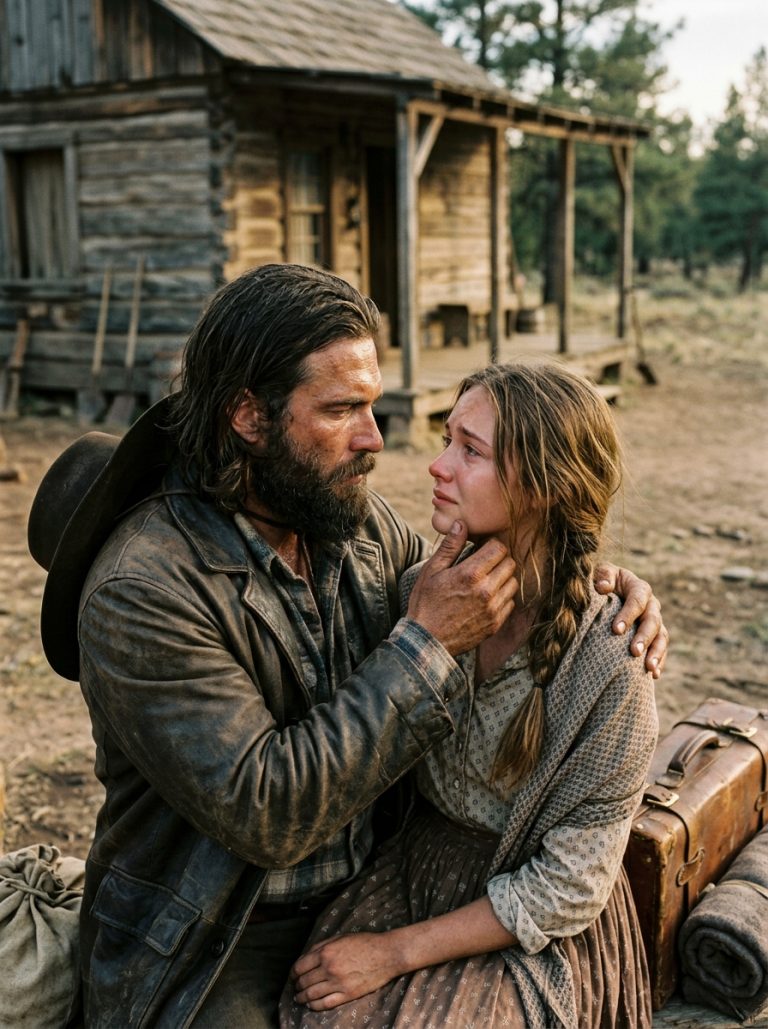
“I’m Cade Morrow,” he said, speaking to her and not to the room. “I have a cattle operation up at Weatherstone Pass. It’s a hard place to live. I want you to know that before you decide.”
“She doesn’t get a—” Gerald started.
“She does,” Cade Morrow said, still looking at Nora. “Or I walk out.”
The room held its breath.
Nora looked back at this man with his serious grey eyes and his hand flat on the table and the fifty dollars that meant something completely different now that someone had treated them like a question rather than a verdict. She thought about the chair she was sitting in and the knots she had been counting and the way the last two years had made her smaller and smaller until she was nearly the size of a person who had given up.
She thought about the word barren and what it had done to the inside of her chest.
“How far is Weatherstone Pass?” she asked.
Something moved in his face. Not a smile, exactly. But something adjacent to it.
“Three hours by horse,” he said. “If the weather holds.”
Outside, the wind shoved hard against the trading post windows, and the amber light shifted, and Nora Greer — who had not made a real choice about anything in two years — felt something happen in the center of her chest. Small. Not dramatic. Just a thing that had been held very still for a long time, shifting.
She unfolded her hands from her lap.
“All right,” she said.
Gerald looked like he wanted to object but had just remembered he was getting fifty dollars, which was forty-nine more than he’d expected. He pocketed the money without ceremony. Someone in the back of the trading post said something to someone else, and more laughter came, but Nora was already standing, and standing changed the acoustics of everything.
Cade Morrow picked up her single bag from beside the chair — she hadn’t asked him to; he simply did it, the way you picked up something someone was going to need carried — and held the door open.
Nora walked through it without looking back.
The cold outside was clean and absolute and smelled of pine trees and the coming dark, and for one strange moment, standing on the porch of Calloway’s Trading Post in Broken Elk, Wyoming, Nora felt something she hadn’t felt in so long she almost didn’t recognize it.
Like air, suddenly, where there had only been pressure.
They were halfway to the horses when she heard Gerald’s voice behind her, rising for the room’s benefit one last time: “Don’t say I didn’t warn you — she’s—”
“I heard what you said,” Cade Morrow replied, not turning around. “I don’t need to hear it again.”
And they rode out of Broken Elk into the wide cold dark, toward a mountain she had never seen, with a man she didn’t know yet, carrying a secret she hadn’t told anyone — a secret that the Laramie doctor had given her not as a final verdict, but as a question mark he hadn’t finished explaining when her husband had walked out of the room.
PART 2
Weatherstone Pass announced itself before they arrived.
The track narrowed, the trees closed in, and then the trees gave way to a view that made Nora pull her horse to a stop without meaning to: a valley folded between two ridges, a working ranch spread across it like a hand laid flat on a table, lamplight already burning in the windows against the darkening sky. Solid. Quiet. Serious, the way things built to last were serious.
“It’s real,” she said, without meaning to say it out loud.
Cade glanced at her. “What did you expect?”
She hadn’t expected anything. She had stopped expecting things as a form of self-preservation. “I don’t know,” she said honestly, and he accepted that without comment, which was the first thing he did that made her think she might be able to breathe here.
The ranch had a name carved into the gate post: MORROW. Just the name. No decoration. She appreciated the directness.
Inside, the house was spare and clean and had the feeling of a place kept functional by someone who understood the purpose of a thing better than its appearance. A stone fireplace. A kitchen with real shelves. A table with four chairs, which told her that at some point there had been more people here than there were now.
She noticed one of the chairs had a child’s hand-carved figure sitting on the seat. A small horse. Rough but unmistakable.
She didn’t ask about it that night.
The rules of the arrangement were established practically, the way Cade Morrow seemed to establish everything — without ceremony but without coldness either. Her room. Her work. The understanding that this was a partnership of necessity and that neither of them needed to pretend otherwise. He spoke to her like she was a capable adult, which, after two years of being spoken about rather than to, hit her somewhere surprisingly tender.
The first week was hard in the way all new and necessary things were hard. Her hands blistered. She learned the particular weight of a water pail at altitude, the way cold arrived up here differently than it did in town — not as weather but as atmosphere, as a permanent condition of the air itself. She made mistakes. Cade corrected them without theater. She corrected them. She made different mistakes.
She did not think about the doctor in Laramie.
She tried not to.
The thing the doctor had said — the thing she had not finished hearing because Thomas had made his decision before the appointment was over and the doctor had still been talking when Thomas walked out and took her attention with him — had been sitting in the back of her mind for two years like a locked door. She had decided, in the numb aftermath of the divorce and Gerald’s house and everything that followed, that it didn’t matter. That a locked door with no key was simply a wall.
But on the eighth morning at Weatherstone Pass, she woke before dawn with a nausea so specific and so absolute that she lay on her back staring at the ceiling and felt the locked door rattle.
By the third morning of this she knew.
She lay in the dark for a long time. Her hands rested on her stomach — flat, ordinary, keeping a secret so enormous it barely fit inside a body.
Barren. Gerald’s voice in the trading post. Thomas’s voice in the lawyer’s office. The doctor’s voice in Laramie, except the doctor’s voice had been saying something different, something she hadn’t finished hearing, something that started with the test results indicate and then Thomas had stood up and that sentence had never arrived at its ending.
She was going to have to tell Cade Morrow.
She was going to have to tell him that the thing his fifty dollars had purchased — the straightforward, childless arrangement he had made with a woman sold as barren — was not what either of them had believed it was.
She found him at the fence line as the sun came up cold and pale behind the eastern ridge, working with the quiet methodical patience of a man who had been doing hard things alone for long enough that hard things had simply become things.
“Cade,” she said.
He looked up.
“I need to tell you something,” she said. “And I need you to know that I didn’t know. I genuinely didn’t know.”
He set down the fence post. He waited.
“I’m pregnant,” Nora said.
The word landed in the cold morning air between them, solid as a stone.
Cade Morrow looked at her for a long, still moment, and she could not read his face at all, and that was the most frightening thing she had encountered since the trading post chair, and she was still standing in it when he said, very quietly:
“How long have you known?”
“Three days certain,” she said. “Two years uncertain.”
He looked at the horizon. Something moved through his face — something large, and not simple, and not anger. Something she didn’t have a name for yet, but which she understood was going to determine everything.
Then he picked the fence post back up.
“Go eat breakfast,” he said. “It’s cold.”
“Cade—”
“Go eat breakfast, Nora.” His voice was not unkind. It was the voice of a man buying himself time to think, which she recognized because she had spent two years doing the same thing. “I’ll come in when I’m done here.”
She went inside. She made breakfast with shaking hands. She set two plates on the table with the four chairs, and she sat down in one, and she waited.
PART 3
He came in an hour later.
He sat down across from her and ate with the focused attention of a man who used routine as structure, and Nora ate too, because her body had recently developed opinions about what it needed and those opinions were non-negotiable. The food was good. She had discovered, somewhere in the first week, that cooking at altitude and cooking in a kitchen that was actually stocked were both different and better than what she’d had access to in Gerald’s house. Small mercies.
When the plates were clear, Cade folded his hands on the table in the particular way she had already come to recognize — a decision being organized.
“Tell me about Laramie,” he said.
So she told him. All of it — the appointment, the doctor, Thomas’s expression when he’d already decided, the way the doctor had still been talking when the chair on Thomas’s side of the desk scraped back, the way she had stood up too, automatically, the way you stood up when the person with authority over the room decided it was over. The two years of believing the incomplete sentence. The word barren becoming a fact simply because it had been repeated often enough by people with enough authority.
Cade listened without interrupting.
When she finished, he was quiet for a moment. “So you never heard what the doctor actually determined.”
“No,” Nora said. “Just the beginning.”
“Then it was never a diagnosis,” he said. “It was a man walking out of a room.”
The precision of this — the simple, careful way he had reframed twenty-four months of her believing something that had hollowed her out from the inside — landed with a force she was not prepared for. She pressed her lips together. Her eyes burned. She was not going to cry at the breakfast table over a fence post man she had known for eight days. She was not.
“I should have stayed and finished the appointment,” she said, because if she focused on the practical then the burning stayed behind her eyes instead of running down her face.
“You were twenty-two,” Cade said. “And you were with a man who had already decided.”
Nora looked out the window. The ridge was catching the morning light now, gold on grey stone, the kind of clean beauty that happened up here every morning like it was easy.
“I understand,” she said, “if this changes the arrangement.”
A pause.
“Changes it how?” he asked.
She turned back to face him. “You bought a childless woman. The terms—”
“I bought a woman who’d been lied about,” Cade said, with the flat finality of a man correcting an incorrect account in a ledger. “By a man who didn’t know what the doctor said because he left before the doctor finished. And by a town that decided the story was easier than the truth.” He met her eyes. “Those aren’t terms I agreed to. Those are just what happened.”
Nora’s throat was doing something difficult. “You might not want—”
“Nora.” His voice was even and direct and did not leave much room for the particular kind of self-sabotage she had been practicing for two years. “Do you want to leave?”
“No,” she said, before she had entirely decided to say it.
“Then we proceed,” he said.
It was not romantic. It was not a declaration. It was a man looking at the facts as they actually were — not as the trading post had narrated them, not as Thomas had arranged them, not as Gerald had sold them — and deciding that the actual facts were workable. Nora understood this, and she understood it was its own kind of grace: the grace of being looked at clearly and not found wrong.
Spring arrived at Weatherstone Pass in slow deliberate increments. The snow retreated from the south-facing slopes first, then the valley floor, then the fence lines, until one morning Nora walked out to feed the horses and the air smelled like something other than cold for the first time in months. Green, almost. The suggestion of it.
Her body changed. She tracked it with a mixture of awe and bewilderment, the way you tracked weather on an unfamiliar mountain — carefully, knowing the patterns were real but not yet knowing what they meant. Cade noticed. He redistributed the heaviest work without announcement, simply appearing beside her when something required lifting and taking the weight as if that were the obvious order of things. She did not thank him effusively. He did not require her to. This was a different language than she had been spoken to in before, and she was learning it.
They talked in the evenings. Slowly at first, and then less slowly. She learned about the child’s carved horse on the chair — his younger brother, grown now, living in Oregon, who had left it behind the summer he turned seventeen and never came back for it. She told him about her mother, about the years before Gerald when the small house had been warm and full of cooking smells and her mother’s voice. About the version of herself she had been before Thomas and the trading post and the two years of reduction.
Cade listened to all of it without trying to fix any of it, which was, she was discovering, the thing about him. He did not require things to be other than they were. He had the particular quality of a man who had spent years alone in a serious landscape and had learned that the landscape didn’t change because you objected to it — you simply learned to navigate it as it actually was. He extended the same courtesy to people.
One evening in April, the fire burning low, she said: “You never said why. In the trading post.”
He looked up from the harness he was mending. “Why what?”
“Why you asked about the doctor. Why you didn’t just— why you cared whether the declaration was legitimate.”
He was quiet for a moment. He set down the harness. “I knew someone,” he said, “who got a label put on her that wasn’t true. By a man who needed the story more than he needed the truth. And she lived the rest of her life as that label, and it wasn’t her.”
He didn’t offer more than that. She didn’t ask. But she understood that what had happened in the trading post — the question about the doctor, the fifty dollars, the she does get a choice — had not been random. He had recognized something. He had acted on what he recognized.
She reached across the table and covered his hand with hers for a moment. Just a moment. He didn’t pull away.
The baby came on a still night in early June.
Ruth Halley, the midwife from the valley’s lower settlement, arrived in the early dark and took charge of the kitchen with the calm authority of a woman who had done this more times than she’d been paid for. Cade paced the length of the porch so many times Nora could hear the boards memorizing his footsteps. She found this — the pacing, specifically, the evidence of it — oddly and profoundly comforting. The sound of a man who was not leaving.
The labor was long. It was the kind of long that had no patience for philosophy, only for the next moment, and the one after that. Ruth talked Nora through it with the pragmatic kindness of a woman who believed in the capability of the person in front of her, which was, Nora would think later, exactly what the moment required.
When the cry came, it was the most startling sound Nora had ever heard — not because it was loud but because it was so specifically, irreducibly alive. A boy. Small and definite and already objecting to the temperature of the world.
Ruth placed him in Nora’s arms and stepped back.
Nora looked at him. He had dark hair and an expression of focused displeasure at everything that had just occurred, and she thought: you are real. You are entirely real. The doctor in Laramie did not say what Thomas wanted him to say, and you are the evidence.
She heard the porch door.
Cade came in with the snow-melt cold still on his coat and stopped when he saw her, and the expression on his face was something she had not seen from him before — unguarded, entirely, in a way that his face didn’t usually permit. He crossed the kitchen without speaking and looked at the boy in her arms with the careful, reverent attention of someone being shown something they had long since stopped expecting.
“He’s all right?” he said, to Ruth, without looking away.
“Both of them are all right,” Ruth said, with the satisfaction of the statement meaning exactly what it said.
Cade sat in the chair beside the bed. He didn’t reach for the baby immediately. He sat there, close, and looked at both of them, and Nora understood — from the particular quality of his stillness, from everything she had learned about how he inhabited a room — that this was not absence. This was the fullest attention he knew how to give.
“I want to call him Daniel,” Nora said. “After my mother’s father.”
“Daniel,” Cade said, and it sounded like an answer to a question he hadn’t known he was waiting to hear.
Summer broke over Weatherstone Pass with the force of something that had been held back long enough. The valley greened. The cattle moved to the upper pasture. Nora, who had arrived in November with a single bag and fifty dollars’ worth of town opinion attached to her name, learned the rhythms of the ranch the way you learned a language — first the words, then the sentences, then the day when you thought in it without noticing.
She was strong up here. Genuinely strong, in the specific way that came from real work in real air, not the performed usefulness of Gerald’s house. Her hands had changed. She had changed. She was the same Nora who had counted floorboard knots in the trading post — that woman hadn’t disappeared; she had simply had the pressure removed, and without the pressure, she had expanded back into the space she had always rightfully occupied.
Daniel grew with the summer, fat and opinionated and extraordinarily interested in the horses, which Cade found genuinely amusing in a way that arrived on his face without his permission and stayed there.
One morning, watching Cade carry Daniel on his shoulders along the fence line, narrating the cattle with the patient thoroughness of a man who had decided a seven-month-old child deserved complete information, Nora felt something move through her that she recognized, after a moment, as happiness. Not the cautious, provisional version she had been allowing herself — a little at a time, like a person who had been hungry so long they didn’t trust the food. The real kind. The kind that took up space.
She had been afraid, for a long time, that the word barren had taken something from her that couldn’t be recovered. That the trading post chair, and Thomas’s walked-out appointment, and Gerald’s fifty dollars had defined the permanent shape of her story.
What she understood now was that they had only defined one chapter of it. A chapter she had not written and would not have chosen, but which had led — along a road she couldn’t have planned — here. To this valley. To this fence line. To this man who had walked into a trading post and asked the one question no one else had thought to ask.
In October, a letter arrived from Broken Elk.
It was from Thomas. Or rather, it was from Thomas’s attorney, which was worse in a different way — the language of a man who couldn’t face the directness of what he’d done and had decided to use formality as insulation. The letter stated, in three paragraphs of legal language, that Thomas had remarried, that his new wife had not yet conceived, and that the doctor in Laramie had been in contact with Thomas’s physician — and that it appeared, based on records now reviewed in full, that the original test results from two years prior had, in fact, indicated that the impediment to conception had been identified as bilateral on Thomas’s side, not Nora’s.
She read the letter twice.
Then she set it on the table, face down, with the careful deliberateness of someone putting something in its correct place.
Thomas had known. Or at minimum, Thomas had left the doctor’s office knowing the sentence was unfinished, and he had chosen to let the unfinished sentence become a verdict against her, because a verdict against her was more convenient than the truth.
She sat with that for a while.
Cade came in from the barn and saw her face and sat down across from her without asking what was in the letter, which was the right thing — he always seemed to know what the right thing was, in the specific sense of what the moment required, not what he personally needed to do with his feelings about it.
“He knew,” Nora said. “Or he chose not to know. Which is the same thing.”
“Yes,” Cade said. “It is.”
“Two years,” she said. “Gerald. The trading post. All of it. Because he chose not to finish the appointment.”
Cade was quiet for a moment. “What do you want to do with it?”
She thought about this. The anger was real — it had been real in one form or another for two years, and now it had a specific address, and she was entitled to it. She thought about writing back. She thought about the particular satisfaction of sending a letter that said: I have a son. He is healthy. And I know what you did.
She thought about Daniel asleep in the next room, making the small steady sounds of a person who had been thoroughly fed and was satisfied with the world.
“Nothing,” she said, finally. “I don’t want to do anything with it.”
Cade looked at her.
“It already did what it’s going to do,” she said. “It got me here. I don’t want to give him any more of the story than that.”
She picked up the letter and walked to the fire and placed it in.
The paper caught quickly, the way paper did. The legal language turned orange and then black and then grey, and the words that had been used to arrange a lie became ash, and the ash went up the chimney into the cold October sky above Weatherstone Pass.
She stood and watched it go.
Cade came and stood beside her, and they were both quiet for a while, looking at the fire, which had gone back to being what a fire was: heat, light, the ordinary company of warmth against a cold outside.
“I’d like us to be married properly,” he said. “If that’s something you’d want.”
She turned to look at him. His face was doing the thing it did — carefully arranged, but not quite managed, the feeling showing through at the edges.
“In the spring,” she said. “When the valley’s green.”
His mouth moved. This time it was actually a smile, small and certain, the kind that didn’t need to be large to mean what it meant.
“Spring,” he agreed.
They were married on a Saturday in May when the grass was new and the horses were restless and Daniel had figured out walking three weeks prior and was applying this skill loudly and in all directions throughout the ceremony, which was conducted by a traveling minister who took the chaos with good humor and managed to get through the vows anyway. Ruth Halley was there. Owen, Cade’s ranch hand, stood at the back with his hat in his hands, looking at his boots during the vows because he was deeply uncomfortable with emotion and had attended anyway, which was its own kind of declaration.
Nora stood in the spring light in a dress that fit her — all of her, without apology — and said: I do.
Not because she had been sold. Not because she had no choice. Not because the arithmetic of survival required it. But because she was standing beside a man who had walked into a trading post and refused the story the room had already written, and in doing so had offered her something rarer than love, though it had become that too.
He had offered her the simple, radical act of being seen accurately.
Years later, Broken Elk would talk about Nora Morrow the way small towns talked about women who had refused the ending assigned to them — with a mixture of admiration and residual discomfort, the way people felt about being wrong. Some remembered her from the trading post chair and quietly revised their accounting of that day. Others had the grace to feel the specific shame that came from having laughed with their mouths full of tobacco while a twenty-four-year-old woman counted knots in the floor.
Nora didn’t require their revision. She wasn’t waiting for the town to correct its ledger. She lived three hours up the mountain, in a valley that smelled of pine and cold water and the particular clean air that came from being exactly where you were supposed to be.
Daniel grew into a boy who climbed everything and had opinions about horses and his father’s patience. A second child followed, a girl they called Mae, who arrived in a summer so warm the whole valley felt like permission. The ranch expanded. The work continued. The evenings kept their quiet, and the fire kept burning, and sometimes Nora would sit with her coffee and watch Cade at the table doing the accounts or mending something, and she would think about the woman who had counted floorboard knots and told herself that surprise was a luxury for girls raised gently.
She had been wrong about that.
Surprise, she had learned, was not a luxury. It was what happened when you refused to let other people finish your sentence. It was what arrived when you stayed long enough, in the right place, with the right person, to find out what the story actually was — not the version shouted across a trading post, not the version Thomas had walked out of, not the version Gerald had sold for fifty dollars.
The real version. The one that had been waiting, patient and intact, for someone to ask the correct question.
And the correct question, as it turned out, was the simplest one: who declared it?
Three words. One man who had thought to say them.
The rest had followed.