HER FATHER DIED ON A TUESDAY — BY FRIDAY, A STRANGER’S NAME WAS ALREADY WRITTEN NEXT TO HERS

PART 1
The pen weighed nothing. That was the part that surprised her.
Clara Whitfield had spent three sleepless nights rehearsing this moment — the ink, the paper, the irrevocable scratch of a signature that would reroute her entire life. She had imagined the pen would resist her, the way her whole body wanted to resist, the way her lungs kept forgetting their job whenever she thought too hard about what she was about to do. But when the attorney slid the contract across his desk and she picked up that slim brass instrument, it weighed nothing at all. As if the universe had decided the lightest objects should carry the heaviest things.
The office smelled of beeswax candles, cold coffee, and the kind of wood polish that only appeared in rooms where men made decisions about other people’s futures. November pressed against the windows in sheets of grey. Outside, Billings moved on — carts, coal smoke, the slow groan of a town that did not stop because one family had stopped. The contract lay open before her, already signed by two witnesses, already stamped, already so thoroughly decided that her name at the bottom felt less like a choice and more like a formality. The number printed beside it did not ask permission either.
$300.
Clara stared at it. She had expected the number to look cruel. It didn’t. It looked like arithmetic, like the cold subtraction of what a body cost when a family was starving and winter had already sharpened its knife. $300 would bury her father in a proper grave with a proper stone, not a pine board and borrowed rope. It would keep her mother, her brother Daniel, and her three younger sisters fed through the worst months. It would buy time — and time, she had learned, was the only currency that actually mattered.
Across the room, Margaret Whitfield sat hunched in a straight-backed chair as if the act of sitting upright required everything she had left. She had stopped weeping sometime around the second night. Not because the grief had eased, but because the body eventually ran dry. Her hands lay twisted in her lap, fingers interlocked so tightly the knuckles had gone bloodless. She was forty-three years old and she looked sixty, and Clara knew, with the specific clarity of someone who had watched sickness dismantle a household piece by piece, that the woman sitting in that chair was not capable of surviving another blow. Which was why Clara was the one holding the pen.
“Miss Whitfield,” the attorney said, without looking up. He tapped the signature line once. It made a sound like a gavel. “We need to move forward.”
Move forward. As though she were choosing a hat at the milliner’s. As though she were selecting thread.
Clara’s younger brother Daniel was sixteen, already broad in the shoulders, already carrying the hollow look of a boy who had decided he was a man. She had heard him through the wall last night, speaking quietly to himself the way frightened people did when they thought no one was listening: I can work the mines. I can go down. Papa did it. And that sentence — those five words — had done something to Clara’s chest that no grief had managed to do. Something cold and absolute. Their father had gone down into the earth for twenty years. He had come back up at the end a man made of cough and apology, his broad shoulders collapsed, his bright eyes clouded with the particular shame of a strong person who could no longer be strong. The mines had not killed him quickly. They had taken him apart, slowly, like a structure being demolished from the inside.
Daniel would not go down into that earth. Not while Clara still had something left to give.
She signed her name.
The scratch of the pen sounded too loud in the room’s careful silence, like something tearing. And in a way something was tearing — not her heart, which had arrived at a strange, flat calm — but her sense of who she was. Clara Whitfield, nineteen years old, daughter of a dead miner, had just become a commodity with a receipt. She pressed the pen down on the final letter and lifted it away and felt the shift in herself the way you felt a temperature change, not in one place but everywhere, all at once.
“The paperwork is complete,” the attorney said, stamping the document with the practiced ease of a man who had done this before and would do it again. “The morning coach departs at six. Mr. Harlan’s ranch foreman will collect you from Redstone Crossing. The ceremony will be conducted upon your arrival.”
Clara stood. Her legs felt borrowed.
Outside, the cold hit her like a verdict. She found her mother on the steps, clutching her coat at the throat, watching with a face that Clara could not hold for long without fracturing.
“It’s signed,” Clara said.
Her mother’s face did something awful. “Clara.” Her voice broke in the middle of the name. “I never — I would never have asked you to —”
“I know,” Clara said, and meant it. She covered her mother’s hands with her own. The skin was dry and cold as paper. “I know you wouldn’t. That’s why I did it myself.”
Margaret Whitfield wept. Clara did not. She pressed her lips together and looked out at the grey street and thought: crying is something I’ll do later, somewhere no one can see me fall apart. She had learned this from her father, in his better years, before the coughing — the way he would absorb each new hardship without expression, file it away, and only let it show in small private moments when he thought the family was asleep. She had thought that quality was cold when she was younger. She understood it now.
That night, she packed by lamplight. Three dresses, all mended at the hem. A Bible with her mother’s handwriting in the margins, small cramped annotations that read like prayers. A novel she had carried so often its spine had softened into the shape of her palm. A photograph of her father from before — standing in front of the house in summer, squinting slightly into the sun, still large, still whole. She held it for a long moment before sliding it between the Bible’s pages like a bookmark.
Nineteen years of life, packed into a single trunk. Not because she traveled light by nature. Because leaving meant you couldn’t afford the weight of everything you’d loved.
A knock at the door.
Daniel stood in the hallway, arms crossed, jaw set the way it had been setting more and more since the funeral — like he was trying to hold his face into the shape of someone older. His eyes were red at the rims, and his anger, when it came, had the wild quality of something that hadn’t decided what it was yet.
“I know what you did,” he said.
Clara turned back to the trunk. “Then you already know why.”
“You sold yourself.” His voice cracked on the last word, which made him angrier. “To some widower out in the middle of nowhere. You don’t even know his name yet.”
“Harlan,” Clara said. “His name is Harlan. And it’s an arrangement, Daniel. Not a—”
“It’s the same thing!” He stepped into the room, and she could see how close he was to the edge of something — grief dressed up as outrage, fear wearing a young man’s face. “Clara, I’ll work. I’ll find something better than the mines, I’ll —”
“The mines killed Papa.” She said it quietly. The quietness did more damage than volume would have. “I watched him go down for the last time. I watched what it did. I’m not going to watch it do that to you.”
Daniel grabbed her arm. Not roughly, but desperately, the way you grabbed someone to stop them from walking off a cliff. “You can’t just — you’re my sister. You’re not supposed to — it’s not fair.”
“No,” Clara agreed. “It isn’t.”
He let go. His eyes were very bright. For a moment he looked exactly the age he was — sixteen, and terrified, and full of a love he didn’t know how to carry without it breaking him.
“I’ll write,” Clara told him, gripping both his wrists the way she used to when he was small and tried to run into the street. “You write back. Tell me everything boring and everything terrible and everything in between. Don’t you try to be brave alone.”
He nodded, once, too stiff to be dignified. When he tried to say something else his voice betrayed him completely, and he pressed his lips shut and walked out of the room as if leaving first might hurt less.
Clara stood alone for a moment in the lamplight. Then she folded the last dress, closed the trunk, and blew out the flame.
She did not sleep.
At dawn she climbed into the stagecoach before her mother could reach her again, because she knew that one more look at that face would demolish every wall she’d built, and she could not afford to be demolished. Not yet. Not here.
The journey took three days. The land unsettled itself gradually — rolling fields giving way to wilder terrain, trees becoming sparse and wind-shaped, towns shrinking to single buildings and then to nothing. Snow covered the earth in undisturbed white, and Clara stared at it for hours, thinking about what she had given away and what she was riding toward. Her fear, strangely, burned itself out somewhere around the second day, leaving behind something cooler and harder: resolve. The kind of resolve that wasn’t brave, exactly, but was simply what happened when there was no other direction left to move.
She thought about the children. The attorney had mentioned them almost as an afterthought — five children, ranging in age. As if children were furniture. As if five small people with their own grief and terror were simply items on an inventory list. She found herself thinking about them more than about the man.
By the time Redstone Crossing appeared through the frost-clouded window, Clara’s hands were steady. She pulled her coat tighter and waited.
A man stood beside a heavy wagon, hat in both hands, posture so carefully correct it suggested someone who took instructions seriously. He had a face shaped by outdoor work, direct brown eyes, and an expression that was neither warm nor hostile — which, she decided, was probably the best she could have hoped for.
“Miss Whitfield,” he said. “Owen Garrett. Foreman at Copper Bend Ranch.”
He extended a hand. She shook it.
“The children,” Clara said as they climbed onto the wagon. “Tell me about them.”
Owen Garrett was quiet long enough that she thought perhaps he’d decided not to. Then he spoke, and his voice had the blunt, careful quality of someone choosing every word with both hands.
“James is nine. Carries himself like he runs the place. Built a wall around himself after his mother passed — you can see it, plain as wood.” He paused. “Lucy’s seven. She stopped talking after the funeral. Not a word in four months.” Another pause, longer. “Henry’s five — restless, loud, the kind of restless that looks like trouble but is mostly just being five. Ada’s three. Follows the boys everywhere.” He slowed, as if the next name required a different kind of handling. “And Mae. She just turned one. She never knew her mother, but she knows something’s missing. You can see it in how she reaches.”
Clara absorbed this in silence. A seven-year-old who had stopped speaking. A nine-year-old building walls. A baby reaching for a shape that wasn’t there.
“And Mr. Harlan?” she asked.
Owen stared at the horizon, where dark clouds were stacking themselves against the sky like a warning.
“Eli Harlan is a good man,” he said at last, slowly, as if the words required verification. “But grief didn’t leave him much. The ranch didn’t stop needing him. The children didn’t stop needing him. And grief doesn’t care about either of those things. He tried to hold it all for as long as he could.” A beat. “He ran out.”
Clara watched the clouds thicken. The first breath of the coming storm moved through the air, carrying the smell of cold earth and pine and distance.
She was quiet the rest of the way.
When Copper Bend Ranch appeared through the trees, her first impression was of a place holding its breath. The barn stood solid against the white fields, the fence posts half-buried in drifted snow, the house itself sturdy and clean but utterly, profoundly still. The kind of stillness that didn’t belong to a house with five children in it.
Before Owen had fully stopped the wagon, the front door opened.
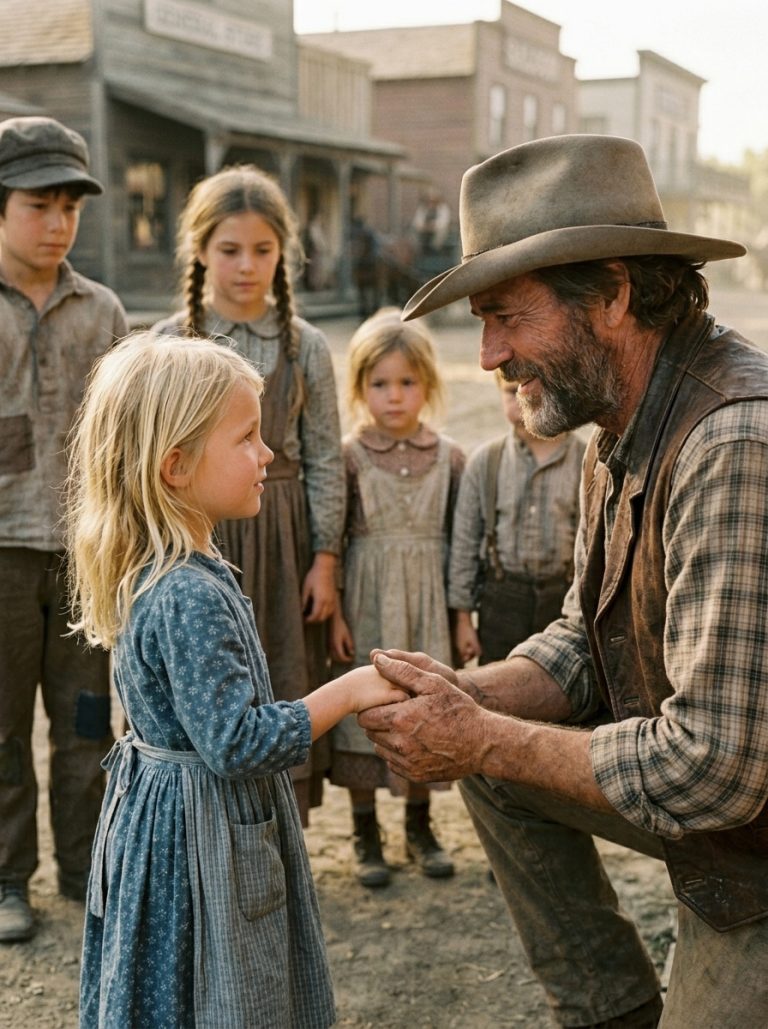
A small girl with dark hair and enormous eyes appeared on the porch, took one look at Clara, and froze. Three years old, Clara thought. Ada.
Clara climbed down and lowered herself to the child’s level, making herself smaller in the way you did when you didn’t want to frighten something small and wary.
“Hello,” she said softly. “I’m Clara.”
Ada stared. Her thumb found her mouth. Then, with the specific unguarded boldness that only very small children possessed, she reached out and laid one careful hand against Clara’s cheek, as if testing the temperature.
“Warm,” Ada announced. And then her hand found Clara’s hand and folded around it with the unconscious certainty of someone who had decided, in the space of four seconds, that this was fine.
“That’s her.”
The voice came from the doorway, flat and deliberate, carrying the full weight of a nine-year-old boy who had appointed himself sentinel. James Harlan stood at the threshold with his baby sister balanced against his hip, and he looked at Clara the way soldiers looked at gates: assessing, suspicious, unwilling to yield ground until yield was proven necessary.
“I know why you’re here,” he said.
Before Clara could answer, a low voice cut across the yard.
“Children. Inside.”
PART 2
Eli Harlan had come around the side of the barn so quietly she hadn’t heard him approach.
He was taller than she’d expected — broad across the shoulders, built for work that didn’t stop — and his face had been carved by something harder than weather. Grief, she thought. Grief did that. It worked on a person’s features the way a river worked on stone, wearing down everything soft until what remained was only structure. His eyes were dark and direct, and they moved across her once with the focused, exhausted attention of a man who had learned to evaluate things fast because fast was all he had.
The children disappeared inside. Owen took the horses without being asked.
“Walk with me,” Eli said.
They moved along the fence line, snow creaking under their boots. The coming storm dragged at the air. Clara kept her hands in her coat pockets and waited.
“I want to say something before the reverend arrives,” he said finally. His voice was measured, as if he’d rehearsed. “I didn’t want this. Not because of you. But because I thought — I believed I could manage on my own.” He stopped walking. “I was wrong.”
Clara faced him. “You paid $300 for a wife,” she said. “I’d like us to both be honest about what that is.”
He met her eyes without flinching. “Yes. I did.”
She studied his face for the thing she’d been dreading — the look that said he saw her as less than a person, as a service, as a problem solved. She didn’t find it. What she found instead was something more complicated: exhaustion, guilt, and underneath both of those, a grief so settled and structural it had become part of his architecture.
“Will you speak to me with respect?” Clara asked.
“Yes.”
“Do you expect me to share your bed?”
The question landed in the cold air between them. He held her gaze for a full, still moment. “No,” he said. “That isn’t part of what I’m asking.” He paused. “Not unless that’s something you’d choose. On your own.”
Clara felt something inside her — not warmth, exactly, but the particular relief of terms being made clear. The first thin sliver of ground she could stand on.
“Then we understand what this is,” she said.
“Yes,” he agreed.
She turned back toward the house. Then she stopped, one more thing pressing against her ribs that needed to be said aloud.
“I’m not your first wife,” Clara told him, without turning around. “And I’m not her replacement. I’m something else. I don’t know the word for it yet. But if that’s something you can accept, then so can I.”
A long pause. The storm moved another step closer.
“I can accept that,” Eli Harlan said.
Inside, the house felt like the moment before a breath was taken. Five children arranged near the fire, scrubbed clean and watchful — all the noise that should have existed in a house full of living things, silenced by something too big for small people to name. Clara noticed James watching her with the narrowed, continuous evaluation of someone who had been disappointed before and had decided disappointment was not going to catch him twice. She noticed seven-year-old Lucy seated slightly apart from the others, perfectly still, her eyes trained on the floor, present in body and absent in every way that mattered. She noticed baby Mae on the rug, her fat fists clenching and unclenching, her eyes on the door as if expecting something she didn’t have a word for.
“I’m hungry,” Henry announced, loudly, like a small explosion in a library.
And Clara thought: good. She could do something about hungry.
She went to the kitchen and started supper, and the act of it — the fire, the flour, the onions, the cold air coming in through the window above the basin — steadied her more than anything else had in three days. Feeding was the first language of care. She had learned that from her mother, who had expressed love almost entirely through food because love required resources and food was what you could give.
James followed her into the kitchen. He stood two feet behind her, arms crossed, watching. When she reached for the salt he made a small movement, as if to correct her.
“Let me,” Clara said, without turning around.
“I know how she — how it’s supposed to be done,” James said stiffly. “I’ve been doing it.”
Clara turned then, and she looked at him not with irritation but with something more direct. “I know you have,” she said. “You’ve been doing everything, haven’t you? For months.” She kept her voice level. “That’s done now. This is my job. Your job is to be nine.”
His jaw worked. His eyes went somewhere she recognized — that place where anger and grief and desperate hope all lived in the same breath, pushing against each other like fists.
He didn’t leave the kitchen. But he stopped reaching for the salt.
That night, five children ate hot supper at the table — and something about the warmth of it, the ordinary miracle of a meal prepared by someone who wasn’t also nine years old and overwhelmed, shifted the air. Ada smiled so broadly her eyes disappeared. Henry ate two bowls and asked for a third. Mae mashed her hands into everything within reach and seemed delighted by the results. Even Lucy, who had not spoken, who had carried her silence like a shield for four months, cleaned her plate with focused attention, her dark eyes tracking Clara’s hands as if she were memorizing something important.
Eli ate standing at the stove, back to the room.
Clara noticed. She let it be. She had learned from watching illness that people found their way back to others at their own pace, and that pulling too hard on someone just learning to breathe again could snap the thread entirely.
Later, climbing the stairs to her room — Maggie Harlan’s room, still holding the ghost of lavender in its walls — Clara sat on the edge of the unfamiliar bed and allowed herself, for the first time since the attorney’s office, to feel the full weight of what had happened. The loneliness settled into her chest like cold water. The low anger at a world that had left her no other door. The fear that she had arrived here as a transaction and would remain one.
She pressed her palm flat against the quilt and made herself a quiet promise. Grief had carried her to this place. But she would not let grief be the whole of what she was.
She had barely finished the thought when she heard, through the thin wall beside her, the sound of a small voice saying something she couldn’t make out, and then silence, and then what she was almost certain was a child crying without sound — the kind that happened when you’d learned crying out loud made things worse.
Clara sat very still in the dark.
Tomorrow, she told herself. One thing at a time.
But even as she thought it, she was already listening for which child it was.
PART 3
The reverend arrived the next morning, pink-nosed and businesslike, stamping snow from his boots with the enthusiasm of a man who had somewhere better to be. Clara stood in the kitchen and heard the sound of his arrival the way she heard the six o’clock bell — as a marker, a line crossed, one version of herself ending and another beginning without ceremony.
James appeared in the doorway.
“Papa says it’s time,” he reported, with the neutral tone of someone delivering a dispatch he hadn’t decided how to feel about yet.
Clara nodded. Her heartbeat was even. She had surprised herself with how even it was.
The main room had been arranged with quiet effort. Someone — Eli, she thought, or perhaps James — had laid pine branches along the mantle, their sharp clean scent doing its best against the stale cold air. The children stood in a line near the fireplace in their good clothes. Henry’s collar was askew. Mae’s red-brown curls had staged a revolt from every available direction. Ada pressed herself against Clara’s skirt the moment Clara entered, as if she’d decided the previous day’s assessment was permanent.
Eli stood by the window. Back straight. Shoulders set. A man awaiting something.
The ceremony was short. Do you take. I do. Do you take. I do. When the reverend reached the part about kissing, Eli stepped forward and pressed his lips to Clara’s cheek — quick, careful, almost gentle in its restraint, like a man who was afraid of the territory he was entering.
When Clara stepped back, she was Clara Harlan.
The reverend left in a hurry, coat still half-buttoned, clearly conscious of the darkening sky. The door closed. Silence reconstituted itself instantly, the way it did in a house that had grown used to quiet as a default.
“Well,” Eli said, into the middle of the room. “That’s finished.”
“Very festive,” Clara replied, and to her left, James’s mouth moved in what was almost — not quite, but almost — a smile.
Henry pulled at his father’s sleeve. “Is she our mama now?”
Eli’s hesitation lasted two full seconds, which in the presence of a five-year-old was geological. Clara crouched before the gap could fill with something worse.
“I didn’t bring you into the world,” she said to Henry, meeting his serious brown eyes. “But I’m going to take care of you. That part’s the same as the other thing.”
Henry weighed this with the gravity of a philosopher considering axioms. “Can you make flapjacks?”
“Yes.”
“All right,” he decided, and Ada climbed directly into Clara’s lap as if the matter had been settled by a body above a quorum.
Eli watched this from his place by the window — watched Ada’s small arms go around Clara’s neck, watched Henry’s verdict land and stick — and something moved across his face: something painful being displaced by something less certain but less painful. He turned and walked outside before it could finish arriving.
“He does that,” James said, from behind her, his voice worn thin by the specific resignation of a child who had watched someone they loved disappear repeatedly and had learned to expect it. “When it gets to be too much. He leaves.”
Clara held Ada against her chest and looked at James, this nine-year-old with iron in his posture and a bruise where his heart was, and she understood the real architecture of what she’d agreed to. Not the paper. Not the $300. This. Five children who had learned that love vacated without warning. One man who had forgotten how to stay inside his own life.
She would have to be very careful. And very patient. And very, very stubborn.
The storm broke before noon — not a gentle first snow but a serious one, the kind that meant business, driving sideways across the fields and erasing the barn and then the fence posts and finally the whole horizon until Copper Bend Ranch existed only as a small bright island of lamplight in a sea of white and roaring wind.
“We’re closed in,” James announced, standing at the window like a young officer reporting to command.
“Then we work with what we have,” Clara said.
She organized the house — not harshly, not with the panic of improvisation, but with the clean efficiency of someone who had run a household since she was twelve. She counted the wood. She assessed the food. She gave each child a task small enough to carry and large enough to matter. James tended the fire because responsibility without burden was a balance he desperately needed. Henry told stories to Ada and Mae, clumsy spiraling tales with no ending that both girls found entrancing. Lucy sat near the window and watched the snow with her unreadable composure, but her eyes, Clara noticed, kept returning to the center of the room — to the activity, to Clara’s hands, to the ordinary life moving through the space that had been empty for so long.
Clara baked bread with Ada standing on a chair beside her, both of them dusted in flour, the kitchen filling with warmth. When Ada pressed her small face against Clara’s arm and said, “You’re warm,” Clara understood the word was carrying more than temperature.
Eli came in after dark, frost on his shoulders, snow packed into the creases of his coat. “Animals are settled,” he said. “Storm won’t ease before morning.”
“Supper’s been ready for an hour,” Clara replied. “Sit down.”
“I can eat standing.”
“I know you can,” Clara said evenly. “Sit anyway. Not as a husband. As a father. Your children need to see you at the table. They need to know you’re still here.”
From across the room, James looked at his father. The iron was still in his posture. But underneath it, something was asking — not demanding, not commanding, just asking — with the specific helplessness of a child who had been strong for too long.
Eli sat down.
The meal was awkward the way all new things were — edges showing, nobody quite sure of the rhythm. Then Henry misjudged the reach for his cup and the soup went sideways, the bowl tipping with the terrible slow certainty of physics, broth spreading across the table and onto the floor in a spreading brown arc.
Henry scrambled back in his chair, his face collapsing. “I’m sorry — I didn’t — I’m sorry —”
The apology kept coming, frantic, stacked one on top of the other, the way a child apologized when they had learned that accidents had consequences. Clara saw it: the bracing. The waiting.
Beside her, Eli’s hands went still on the table. She felt the room hold its breath. Felt him feeling the old shape of his own anger, the months when grief had made him into someone he didn’t recognize, when even small chaos had detonated into shouting that left everyone in the room smaller than before.
A long, suspended second.
Then Eli exhaled through his nose, and his face did something she hadn’t seen it do yet: it softened. He looked at his son — really looked at him, with the attention of a man who had been looking slightly past people for a very long time.
“Henry.” His voice was rough and careful. “It’s soup.”
Henry blinked. “I know, but—”
“I’ve spilled worse.” Eli met his son’s eyes. “You don’t need to apologize for a spilled bowl.”
Henry stared. Somewhere to Clara’s left, Ada made a small hiccuping laugh — delighted by the splash, unbothered by the mess — and the laugh was so sudden and so rusty, like a hinge that hadn’t moved in seasons, that everyone turned toward it. Even Lucy’s eyes went wide.
Something cracked. Not dramatically. Not with the sound of something breaking. More like the first fissure in spring ice — the kind that meant the thaw had decided to begin.
The children did not relax all at once. Children like these never did; they tested trust in increments, offering small amounts and waiting to see what happened. But the air loosened. Elbows came off the table. Henry told another story. Ada stole food from Mae’s bowl, and Mae retaliated by hitting Ada with her spoon, and nobody cried about it.
Eli ate his supper at the table, and when he finished, he didn’t immediately leave.
That night, after the children slept, Clara found him in the kitchen, standing over the cleaned table with the face of a man sitting judgment on himself.
“Why was Henry so frightened?” she asked, though she already knew.
Eli’s jaw worked. His eyes stayed on the wood grain. “After Maggie died,” he said, “I lost myself for a while. I yelled. Broke things. Scared them.” He paused. “Scared myself.”
“They think it’s theirs to carry,” Clara said. “Children always absorb the grief of the people they love and call it their own fault. If you don’t name what happened out loud, they’ll spend their whole lives inventing reasons.”
He looked at her. “I don’t know how to say it.”
“Practice,” Clara told him. “I’ll be there when you do.”
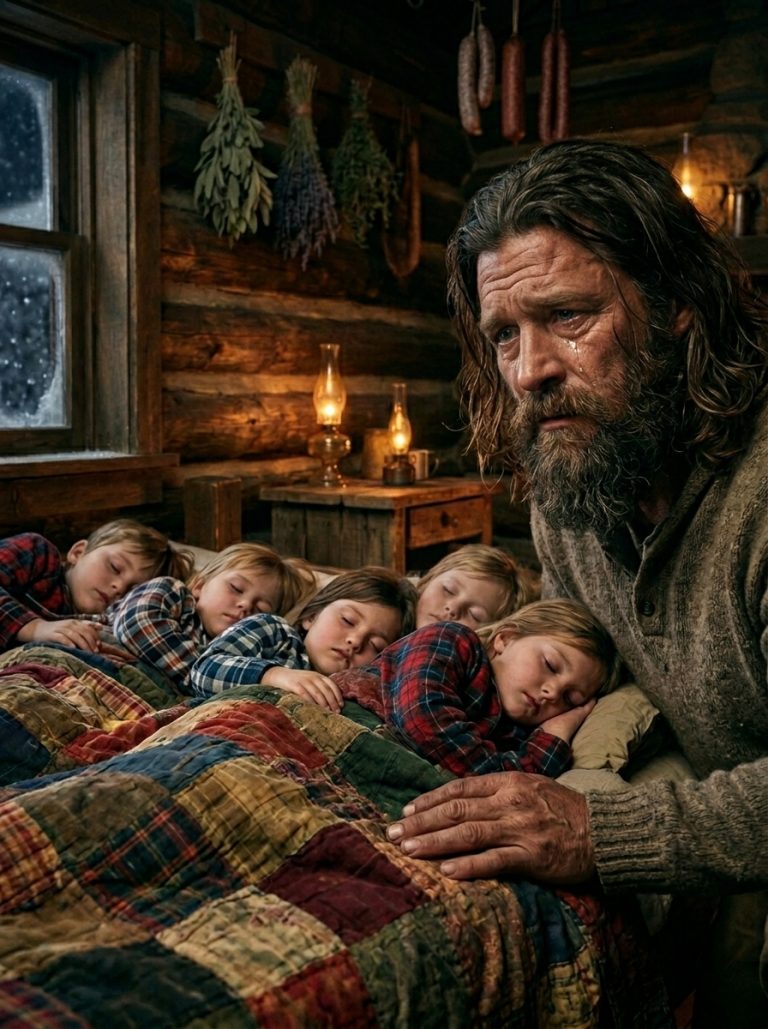
The storm lasted three days. In those three days the house changed — not because the weather eased, but because fear eased, which was a different and more significant thing. Clara filled the hours with games and stories and the quiet firm structure of routine, the kind that told children the world could be predicted again, that Tuesday led to Wednesday, that breakfast came in the morning and sleep came at night and that was not going to stop. Tom began to play instead of supervise. Henry laughed without checking to see if laughter was permitted. Ada stopped flinching at loud sounds. Mae toddled between laps as if she owned all of them. And Lucy — Lucy sat closer each day to the center of the room, her silence less like a wall and more like something choosing its moment.
On the third morning, with snow still pressed against the windows, Clara sang while she cooked. An old lullaby, the kind her mother had sung over the kitchen stove, low and plain as bread. She hadn’t meant to sing it; it simply rose in her the way breathing rose, because the kitchen was warm and the children were near and for the first time since standing in that attorney’s office, she felt something that was not only survival. Something that had no practical use at all.
She was at the second verse when she heard another voice join in.
Thin. Uncertain. Like someone testing whether a frozen river could hold.
Clara kept her eyes on the pot. Kept stirring. Kept singing.
When the song ended, she turned.
Lucy stood in the kitchen doorway, tears running down her face in two straight lines, her eyes wide and bewildered, as if she’d just discovered that she contained more than silence.
“I was scared,” Lucy said. Her voice was small and rough from not being used, and it was the most beautiful sound in the room. “If I talked — if I said things out loud — then she’d really be gone.”
Clara crossed the kitchen in four steps and folded Lucy into her arms, and Lucy shook against her, months of held grief coming out in long shuddering waves, the kind that had no sound because they were too large for sound, the kind that had been waiting in the dark for a door to open.
Clara held her. She didn’t say it’s okay. She didn’t say she’s still with you. She said nothing clever at all, because she had learned that the right thing was not always a word. Sometimes the right thing was just staying.
When Eli came in from the barn that evening, Lucy was waiting at the door.
“Hi, Papa,” she said.
Eli’s face went through several things in rapid succession — surprise, recognition, and then a sudden disintegration of all the carefully maintained structure, a man coming apart at the best possible moment. He went to his knees in the snow-tracked hallway and gathered his daughter against his chest, and the sound he made — not a sob exactly, not laughter exactly, something in between, something warm and terrible and alive — filled the hallway and went up the stairs and reached into every room in that silent house.
After that, the house breathed again.
Winter broke slowly, the way winters did — not announcing itself, just gradually releasing. Snow became mud became pale green shoots pushing up through the south-facing fields. The air smelled of cold earth and possibility. The ranch became louder. Children shouted from the barn. Henry had opinions about everything and expressed them all. Ada kept a running commentary on the state of the world. Lucy talked now — carefully still, choosing her moments, but talking — and there was something in the way she did it, like someone tasting a fruit they’d been afraid of, that made Clara’s chest ache with tenderness.
Clara rose before dawn. Seven people’s breakfast. Lessons at the table, because she had decided that James and Lucy and Henry would grow up knowing that words on a page were doors and that doors could not be closed against you if you held the key. Chores allocated with surgical care so that responsibility did not become theft. She worked hard, and she was tired, and somewhere around the third month she noticed that tired didn’t feel like punishment anymore. It felt like purpose.
Eli changed in smaller ways than she’d expected, and larger ones. He came home earlier. He stopped using the barn as an escape hatch when feelings arrived in a room. He sat beside the fire and listened to Henry’s stories with an expression that was trying very hard to be neutral and not quite managing. He spoke haltingly at first, like a man attempting a language he had loved and then abandoned, uncertain whether it still worked. But he kept speaking.
One evening in late February, standing together at the kitchen basin after supper, Eli said quietly: “You changed everything in this house.”
“We all did,” Clara replied. And she meant it entirely — because she had arrived believing this was something she would do for other people, and somewhere between the bread-baking and the supper table and Lucy’s first words, she had understood that it was also something being done for her. That family was not a thing one person constructed alone. It was something people chose, repeatedly, especially when it was difficult.
Eli dried his hands on the cloth hanging from his belt. “I need to tell you something.” His voice had the careful quality of a man navigating uncertain ground. “I’m falling in love with you.” He said it like he was reporting a weather condition that had surprised him. “I didn’t plan for it. I’m not sure I wanted it. But there it is.”
Clara’s hands went still in the wash water. Soap suds ran over her knuckles.
She had told herself — in the attorney’s office, on the stagecoach, in the lavender-scented room on the first night — that she would not allow herself to hope here. Not while she had been sold. Not while the contract’s ink was barely dry. Hope, she had decided, was a luxury she had given up along with everything else.
But love had apparently not read that contract.
“I am too,” she said quietly. And then, because she was Clara Whitfield and had learned that precision mattered: “I didn’t want to be. I told myself not to be. And then I was anyway.”
Eli turned to look at her. Something in his face broke open in a way that wasn’t painful — the way ice broke in spring, not destruction but release.
The first Sunday they attended church in Redstone Crossing, the town already had its version of their story. Towns always constructed stories about the people who moved through them; it was how towns made sense of themselves. Clara felt the assessments from the women’s section — some pitying, some suspicious, some quietly approving, all curious. The men looked at Eli with the sideways attention of a community recalibrating.
After the service, at the social gathering in the churchyard, a woman named Helen Morse found Clara near the refreshment table with the specific directness of someone who had been sharpening a sentence for days.
“It must be difficult,” Helen said, her smile arranged into something that was technically polite. “Coming into an established household. Taking on a man’s children. Especially for someone so young. Someone with — well — so little preparation for it.”
Clara looked at her steadily. She felt the heat arrive in her face and let it pass. She had learned that people like this expected reaction, that reaction was the point, and she had no interest in being the point.
Before she could respond, Eli appeared at her side. He took her hand — openly, without ceremony, without the slight hesitation of a man managing perception — and he said, loudly enough to be heard by the three women who had been listening from three feet away:
“My wife rebuilt my family. My children eat supper at the table and my daughter speaks again and my son has started to act his age.” His voice was even and certain. “I’m not sure what preparation has to do with any of that.”
Helen’s smile went somewhere. The women at the edge of the circle rearranged their faces.
The walk home was quiet, and when Clara said, “You didn’t have to do that,” Eli said, “I know,” and the fact of his choosing to was something she carried like a warm stone the rest of the day.
Spring arrived the way blessings sometimes did — quiet, undramatic, and slightly shocking. Clara woke one morning in April with the specific sense of her body having become a different shape, a secret gathering in her before she had words for it. She stood at the bedroom window and watched the pale-green fields and waited until she was certain.
When she told Eli, he held her as if he were afraid the world would make another claim on her.
“I won’t lose you,” he said, his mouth against her hair, and she heard the full meaning of it — not just the pregnancy but everything, the way he had lost Maggie, the way that loss had calcified inside him, and how the calcification was still there, underneath the healing, in the nights when she heard him awake and still beside her.
“You won’t,” she promised. And then she said what she had come to believe, which was that a promise was not a certainty but a commitment — not about controlling what the universe did, but about choosing, clearly, to remain.
The baby came in early May, on a morning of ridiculous brightness, the sky the particular blue of things that didn’t know they were beautiful. Clara woke Eli with her hand flat on his chest and a voice she was proud of for its steadiness. He moved too fast and knocked over his boots and shouted instructions in two directions at once and then caught himself and softened, and Clara thought: there it is. There is the man who is learning to stay.
Owen rode for the doctor. The midwife, Ruth, arrived with capable hands and the settled composure of someone who had watched women do the hardest thing there was and come through the other side. Eli refused to leave — refused to be shepherded into the parlor, refused the comfortable distance of the hallway — and instead sat where she could reach him and said I’m here at intervals, softly, the way you said the most important thing with the least decoration.
When the cry came, it broke through the house like light breaking through water.
A girl. Strong, certain, already objecting to the world. Placed into Clara’s arms with the irreversible specificity of a fact.
Eli knelt beside the bed, his face wet, and said, “She’s beautiful,” as if the word was barely sufficient for what he was feeling. Clara looked at her daughter — this person who had arrived out of everything difficult, who had been begun in a house full of grief and had been carried through a Montana winter on nothing but stubborn love — and felt something in her chest open like a window.
They named her Catherine Margaret Harlan. Catherine for Clara’s mother, still alive and writing letters, still holding the family together in Billings with the money that $300 had bought. Margaret for the woman who had lived in these rooms before Clara, whose lavender still faintly haunted the bedroom walls, whose children had loved her and who had not gotten enough time.
The children met their sister that evening in a ceremony of chaos and reverence. James stood straighter than seemed biologically possible and began immediately planning a protective perimeter. Henry took one look at the baby, said “She’s small — can we keep her?” as if she were a found kitten, and then grinned so broadly his face almost couldn’t contain it when Catherine wrapped one tiny fist around his finger. Ada declared ownership: “My baby.” Lucy held her with the unhurried gentleness of someone who understood what it meant to be small and new and uncertain of the world. Mae, just over a year old herself and still working out the logistics of walking, approached the bundle with enormous scientific interest, patted the blanket decisively, and announced, with perfect toddler authority, “Mine,” which seemed to Clara to about sum it up.
Summer came down on Copper Bend Ranch like a blessing that had been waiting to be permitted. The fields greened. The livestock expanded. The house generated the noise it had always been designed for — not the managed, effortful noise of children trying to fill silence, but the ordinary chaotic music of people living fully in their own lives. Eli worked hard and came home each evening. He laughed now, real laughter, the kind that arrived without permission and didn’t care what it looked like. He held his children openly, without the careful rationing of someone afraid that touch was a resource that might run out.
Clara taught lessons under the big cottonwood by the fence — reading and arithmetic and how to ask good questions and how to listen to the answers. She wrote long letters to Daniel and received long letters back. She kept her promise. She told him everything, and he told her everything, and the distance between them stayed geographic instead of becoming something else.
On the first anniversary of the day she had signed her name in the attorney’s office — the day that had felt, in that still November room, like the end of something — Eli surprised her.
The whole of the Redstone Crossing community was there when Clara and Eli stepped out of the house: lanterns hung from the fence posts, tables stretched the length of the yard piled with food, children running between adult legs in the blue dusk. People had come from miles away, drawn by the specific gravity of a place that had become warm again after a long cold. Even Helen Morse stood at the edge of things, stiff-shouldered but present, watching with eyes that had not quite decided what to do with what they were seeing.
Clara moved through it all with Catherine on her hip and Ada attached to her skirt and Henry blazing past like a comet with unclear trajectory. James stood near the fence with his arms crossed, trying to look disinterested, glowing. Lucy laughed with another girl near the lanterns as if laughter had always belonged to her. Eli watched all of it from across the yard with the expression of a man standing inside a life he had once given up believing could exist.
When the guests finally left and the house settled into the particular quiet that only came after large happiness, Eli led Clara outside. The first snow of the season had begun — not the storm kind, not the blotting-out kind, but the small kind, the soft kind, the kind that fell like punctuation.
“I want to say something,” Eli said. He turned to face her, and his eyes in the lamplight were clear and direct and carrying everything. “When you climbed down from that wagon a year ago, I thought I was solving a problem. I thought I was acquiring something I needed, the way you acquire seed corn or fence wire. Practical. Necessary.” His jaw worked. “I didn’t understand that you were a person walking into a house full of broken pieces, and that instead of protecting yourself from them, you chose to stay and put them back together.” He paused. “I’m ashamed of the first thing. And I am — I don’t have a word big enough for what I am about the second.”
Clara’s eyes burned. She didn’t blink it back.
He reached into his coat pocket and took out a ring — gold, worn smooth at the edges with age and use. “This was my mother’s,” he said. “I have been keeping it without knowing what I was keeping it for. I think now I was keeping it for a moment when I was certain.” He slid it onto her finger, and it fit, and the fact of its fitting felt like the universe making a small dry joke at the expense of everyone who thought love could be predicted.
“This is not for duty,” he said. “Or for the children, or for the ranch, or for survival, though all of those things are real. This is because I love you. Because every morning I wake up and choose you, and every morning the choosing is the same answer.” His voice roughened. “This life is ours. Not assigned. Ours.”
Clara looked at the ring on her hand, at the snow falling through the lamplight, at this man who had been hollowed out by grief and was filling back up, not with what had been there before but with something different, something that had her shape in it.
“I choose you too,” she said.
He kissed her under the falling snow, not the careful apologetic kiss from the reverend’s ceremony, not the restrained kiss of two people negotiating terms. This was something else — certain and warm and entirely without conditions, two people who had been pushed together by grief and loss and the brutal arithmetic of survival, and who had, in the space of one Montana winter, written something completely different over the top of it.
Years later, Redstone Crossing would still tell the story of Clara Harlan. They told it in different ways depending on who was telling it — some as a scandal resolved into respectability, some as a love story, some as a lesson about what quiet courage could do when it decided not to leave. The children grew up and went out into the world and came back on holidays with mud on their boots and news in their voices. Daniel visited every summer and pretended he was checking on his sister and was obviously just homesick for the place she had built. Catherine Margaret Harlan grew into a girl with her mother’s stubbornness and her father’s directness and an absolute refusal to be anyone other than herself.
Clara knew the real story was simpler than any of the town’s versions, and harder, and less like legend. She had arrived in the middle of November with a trunk and a heart locked down tight, and she had been bought for $300, and she had not stayed bought. She had looked at five children who had learned that love left without warning and one man who had learned that staying hurt, and she had decided — not dramatically, not with speeches, just with ordinary daily stubborn insistence — that she was not going to let that be the only story this house knew how to tell.
She had been given nothing but herself to work with. It had been enough.
And if the town was surprised by what had grown at Copper Bend Ranch out of grief and transaction and a winter that hadn’t let anyone look away — well. They had simply forgotten what happened when love decided not to ask for permission.
It put down roots. It found the cracks in every wall. And eventually, quietly, stubbornly, it made the whole house warm.