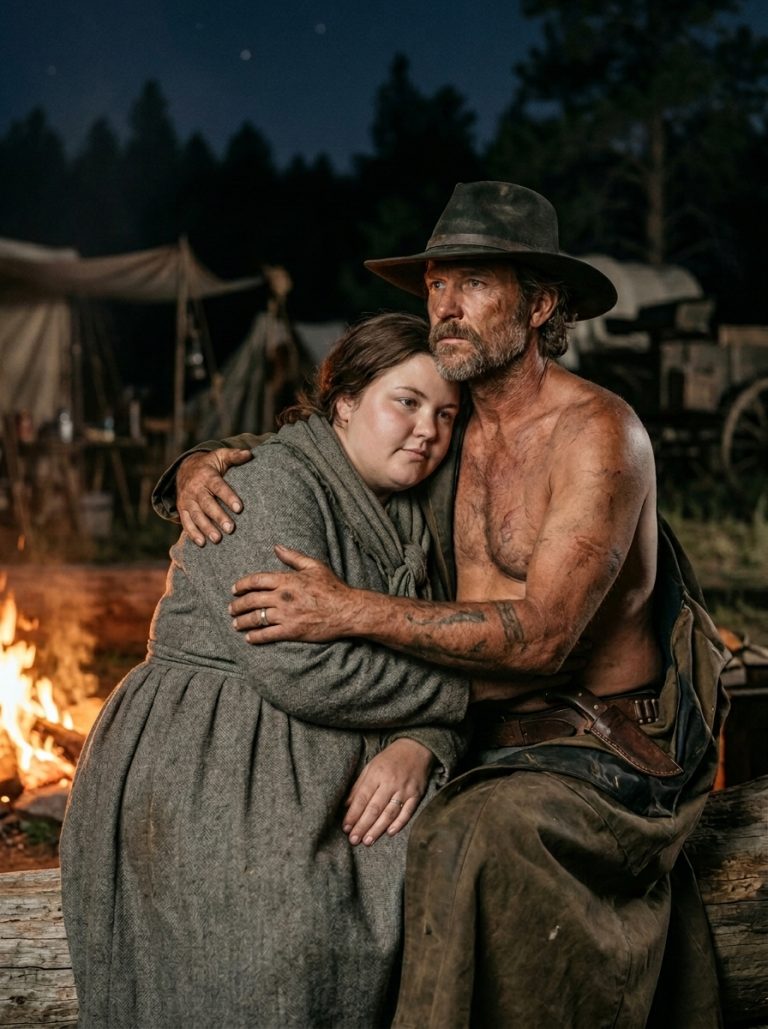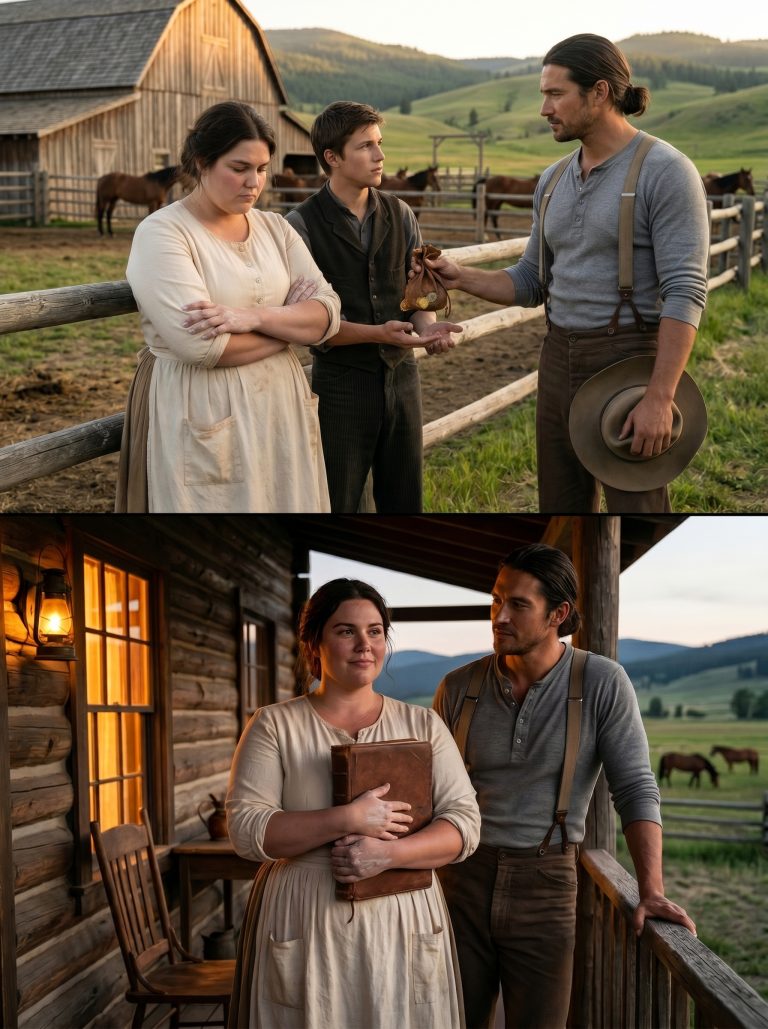
She Married A Rancher To Feed Her 5 Children — Then Her Daughter Broke 2 Years Of Silence With One Whisper

The night Clara Bowen finally said it out loud, she was standing at the top of the stairs with her back against the wall and both hands pressed flat to the plaster like she was trying to hold the house together from the inside.
She had been holding it inside for two years.
Two years of being told she was wrong. That grief made children see things. That the dark played tricks. That her papa had simply driven a bad axle up a worse road and the mountain had done what mountains do to men who pushed their luck past the edge of reason. Two years of watching the man who smiled at her across the supper table — the man with the silver ring and the hymn always half-stuck in his throat — and knowing, in the wordless way children know things before they have language for them, that the smile meant something different than smiles were supposed to mean.
She hadn’t spoken because she was thirteen when it happened. Then fourteen. Then fifteen.
And every time the words formed, someone in that house had already told her she was wrong before she could get them out.
But she was sixteen now. And the new man — the one her mother had married out of desperation and flour-sack poverty — was not like the others.
And so, at the top of the stairs on a February night, Clara Bowen opened her mouth.
What came out was going to change everything.
PART 1
Millhaven Ranch sat on the eastern bench of the Powder River country like a fist pressed into the earth — wide, flat-roofed, built for endurance rather than comfort, the kind of place that looked exactly like what it was: a working operation that had no interest in impressing anyone. Three hundred acres of grazing land, a main house with too many rooms and not enough warmth, a bunkhouse that ran eight men at peak season, and a reputation in the surrounding county for producing good cattle and keeping to itself.
It had belonged to the Cade family for thirty years before Lena Bowen arrived with five children, a grief she was still learning to carry, and a plain agreement of marriage that neither she nor Warren Cade had pretended was anything other than what it was.
Necessary. Mutual. Practical.
Lena was thirty-four. A widow. Her first husband, Gideon Bowen, had died two years earlier when his freight wagon went off the Black Timber road, axle broken, the whole rig tumbling into the ravine below the ridge crossing. The county had called it an accident. The insurance company had called it an accident. Her father-in-law had called it the kind of thing that happened to men who drove too hard in bad weather.
Lena had called it grief and moved forward because five children did not allow her the luxury of standing still.
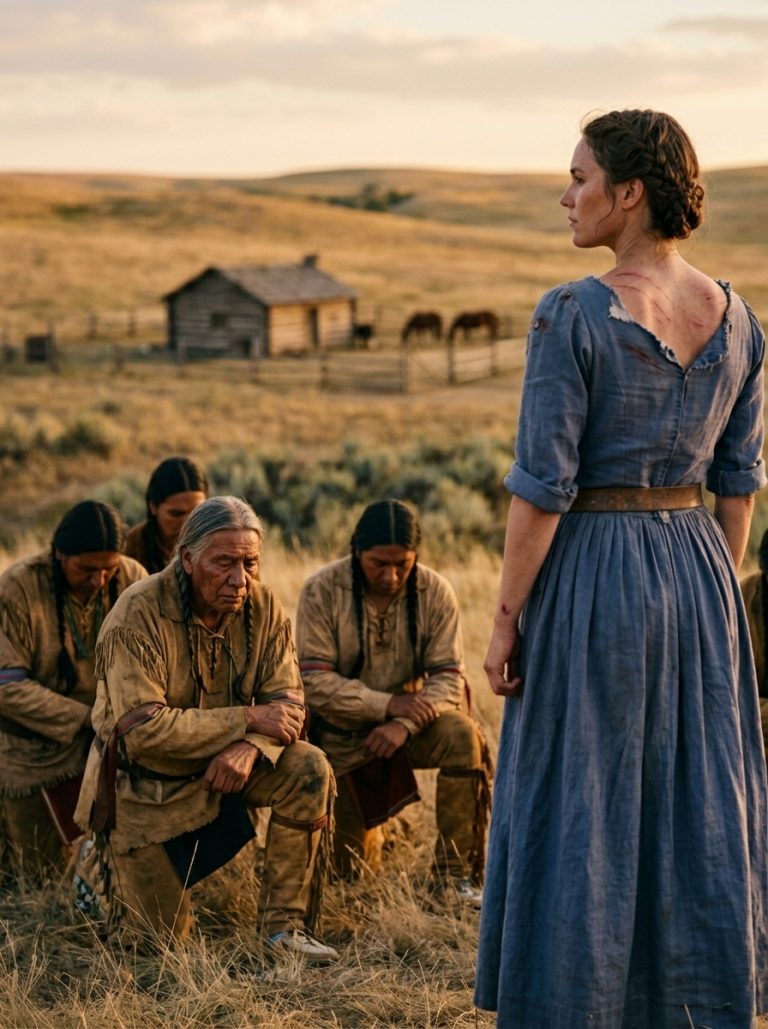
The oldest was Clara — sixteen now, dark-haired and quiet in the way of people who have learned that silence is safer than speech. Then came the boys: Miles, fourteen, earnest and watchful. Theo, eleven, loud in the manner of boys who have not yet learned to be afraid. The two youngest were girls — Bea, eight, who collected things, and Susie, six, who collected trouble.
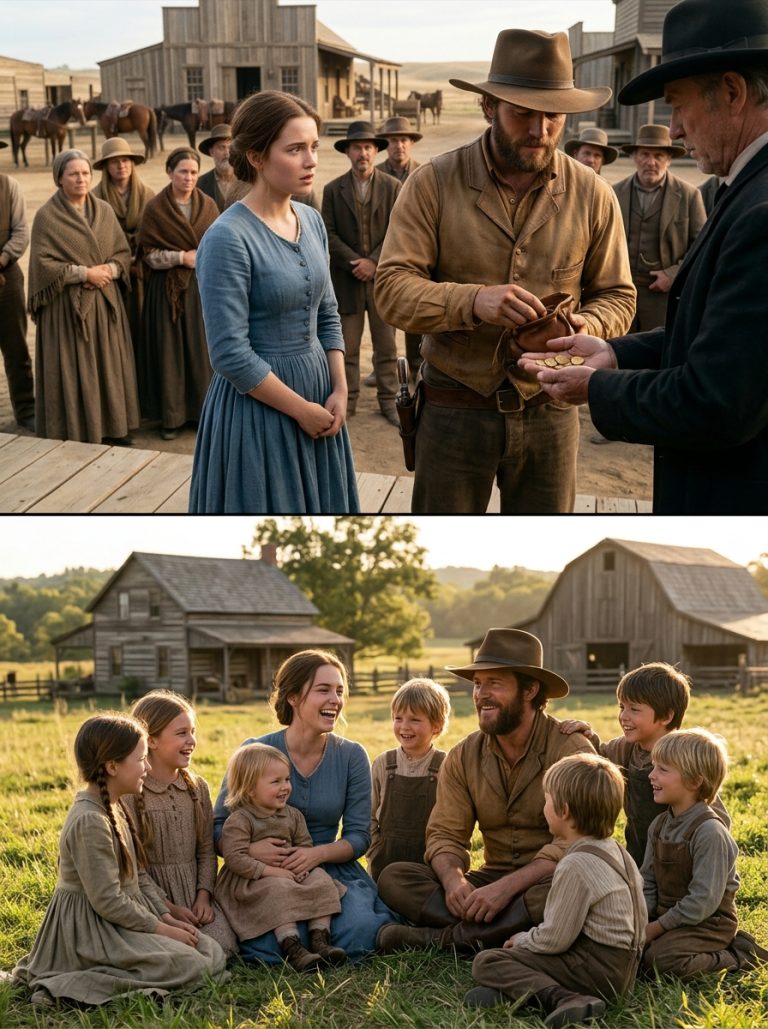
Warren Cade had married Lena in November with a ceremony that lasted eleven minutes and a reception that consisted of coffee and corn bread at the kitchen table. He was forty-one. Broad through the chest and spare with words, the kind of man who communicated primarily through action — a gate mended before you asked, a fire banked before you woke, a problem absorbed and dealt with so quietly you only knew it had existed by its absence.
He had been married once before. His wife had died of fever eight years ago. He had no children.
The county had opinions about the arrangement. Most of them were delivered over back fences in the language of concern that is really just curiosity wearing a sympathetic hat. Lena ignored them. She had five children to feed and a winter to survive and no patience left for the arithmetic of other people’s judgments.
What she had not expected — what she had not allowed herself to expect, because hope was a thing you rationed when you’d been disappointed enough times — was that Warren Cade would be decent.
Not charming. Not warm in any obvious way. But decent, in the way of men who have decided that their word means something and then spent their whole lives making sure it does.
The first week, he’d moved the younger children’s rooms to the warmer side of the house without being asked. The second, he’d found Miles in the barn teaching himself to mend harness by feel in the dark and had sat beside him for two hours without commenting on the tears the boy thought he was hiding. The third, he’d told Lena plainly that his house was hers now and the children were to be treated accordingly by every man on the property — and that any man who treated them otherwise would find himself needing new employment before the day was out.
Lena had looked at him for a long moment after that.
“You mean that,” she said. Not a question.
“I don’t say things I don’t mean,” he replied. “Waste of words.”
She had filed that away alongside a small collection of observations she was building about this man who had opened his house to her family without theater or demand, and was beginning to think that the county’s opinions could go straight to the bottom of the Powder River.
The ranch hand named Cole Devitt had been at Millhaven for four years.
He was the kind of man who made himself useful in ways that created dependency — he knew the land, knew the cattle routes, knew the freight suppliers and the seasonal rhythms of the whole operation. He had a face that smiled easily and hands that worked hard and a manner around other men that was just deferential enough to feel respectful without quite being so. Warren kept him because he was competent and competent men in the Powder River country were not easily replaced.
What Warren did not know — what no one at Millhaven had connected, because the pieces had been kept in separate rooms by careful hands — was that Cole Devitt had known Gideon Bowen.
Had worked the same freight routes, two years before Millhaven. Had argued with Gideon over a contract settlement that Gideon had refused to falsify. Had been present, three days before Gideon’s wagon went off the Black Timber road, at Hobb’s Forge, where the axle repair work was logged.
Clara knew some of this.
She knew it the way she knew it — not from documents or conversations, but from being sixteen years old in a house where adults forgot that children had ears and eyes and the particular, relentless attention of people who have learned that the world will not protect them unless they understand it first.
She had seen Cole Devitt’s face the morning they brought the news about her father. She had watched, from the top of the stairs, through the banister rails. She had been thirteen and still in her nightgown and the adults below had not looked up.
His face, when the foreman spoke the words, had done something that grief did not do.
It had smoothed out.
Not the blankness of shock. The specific, deliberate relaxation of a man receiving news he had already arranged.
She had known, in that instant, the way the body knows things before the mind will accept them. And then the mind had rejected it, because she was thirteen and her father was dead and the world had already shown her that it was not interested in what she thought she saw.
Two years of being told she was fragile. Imaginative. That loss made the mind construct explanations it could live with. That she should speak to the pastor. That time would settle her.
Two years of Cole Devitt smiling at her across the supper table with the particular ease of a man who believed the only witness to his real face was a child nobody would listen to.
He had miscalculated the arrival of Warren Cade.
It started with a scrap of paper Bea brought to Lena from the office kindling basket, because Bea collected things and a paper with numbers on it was a thing worth collecting.
Lena looked at it. Looked at it again.
She brought it to Warren that evening after supper.
He spread it on the desk under the lamp and went very still.
Red Mill freight — axle advance — C.D.
Three words and two initials. The kind of notation that meant nothing unless you already knew what question it was answering.
Warren looked up. “Where did Bea find this?”
“Kindling basket. Office side.”
“It was going to be burned.”
“Yes.”
He turned the scrap over in his fingers. “C.D.,” he said.
Lena watched his face. “Cole Devitt handled the Red Mill freight accounts before you took full ownership,” she said carefully. “I know because Gideon hauled Red Mill runs. He mentioned the accounts manager more than once.”
Warren set the paper down flat on the desk. “Your husband’s wagon — the axle.”
“Failed on the Black Timber road,” Lena said. “The repair had been paid for. The forge at Hobb’s had a receipt.”
“But no repair done.”
They looked at each other across the lamp.
“I don’t know that,” Lena said.
“Not yet,” Warren answered.
That night, lying awake in the room that still felt like someone else’s, Lena heard the sound she had been hearing for two years without letting herself name it — the particular quiet of a house where something was wrong and everyone was waiting for someone else to say it first.
She was done waiting.
But before she could act, something happened that moved the whole matter out of her hands.
Clara came to the top of the stairs.
And finally — after two years of silence so long and heavy it had become its own kind of damage — she spoke.
PART 2
Warren heard the girl’s voice from the office where he was still sitting with the scrap of paper and the lamp and the slow, methodical turning-over of what he knew and what he suspected.
He heard Lena’s sharp inhale. Then quiet. The particular quality of a silence where something true is being said.
He did not move immediately. He understood, without being told, that some truths needed to be received by a mother before they could be handed to anyone else.
When Lena appeared in the office doorway ten minutes later, her face had changed.
Not broken. Harder. The specific hardening of a woman who has just had a grief confirmed that she’d been carrying as suspicion, which is in some ways worse than either grief or suspicion alone because it means the time spent doubting herself was stolen from her.
“Clara saw him,” Lena said. “The night before Gideon’s last run. She was in the barn — she couldn’t sleep. She saw Cole Devitt at the wagon. Under it. She was thirteen. She didn’t understand what she was seeing until later, and by then—” Her jaw tightened. “By then everyone had already told her she was confused.”
“How long has she known what she saw?”
“She’s known since the funeral.” Lena pressed one hand flat against the doorframe. “She’s been carrying it alone for two years because every adult in her life told her grief was making her see things.”
Warren looked at the scrap of paper on the desk. Then at Lena.
“Did she describe what she saw him do?”
“He was under the wagon. She heard a sound — metal on wood. She thought he was doing repairs. She thought—” Lena stopped. “She was thirteen. She thought she was seeing something ordinary.”
“And the ring?”
Lena’s eyes sharpened. “What ring?”
“Cole wears a square-cut ring on his right hand. Silver. His brother’s.” Warren said it evenly. “If she was close enough to see him under the wagon, she was close enough to see his hands.”
A beat of silence.
“She said she remembered something cold and bright near the axle bolt,” Lena said slowly. “She mentioned it tonight. Said she always thought it was a tool catching the lantern light.”
Warren stood.
“It wasn’t a tool,” he said.
The scrap of paper on the desk. A girl’s two-year-old memory. A dead man’s wagon and a paid-for repair that never happened.
Separately they were shadows. Together they were beginning to have the shape of a man.
“There’s something else,” Lena said. Her voice had dropped to something careful and controlled. “She said that the morning the foreman brought the news — she watched from the stairs. She saw Cole’s face when he heard.”
“And?”
“She said it went smooth.” Lena met his eyes. “Like a man who already knew.”
The room was quiet enough that the lamp flame’s movement was audible.
“Cole’s been at this ranch four years,” Warren said. “He knows where the records are kept. He knows the feed room. He knows which pages in the winter ledger would connect him to the Red Mill freight advance.” He looked toward the dark window. “If he’s been watching us — if he knows we’ve started looking—”
“He’ll move first,” Lena said.
“Yes.”
They stood on either side of that word and understood what it meant.
Whatever was going to happen next was going to happen soon. And the girl upstairs who had been silent for two years had just become the most important witness in a case that the county’s sheriff — a man named Pruitt who had been accepting Dellwood Freight’s hospitality at cards every third Friday for longer than anyone liked to count — was going to do everything in his power to make disappear.
Warren picked up the paper scrap and folded it into his coat pocket.
“I need to check the feed room before morning,” he said.
“I’m coming with you,” Lena said.
He looked at her for a moment. Then: “Close enough to hear. Not close enough to be his first reach.”
“That,” Lena said, “is not the same as no.”
He accepted that. Because it was true.
PART 3
The feed room in winter smelled of grain dust and cold leather and the particular dryness of spaces that held the bones of a working ranch — the records, the tallies, the quiet paper evidence of where every dollar and hour had gone. Warren had always kept it orderly. A place for everything. Nothing burned until he’d seen it.
Cole Devitt knew this about him.
What Cole did not know was that Warren had spent the hour after supper quietly relocating three things: the winter ledger to a different shelf, a copy of the Red Mill freight accounts to a sealed envelope in the desk drawer, and his own presence to the far side of the grain bins where the dark was complete and the sightline covered the entire room.
Lena stood in the narrow passage between the feed room and the kitchen, door cracked to a finger’s width, kitchen knife in her hand more because it gave her hands something certain to hold than because she intended to use it. Miles and Theo were in their room with explicit instructions that did not require explanation. Mrs. Garrett, the cook, sat in the kitchen hallway with the expression of a woman who had seen enough of men’s messes to know exactly what kind of night this was.
Clara was upstairs.
She had asked, twice, to be somewhere she could see.
Lena had said no twice. The third time, Clara had looked at her mother with the eyes of a girl who had spent two years being told to stay behind doors while the truth she was carrying went undefended, and Lena had felt the argument dissolve.
“Top of the stairs,” Lena had said. “Not one step further. You hear only.”
Clara had nodded and gone without another word.
The first hour passed in the ordinary sounds of a ranch at night — horses shifting, wind working at the eaves, the distant sound of the bunkhouse settling into dark.
The second hour brought a change in the quality of the silence outside.
Warren heard it before he saw anything. A different weight to the air. The specific absence of sound that meant something was moving carefully rather than carelessly through it.
The feed room door opened without a knock.
Cole Devitt entered the way guilty men enter spaces they believe are empty — not stealthily, but with the focused efficiency of someone executing a plan. He carried a shuttered lantern opened to the narrowest possible slit. He went first to the high shelf. Then the ledger stack. Then he crouched near the back wall with the practiced ease of a man who had done this before and knew exactly what he was looking for.
Behind the lowest wall brace, pressed into a gap between boards, was an oilskin packet.
He eased it free.
“Set it on the barrel,” Warren said.
Cole spun. The lantern threw wild light across the walls.
For one full second his face showed the thing underneath — the animal calculation, the rapid measuring of exits. Then the familiar ease tried to reassemble itself over the top, the way a man puts his coat back on after you’ve seen what’s under it.
“Mr. Cade.” His breathing was harder than the situation called for. “You near stopped my heart.”
“The packet,” Warren said.
Cole’s gaze moved left and right. Reid, the foreman, stepped out from behind the grain bins on the left side, and the geometry of exits collapsed entirely.
Cole set the packet on the barrel with the deliberateness of a man surrendering a weapon.
“Open it,” Warren said.
Inside the oilskin: the missing ledger page from the storm week. Two freight receipts from Red Mill with Cole’s hand on them. A narrow account strip showing axle allowance collected and signed.
And one more thing Warren had not expected — a folded note in Gideon Bowen’s hand.
C.D. — shortchanged the axle timber again. I won’t haul rotten wood to save another man money. This ends or I take it to the freight office.
Warren looked at it for a long time.
Then he set it down.
“Axle allowance collected,” he said. “No repair done. And Gideon Bowen threatening to report you to the freight office three days before his wagon went off Black Timber road.”
Cole’s jaw worked. “Men pay for repairs they never get every season. It’s common.”
“And dead men’s notes?”
“That note doesn’t say anything.”
“It says you had a reason.” Warren kept his voice level. “Clara was in the barn the night before his last run. She saw you under the wagon. She remembered a square-cut ring catching lantern light near the axle bolt.” He paused. “She’s been carrying that for two years while everyone around her told her she was wrong.”
Something moved through Cole’s expression then — not guilt, not quite. Something uglier. The specific resentment of a man who believed a child’s silence was owed to him.
“A sixteen-year-old girl’s memory,” he said. “That’s what you’re standing on.”
“Along with the ledger page you cut out,” Warren said. “The freight receipt. The note. The hiding place. And the fact that you’re standing in my feed room at midnight retrieving papers you buried in my wall.”
Cole’s eyes moved to the door. “Sheriff Pruitt will find ten holes in this before breakfast.”
“I wondered when you’d say his name,” Warren said.
The door opened.
Pruitt entered with one deputy at his shoulder, and Warren understood from the timing that Cole had sent word before coming — had arranged a safety net, a man to control the narrative if the trap closed wrong. Pruitt had the look of a man who’d arrived expecting to manage confusion and had found instead a lit room, an open oilskin, hidden documents on a barrel, and a foreman whose face showed absolute disgust.
“What’s happened here?” Pruitt said.
“Hidden records,” Warren said, “and the man who hid them.”
Pruitt’s gaze went to Cole. In that glance was the thing Lena had told Warren to watch for — not partnership, exactly, but the practiced familiarity of two men who had managed a problem together before and were calculating whether they could manage it again.
“Best let me take custody of those papers,” Pruitt said carefully.
Cole’s fear outran his patience. “Take custody? Like you took custody of Harrow — like you told me a broken axle and a grieving widow wouldn’t survive the winter’s talk?” He heard himself and stopped. Too late.
The deputy looked at the sheriff.
Pruitt’s color left his face in a single movement.
“I mean—” Cole started.
“You mean,” Warren said very quietly, “that this isn’t the first death you expected him to make disappear.”
The room did not erupt. Rooms with that kind of truth in them rarely do. They go very still, the way the air goes still in the second between lightning and thunder, while everything recalibrates around what has just been said.
Pruitt’s hand moved toward his belt.
“Copies of every document on that barrel are already sealed and south of this county,” Warren said. “In three separate hands. One of them is a circuit judge.”
He had done this two days ago. Not from certainty — he hadn’t had certainty then — but from the understanding that a guilty man who felt cornered would come for the evidence, and that evidence only protected people when it existed somewhere a single corrupt sheriff couldn’t reach it.
Cole lunged.
Not at Warren. At the papers — because desperate men always show you what they value most in the moment they have the least to lose.
Warren hit him shoulder-first and drove him hard against the grain bins. The lantern toppled. Reid caught it before the flame broke loose. Cole swung wild, his right hand connecting with nothing, the square-cut ring flashing once in the light — and Warren saw it clearly, finally, the ordinary object that had lived in Clara’s memory for two years as the detail everyone told her she was wrong about.
He trapped Cole’s arm. Brought his wrist down against the barrel edge. The ring scraped wood. Cole cried out. Reid pinned the other shoulder. A feed rope came off the peg, and in thirty seconds Cole Devitt’s hands were bound behind him and his face was pressed into the grain bin and two years of uncontested certainty were gone from his body entirely.
Pruitt moved one step forward.
The deputy did not move with him.
Lena stepped into the doorway from the passage side. She looked at the young deputy directly. “You see what’s on that barrel.”
He swallowed. “Yes, ma’am.”
“Then keep seeing it.”
He stayed.
Pruitt tried once more, the last reach of a man who has run out of room. “I can take him in. Handle this right.”
“Not alone,” Warren said.
The sheriff looked at his deputy. At the documents. At Reid’s face and Lena’s face and the bound man on the floor. He looked at the shape of a situation that had moved beyond the private management of old favors, and he understood — in the way men like him always eventually understand — that the moment had passed when he could have controlled it.
He put his gloves on slowly.
“I’ll ride him in at dawn,” he said. “Pray what you’ve got holds.”
“It will hold enough,” Warren answered.
After Pruitt left, the feed room held the heavy silence of a space where something buried had finally, at great cost, been forced into the air.
Cole sat on the floor with straw on his knee and all the smoothness gone from him forever. Just a man. Just the ordinary smallness of a man who had made himself large by standing on damage he’d done to others.
Warren gathered the papers one by one.
Lena remained in the doorway. Then she moved past Cole without looking at him — because he did not deserve her eyes — and went to her husband and stood beside him.
“It’s done,” Warren said.
Not finished. Not healed. But done in the one way that mattered first.
The truth was no longer his alone to keep.
From the top of the stairs, Clara heard the feed room door open and close. Heard her mother’s footsteps in the passage. Heard the specific quality of the silence that followed — not the silence of something ongoing and unresolved, but the silence of something that had run its course.
She sat on the top step with her knees pulled up and her back against the wall, the same position she’d held two years ago when she watched through the banister rails and saw Cole Devitt’s face smooth out at the news of her father’s death.
She had been thirteen then.
A child in a nightgown with a terrible piece of knowledge and no one to give it to.
She was sixteen now. And the knowledge had been given, and received, and acted upon, and was at this moment sitting in sealed envelopes in three separate locations south of the county, waiting to do what truth does when it finally gets enough room.
Her mother appeared at the bottom of the stairs.
She looked up at Clara.
Neither of them spoke for a moment.
Then Lena climbed the stairs and sat beside her daughter on the top step, and put one arm around her, and Clara — who had been holding herself together with the specific rigidity of someone who cannot afford to come apart — felt the rigidity begin to go.
She did not cry loudly. She had never been a loud crier. She pressed her face against her mother’s shoulder and shook, silently, with two years of it, and Lena held her and said nothing because there was nothing to say that the holding didn’t already contain.
Warren appeared at the bottom of the stairs. He took one look at them and went to the kitchen to put water on, because useful was what he knew how to be, and useful was what the moment needed.
The county did not become clean overnight.
Justice, in the Powder River country in winter, arrived the way everything arrived — slowly, with difficulty, shaped by the terrain it had to cross.
Cole Devitt was held at the Red Mill courthouse pending circuit court. The freight records tied him to the axle allowance and Gideon Bowen’s note. Clara’s testimony — given once, in careful language, in a room with a judge and no one she feared present — tied him to the barn and the night and the two years she had spent being told her own eyes were wrong.
It was not a clean conviction. It was the kind the world more often provides: partial, contested, expensive, and still worth every ounce of effort it took to get.
Sheriff Pruitt resigned before the circuit court arrived. Questions about old freight settlements and closed death reports had a way of making a man’s badge feel heavier than it used to.
The county talked. Some blamed Warren for making private trouble into public spectacle. Some blamed Lena for bringing complications to an orderly ranch. Some — the particular corner of any community that prefers to blame those who’ve been harmed rather than examine what they’ve been standing beside — suggested Clara had manufactured or exaggerated her memory.
Clara read one such opinion, delivered second-hand through a schoolmate, and said nothing for a full day.
Then she found Warren mending a fence line in the north field and asked him something she had been building toward for weeks.
“Did you believe me,” she said, “before you had the papers?”
He set down the mending tool and looked at her with the directness that was his primary way of showing respect.
“Yes,” he said.
“Why?”
“Because the way you described Cole’s face that morning — the way it smoothed out.” He picked the tool back up. “I’ve seen that look on a man before. You don’t invent a detail like that. You only remember it if you saw it.”
Clara looked at the fence line stretching away across the frozen ground.
“Two years,” she said.
“Yes.”
“Everyone told me I was wrong.”
“They were wrong,” he said. Simply. No apology on others’ behalf, because it wasn’t his to give. Just the plain statement of fact that she had been right and they had been wrong and those two things were now in their correct positions.
She nodded once.
Then she picked up the other end of the fence wire without being asked and held it taut while he worked, and they finished the section together in the cold afternoon quiet, and something in her posture — the set of her shoulders, the angle of her chin — had shifted by the time they walked back to the house.
Not healed. That would take longer. Maybe it would always be unfinished, the way certain injuries leave a permanent change in the architecture of a person.
But upright. No longer braced for the impact of being told she was wrong.
Spring came to Millhaven the way spring came to that country — gradually, then all at once, snow retreating up the ridges and the bottomland going soft and the cattle moving out to the lower pastures with the particular urgency of animals who have spent seven months indoors.
Lena’s baby came in April. A girl, born before dawn with Mrs. Garrett in attendance and Warren pacing the porch in the manner of men who are very competent at everything except the particular helplessness of waiting for news from behind a closed door.
When he was brought in to see the child, he stood at the bedside with his hat in his hands and looked at the infant with an expression that Lena had not seen on him before — something underneath his usual measured calm, something that had been held carefully at bay for a long time and was now, in the face of this small new person, simply too large to contain.
“She needs a name,” Lena said.
He looked at her. “Your choosing.”
“I was thinking Hope,” Lena said. “Because this house earned it.”
He was quiet for a moment. Then: “Yes.”
Clara came to the bedside later with Bea and Susie crowded behind her. She touched the baby’s fingers — marveled, the way everyone marveled, at how complete and improbable a new person was.
“She doesn’t know any of it happened,” Clara said softly.
“No,” Lena agreed.
“She gets to start clean.”
“She does.”
Clara looked at the baby for a long time. There was something moving through her face — complex and not entirely resolved, the way feelings look on people who are in the process of deciding what to do with them.
Then she smiled. Small and real and entirely her own.
“Good,” she said.
By summer, the rhythms of Millhaven had rebuilt themselves around a new shape.
Miles took on more fence work and was quietly proud of this in the way of fourteen-year-old boys who have decided that competence is the primary form of dignity available to them. Theo discovered a talent for reading cattle temperament that Reid declared was either a gift or an annoyance depending on whether Theo was using it at a useful moment. Bea organized her collections into labeled boxes with a seriousness that suggested a future as either a scientist or a judge. Susie remained a force of nature requiring active management.
Clara went back to school in the valley town. She came home one afternoon and told her mother that a girl in her class had asked why she’d been so quiet the past two years, and that Clara had told her: I was waiting until I had somewhere safe to put the truth.
The girl had apparently found this confusing.
Clara had apparently found the girl’s confusion clarifying.
One evening near the end of summer, Lena found Warren at the back fence watching the last light go off the upper ridge in that long, amber way it did in August — slowly, as if the day was reluctant to conclude.
She stood beside him.
They were not, precisely, in love. Not yet. Possibly heading there. Possibly building something that would one day be called that by the people watching from outside, though inside it felt less like a feeling and more like a structure — something assembled carefully from compatible materials over a long time with a lot of attention paid to whether each piece was sound before adding the next.
“This wasn’t what you agreed to,” she said.
“No,” he said.
“A widow and five children was the agreement. Not a murder investigation and a corrupt sheriff and a daughter who needed someone to believe her.”
“No,” he said again.
“Do you regret it?”
He looked at the ridge for a moment.
“I regret the two years she spent alone with it,” he said. “I don’t regret any of the rest.”
Lena looked at the house behind them — lit windows, the sound of children arguing about something that was almost certainly trivial, Mrs. Garrett’s voice cutting through the argument with the authority of long experience, Hope’s occasional announcement of her existence from somewhere in the interior.
“She told me something this week,” Lena said. “Clara.”
He waited.
“She said that the night she finally spoke — at the top of the stairs — she almost didn’t. She said she’d almost talked herself out of it again the way she always had. And then she thought about the way you listened. In general. The way you listened to everyone in the house.” Lena paused. “She said she thought: if I say it to him, he won’t tell me I’m wrong before he hears it.”
Warren was quiet for a long time.
“And was she right?” Lena asked.
“Yes,” he said.
She nodded.
They stood together at the fence while the light finished leaving the ridge and the first stars came up over the Powder River country, cold and clear and indifferent to the small human dramas unfolding beneath them. The kind of stars that had looked down on this land for longer than anyone had been here to be harmed by it or protected in it or to build, slowly and at great cost, something worth staying for.
Inside the house, Clara laughed at something — sudden and unguarded, the laugh of a person who has temporarily forgotten to be careful.
Lena felt it in her chest.
Warren, beside her, made a sound that was not quite a smile but was adjacent to one.
“She’s going to be all right,” Lena said.
“Yes,” he said. “She is.”
Later, when people in the county told the story of what happened at Millhaven Ranch that winter — and they did tell it, the way communities tell the stories that clarify what they believe about themselves — they tended to focus on the confrontation in the feed room. The hidden papers. The moment Cole Devitt’s certainty collapsed in front of witnesses.
What they left out, because it was harder to make into a story, was the part that had actually mattered most.
A girl at the top of a staircase. Two years of silence finally reaching its limit. A man in an office below who had built, without drama or announcement, the kind of house where the truth could be handed to someone and trusted to be held.
That was the part that had made everything else possible.
Safety, Lena understood now, was not the thickness of the walls or the money in the land or the strength of the man who worked it.
Safety was what a house chose to be when silence would have cost it less.
And that choice, made quietly and without ceremony, on an ordinary evening in a difficult winter, was the thing that had turned Millhaven Ranch from a place her children survived into a place they lived.