She Had No Choice But To Trust A Mountain Stranger With Everything — Months Later The Doctor Who Called Her Shameful Came Begging At Her Door

She had rehearsed the climb a hundred times before she made it.
Not the physical part — the trail, the switchbacks, the way her boots slipped on loose shale in the October cold. She had rehearsed what she would say when she got there. Who she would claim to be. How she would stand so that the damage didn’t show in the first five seconds. She had been managing first impressions for so long that the preparation had become its own kind of exhaustion, a second job she worked every waking hour just to exist in the same county as people who had decided, without asking, what she was.
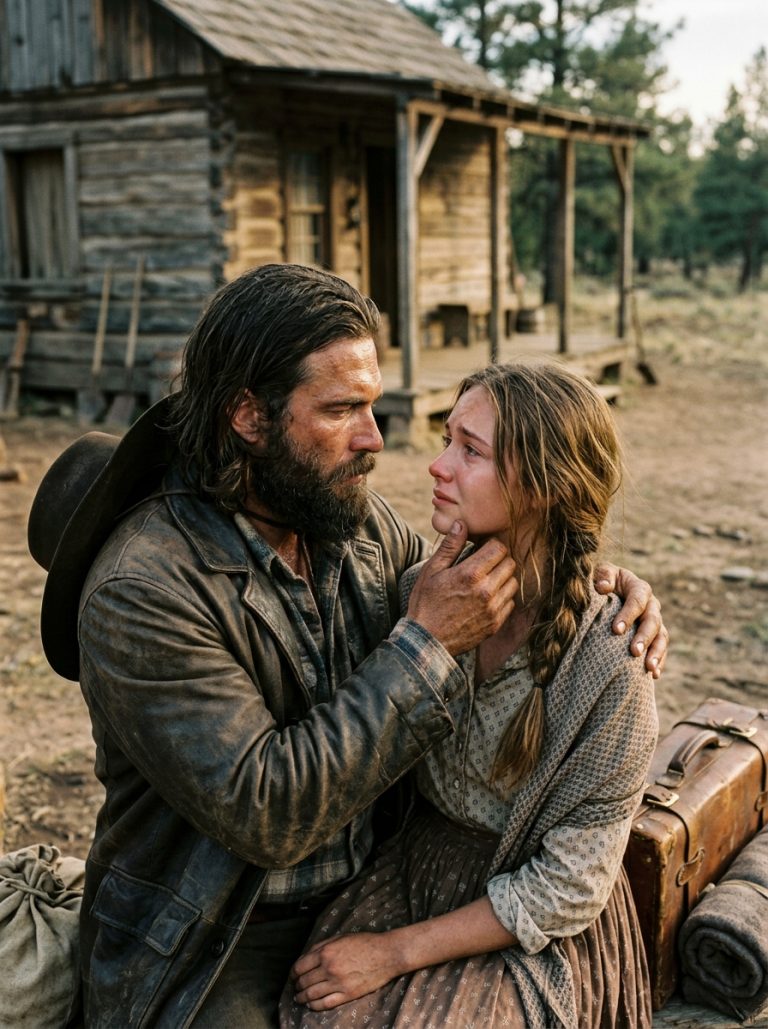
What she hadn’t rehearsed was the moment he opened the door.
Or the moment he said, with the flat clarity of a man who had no interest in performance: Tell me where it started. I can’t treat what I can’t see.
Her whole body went cold.
Because those words — let me see — were either the beginning of her salvation or the worst mistake she had ever made at altitude.
She had seven seconds to decide which.
PART 1
The town of Millford sat in a valley so pleased with its own respectability that it had confused propriety for virtue sometime around 1870 and never looked back.
It had a church, a bank, two dry goods stores, a post office, a schoolhouse, and a physician named Dr. Gerald Oates who had trained in Philadelphia and had never quite gotten over it. It had opinion in abundance — about the weather, about politics, about the price of flour, and most especially about women who did not fit into the shapes the town had pre-cut for them.
Mae Whitfield did not fit.
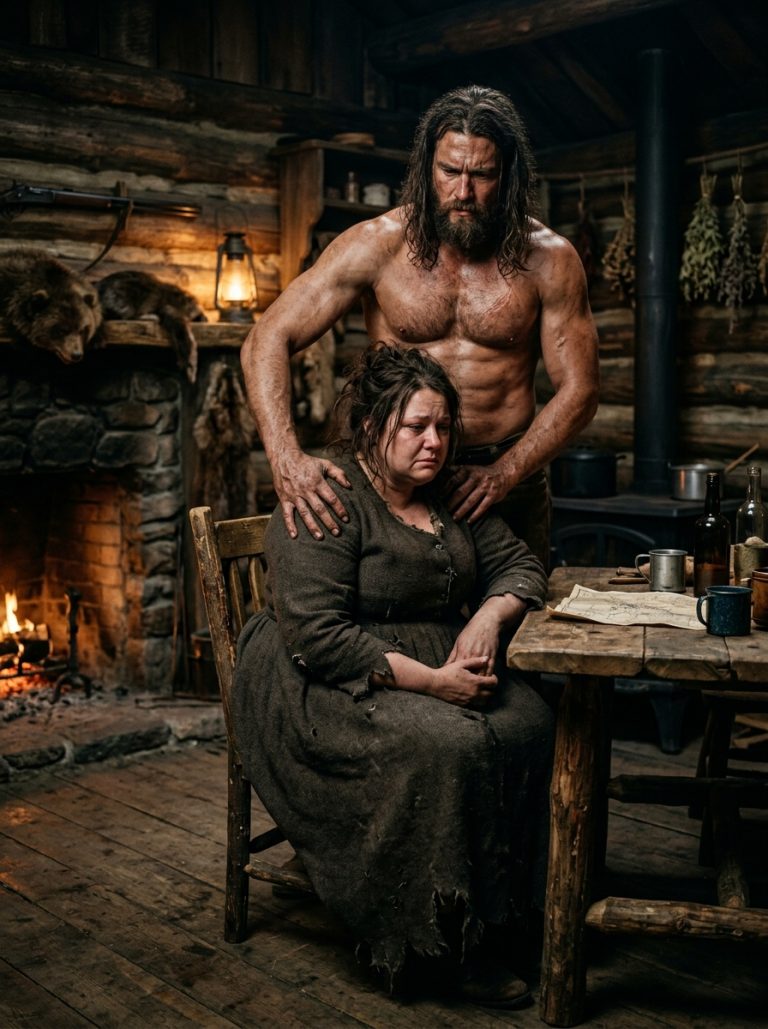
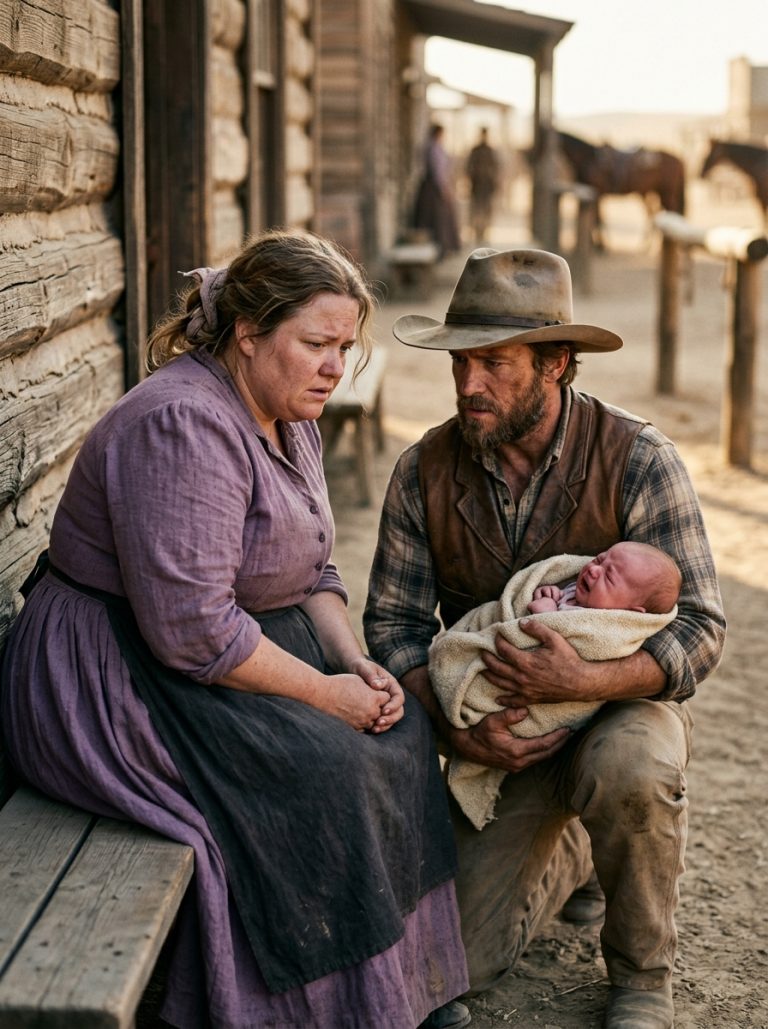
She was twenty-seven. Unmarried. Large in the way that some women are large — not softly, not apologetically, but solidly, taking up the space her body required and making no visible effort to reduce it. She worked as a seamstress out of the two-room house she shared with her mother, Pearl, and had been working as one since her father died and the alternative was dependency, which Mae had decided at nineteen was not something she intended to practice.
She was good at the work. The best in Millford, if she was honest, which she generally was even when honesty cost her. She could look at a woman’s body and understand its geometry, could cut cloth to serve shape rather than shame it, could hem a dress so that a woman walked out of Mae’s house feeling like the clothing had been written for her rather than imposed upon her.
The town used her skill and discussed her existence as if the two were unrelated.
The rash had begun in August.
Left forearm first, where the bolt cloth dragged across her skin during long cutting hours in the heat. She had thought it was the heat. Then she thought it was soap. Then she thought it would pass the way inconvenient things sometimes passed if you declined to give them attention. By September it had moved to her neck and shoulder. By October her whole left side felt like the inside of a lit stove, and she was losing sleep, losing appetite, losing the particular steadiness of a woman who has built her life on the premise that she can handle what comes.
She had gone to Dr. Oates because there was no one else.
She had sat in his waiting room for forty minutes while men with far lesser complaints were seen ahead of her, which she noted with the practiced invisibility of a woman who has learned to collect injustices without reacting to each one individually, because reacting individually would be a full-time occupation.
When Oates finally called her back, he had looked at her forearm for approximately ten seconds.
“Moral rash,” he said.
Mae had stared at him. “I beg your pardon.”
“The skin reflects the interior life.” He said it the way men said things they’d said so often they no longer heard themselves saying them. “Stress. Excess. Irregular habits.” His eyes moved over her in the way that certain men’s eyes moved — not looking, cataloguing. “Women of your particular… constitution… tend to be prone.”
Mae had left before he finished the sentence.
She had walked home through October air that smelled of coming snow and wood-smoke and the particular bitterness of being treated like a condition rather than a person. She had sat at her cutting table for a long time without cutting anything. Then Pearl had come in with tea and the expression of a woman who read her daughter’s silences accurately, and Mae had said, quietly and without drama: “I’m going up the mountain.”
Pearl had set down the tea. “To see him.”
“Yes.”
“Mae—”
“There is no one else.” She had said it plainly, because plain was what she had left. “Everyone in this valley has already decided what I am. He’s the only one I haven’t spoken to yet.”
Pearl had looked at her for a long time. “Be careful.”
“I’m always careful.” Mae had picked up her coat. “It hasn’t helped yet, but I keep trying.”
His name was Joel Hardt.
The valley called him various things, depending on who was talking and what they needed from the telling. The mountain hermit. The cowboy doctor. The Boston-trained savage who’d abandoned civilization for reasons that must certainly be shameful because why else would a man leave Boston. The one to go to when the regular doctor had failed you and failure was no longer an option.
He had lived on the mountain for eight years in a cabin he’d built himself, with a clinic room off the back that smelled of cedar and dried herb and the particular cleanliness of a space that was taken seriously. He kept horses. He kept records. He kept to himself with a thoroughness that Millford found simultaneously suspicious and magnetic, because a man who doesn’t need your approval is both threatening and irresistible to a town that runs on approval as its primary currency.
Mae had heard about him the way women heard about useful things — quietly, through the network of other women who knew things the official channels didn’t publicize. Rosa Vargas, who lived with her husband on the cattle spread below the tree line, had mentioned his name twice in the past year. Emily Strand’s mother had mentioned it once, in a lowered voice, with the careful quality of a woman passing along information she knew to be valuable and wasn’t certain she was supposed to share.
Mae had filed it away.
She had not expected to need it.
She had been wrong about that, which was uncomfortable, because she was not often wrong.
The trail up took two hours on a clear day. In October, with the first cold properly settled and the shale patches glazed with overnight frost, it took closer to three. Mae walked steadily. She was good at walking, good at endurance, good at the kind of forward motion that required nothing from you except continuing. The burning along her side was worse in cold air — something about the temperature tightening everything — and she kept her left arm close to her body and breathed through the sharper moments and did not allow herself to think about what she was doing until she was already doing it and turning back required more energy than going forward.
The cabin appeared around a bend in the trail without ceremony. It was larger than she’d expected — not grand, but considered. Built by someone who understood that function and dignity were not in conflict. A covered porch ran across the front. Firewood stacked high along the south wall. Smoke from the chimney rising clean and straight in the still air.
Mae stood at the edge of the clearing for a moment.
She had rehearsed this.
Then the door opened before she knocked, because he had heard her boots on the porch steps, and Joel Hardt stood in the doorway looking at her with the direct, unhurried attention of a man who had decided a long time ago that first impressions were most useful when you let other people make them.
He was lean and weathered, somewhere in his mid-thirties, with the kind of face that had been shaped more by attention than by ease. Dark hair gone gray at the temples. Hands that were visibly a working man’s hands and also, she noticed in the particular way of a woman trained to notice construction, surgeon’s hands. Steady. Precise.
He looked at her arm — the one she was holding close — and then at her face.
“You came a long way,” he said.
“Millford.” She kept her voice level. “Dr. Oates sent me home.”
“What did he say it was?”
Mae held his gaze. “He called it a moral rash.”
Something moved through Joel Hardt’s expression — quick and controlled, but not entirely suppressible. Anger, she thought. Not at her.
“Come in,” he said. “Tell me when it started and what you were doing.”
She crossed the threshold and he closed the door behind her and the cabin received her with the warmth of a space that had been lived in carefully — the fire, the smell of cedar and something herbal she couldn’t name, the order of a man who used every inch of his space with intention.
He gestured to a chair beside the examination table. “Sit. Start at the beginning.”
She sat. She started at the beginning.
He listened without interrupting. This alone distinguished him from every medical interaction she had ever had, because Oates interrupted constantly, filling the space of her account with his conclusions before she had finished supplying the evidence. Joel Hardt listened the way she sewed — with the understanding that you could not cut cloth you hadn’t yet measured, and that measuring required patience and the willingness to be surprised by what you found.
When she finished, he asked three questions. When had she started working with the new bolt cloth from St. Louis. Whether the burning worsened in heat or cold. Whether she had changed her diet or her sleep in the months before it started.
She answered all three.
Then he said: “I need to examine the affected areas. All of them, to understand how far it’s spread. Otherwise I’m treating a guess instead of a condition.”
The room changed.
Not from his tone — his tone was exactly what it had been, clinical and direct. It changed from inside her, from the place where every warning she had ever received about being a woman alone with a man she didn’t know pressed forward all at once like a crowd against a gate. Her pulse lifted. The warmth of the cabin suddenly felt different.
Joel Hardt watched her face and stepped back from the table.
“This is medicine,” he said. Not defensively. Not coaxingly. The way someone stated weather or distance. “Not a transaction. If you need to leave, leave. But the rash has gone systemic, and treating the edge of it while the center spreads is how people end up worse in February than they were in October.”
The plainness of it moved through her panic faster than reassurance would have.
He turned his back. Crossed to the far wall. Lit a second lamp and set it near the table so the light was better. “Tell me when you’re ready,” he said. Still not looking.
That small act — the lamp, the turned back, the waiting — was the thing that steadied her. Not an oath. Not a speech about honor. Just a man reducing his own presence so she could make a choice without pressure.
Mae loosened the buttons of her dress with hands that shook only slightly.
“Ready,” she said.
He came to the table and he looked — not the way Oates had looked, the cataloguing look that made her feel like evidence in someone else’s case. He observed. His fingers were warm and careful and moved with the precision of someone who understood that touching a person in pain required both skill and permission, and that permission was not a formality but an ongoing condition.
He was quiet while he worked. Occasionally he said something under his breath — not to her but to himself, the running notation of a mind working through a problem. She caught fragments: friction pattern, systemic response, immune cascade. Words that meant her body was a system he was trying to understand rather than a moral argument he’d already concluded.
After several minutes he stepped back.
“Cover yourself,” he said, and turned again.
While she dressed, he talked. A dye compound in the imported scarlet cloth — coal-tar based, increasingly common in St. Louis fabrics, reactive in certain bodies under conditions of prolonged exposure, heat, and what he called chronic physiological stress, which he defined without any particular delicacy as the kind your body carries when it spends too long braced for the next piece of cruelty.
Mae’s hands stilled on her buttons.
“You’re saying the town made it worse,” she said.
“I’m saying your immune system doesn’t distinguish between a bolt of bad cloth and a year of being treated like a public inconvenience.” He was crushing something into a bowl at the counter — dried leaves, something pale and fibrous, the smell sharp and green. “Shame is not just an emotion. In sufficient quantity, sustained over sufficient time, it is a physiological condition. Dr. Oates missed the cause. That was ignorance. Calling it moral was cruelty.”
No one had ever spoken to her illness that way. As if the town’s treatment of her were not background noise but direct injury.
She had to look at the window for a moment.
He brought the bowl to the table. “First application will sting. Then it won’t.”
It stung sharply, precisely as promised, and then the sting unraveled into something cold and clean that felt — not like cure, she was experienced enough with her own body to know it was not cure — but like the first genuine relief she had felt in two months. Her eyes filled without her permission.
She turned her face away.
Joel Hardt set the bowl aside and stoked the fire.
He gave her the privacy of not being watched.
When she had collected herself she said, “I should pay you.”
“Keep it.”
“I can’t stay without contributing.”
“I didn’t say you were staying.”
The words hit her wrong, and he must have seen it, because he continued immediately: “I said you can’t go back down today safely. The trail will be ice by afternoon. You’ll sleep here — there’s a room at the back. Tomorrow, if you want to leave, you leave.”
Mae looked at him.
“And if I stay past tomorrow?”
“Then we’ll figure out what’s useful,” he said. “I have curtains that look like a disagreement in a feed sack. You may have opinions.”
She did not smile. But something in her chest, some tightly held mechanism, moved.
That night she lay in the narrow back room under a wool quilt and listened to the mountain settle around the cabin — wind in the pines, a horse shifting in the dark, the fire breathing in the next room — and felt, for the first time in months, the burning along her side ease enough that she could think past it.
She had come up the mountain expecting the worst and found something she had no good word for yet.
Something that felt, dangerously, like being seen correctly.
She told herself that was the relief talking. That she should not build anything on one night of reduced pain and one man’s steady hands.
She almost convinced herself.
By morning, when she woke to coffee and cedar smoke and the sound of someone moving in the next room with the unhurried purpose of a person who had decided the day was worth meeting, she understood she was not going back down the mountain.
Not yet.
Maybe not for a long time.
PART 2
The first week passed in the particular rhythm of two careful people building the grammar of a shared space — learning where each other’s silences were load-bearing and which ones were simply quiet.
Joel rose before dawn. By the time Mae came to the kitchen he had already done the horses, split wood, and had water boiling with the focused economy of a man for whom mornings were not eased into but entered directly. He spoke little while working. The silence was not hostile. It was the silence of a person for whom words were tools rather than filler, deployed when they had something to carry.
Mae mended. What had started with the curtains — which were, as advertised, a textile catastrophe — expanded into shirts, a saddle blanket with a split seam, a grain sack repurposed as a winter bag. She worked at the table by the window where the light came in clean off the snow, and occasionally she was aware of him watching her needle move with the expression of a man noticing a skill he hadn’t anticipated.
On the fourth morning, the swelling along her forearms had begun to recede.
On the sixth, she could move her left arm without the burning spiking into her shoulder.
On the eighth morning, a woman came up the trail.
Mae heard the horse before Joel did — or at least, she said something before he moved, which surprised him enough that he looked at her with a sharpness that recalibrated something in his assessment of her. The rider was young, dark-eyed, visibly pregnant, and moving with the careful urgency of a woman whose body had become a source of anxiety rather than comfort.
Her name was Catalina Vega. Her husband, Tomas, ran cattle four miles below the tree line.
“The baby hasn’t turned,” she said, before Joel had finished helping her down. “I can feel it. Wrong weight under my ribs. Tomas says I’m imagining.” Her jaw set. “I am not imagining.”
“I know,” Joel said, and the certainty in it — no qualification, no let’s see — made Catalina’s shoulders drop slightly with relief.
He brought her inside. He motioned for Mae to stay.
You’ll be useful, he said, and moved to the examination room.
Mae followed.
She had never been in a room where a life might arrive. The closest she had come was her father’s death, which was a different kind of attendance — the leaving rather than the coming. Catalina’s baby was breech, confirmed by Joel’s careful hands and the tension that moved through his jaw in a way Mae had learned to read as serious but not hopeless. He worked patiently, trying to coax the child into a better position. Catalina gripped the chair arm until her knuckles went pale.
Mae knelt beside her.
She did not know anatomy. She did not know the names of what Joel was doing. What she knew was fear in a woman’s body, and what fear needed from the person beside it.
She talked. Not about the procedure. About ordinary things — the light on the snow that morning, the curtains she’d fixed, the particular stubbornness of old thread. Nonsense and steadiness combined. She pressed a cool cloth to Catalina’s neck when nausea came. She met her eyes whenever they went wide and held them with the specific message of I am here and we are going to stay here together until this is done.
When Catalina left, exhausted but calmer, the baby no more turned but the fear somewhat reduced, Joel washed his hands at the basin and was quiet for a moment.
“You kept her from going under,” he said.
“I just talked to her.”
“You gave her something to anchor to.” He dried his hands. “That is not a small thing.”
Over the following weeks Catalina came back. So did others — a ranch wife with swollen ankles and the haunted look of a woman nobody had taken seriously in months. A young widow with a cough she’d been ignoring in the determined way of people who have decided that acknowledging illness is a luxury they cannot afford. A girl of twelve with red patches on her wrists who would not look up while her mother spoke for her.
That last one stopped Mae’s heart.
She knelt in front of the girl the way Joel had knelt in front of her that first day — making herself smaller, less threatening, bringing herself to eye level — and pushed up her own sleeve to show the fading traces on her forearm.
“I had this,” Mae said.
The girl looked up for the first time. “Did people say things about you?”
“Yes.”
“Did you believe them?”
Mae looked at the girl’s careful, braced face — the face of a child who had learned to absorb judgment before it could fully land, as a form of protection. “For too long,” she said. “Then I stopped.”
The girl’s mouth trembled.
Mae wanted to gather her up and carry her away from every adult who had ever made her feel like evidence of something shameful. Instead she did what Joel had taught her: she asked questions, she listened to the answers, she let the examination tell its own story.
The girl had been sorting new ribbons and dyed cloth in her father’s dry goods store. Scarlet cloth. Imported from St. Louis.
Mae’s mind went very still.
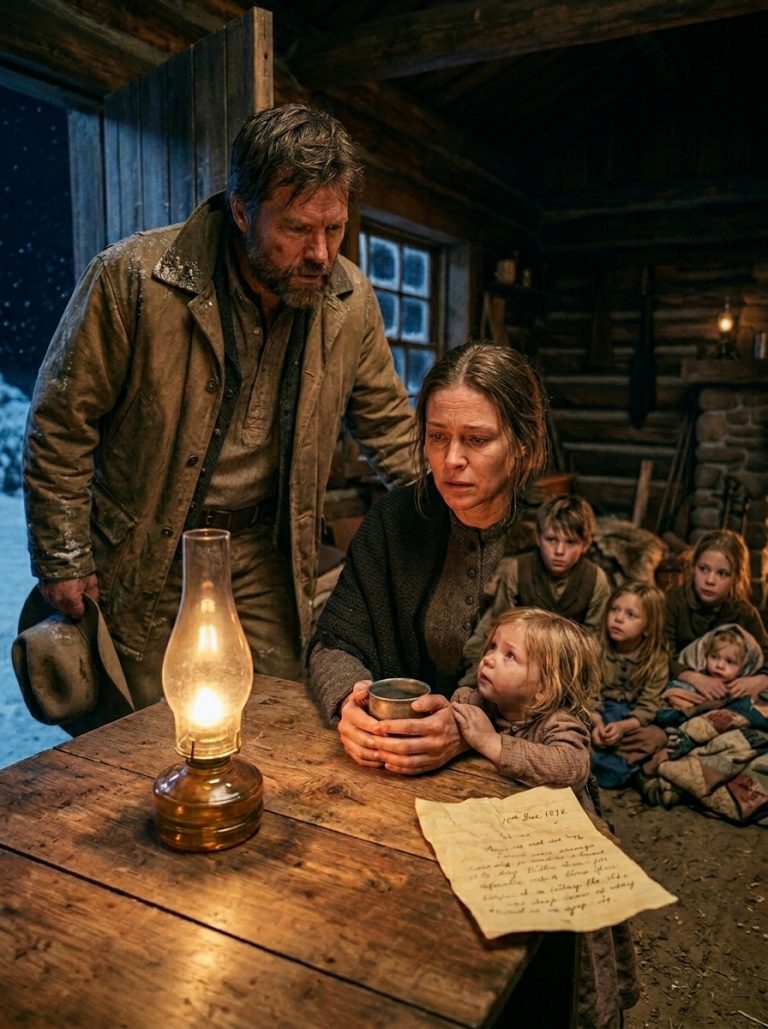
That evening, after the girl had gone and the sky had darkened over the mountain, she sat at the table with a piece of paper and began writing names. Cases. Details. The pattern that had been forming in the back of her mind for days assembling itself into something visible.
Joel came to look over her shoulder.
He was quiet for a long time.
“You see it,” she said.
“I see it,” he confirmed. “The coal-tar crimson. Not in everyone — the body has to be primed, the exposure has to be sustained, there has to be enough friction and heat and—” he paused. “And enough of what your immune system reads as sustained threat.”
Mae set down her pen. The old fury moved through her — clean and hot and useful. “Oates had every piece of this information. I told him what I did for work. I told him what cloth I used. He didn’t ask a single question.”
Joel’s voice came from just behind her. “Men who have decided they already know the answer tend not to ask questions that might complicate it.”
She stared at her list.
“He’s going to keep doing this,” she said. “To the next woman who comes in. To the next girl with cloth on her wrists.”
“Yes,” Joel said. “Unless someone makes the pattern public.”
The word public sat between them with a weight that meant more than one thing.
Mae looked up at him.
Before she could say what she was thinking, hoofbeats came up the mountain trail — multiple horses, moving with the organized purpose of people who had decided they had authority over where they were going.
Joel was at the window before she reached it.
And what was coming up the trail was not a patient.
It was Millford.
PART 3
Dr. Oates rode at the front.
He had assembled a small delegation with the instinct of a man who understood that authority traveled better in groups — the sheriff, pale-faced and uncomfortable in the way of men doing someone else’s political work. Jacob Strand, who owned the larger dry goods store and had approximately three times more opinion than circumstance warranted. Two women from the church auxiliary in dark cloaks who had the particular energy of people who had come to witness rather than act. And behind them all, in a wagon Mae had not immediately registered — Pearl.
Her mother.
Mae’s chest tightened.
Joel came to stand beside her on the porch without theatrics, just present, which was what the moment required.
Oates pulled up his horse and looked at Mae with the expression of a man who believed he was performing rescue. “Miss Whitfield. You’ve been away long enough. The town is concerned.”
“The town,” Mae said, “did not climb a mountain to help me.”
Strand cleared his throat. “There is the matter of reputation.”
“Whose.”
The church women exchanged a look.
Oates pressed forward. “What is happening here is not appropriate. A single woman, living in close quarters with a man of questionable standing, outside the bounds of—”
“I have been receiving medical treatment,” Mae said. “Which you refused to provide.”
“What I provided was a diagnosis.”
“You provided an insult and called it medicine.”
Oates’s face reddened. “Miss Whitfield, you will come down this mountain today or you will face the consequences of your choices in this community.”
Joel’s voice, when it came, was the temperature of deep well water. “You rode an hour up a mountain to threaten a sick woman for seeking care you were too proud to give her. I want to make sure we’re all clear on what’s actually happening here.”
Oates turned on him. “You have no standing in this valley. No oversight, no credentials recognized by any board—”
“I have a medical degree from Harvard,” Joel said. “And a patient list that includes half the people who’ve come to you first and left worse than they arrived. But please, continue.”
The sheriff shifted in his saddle. Jacob Strand examined the middle distance.
Then Pearl climbed down from the wagon.
She moved past the men without acknowledging them, walked to the base of the porch steps, and looked up at her daughter with the expression of a woman who had spent a significant period of time deciding what to do and had arrived at her conclusion.
“I should have come sooner,” Pearl said.
Mae stared at her.
“I read your note again after you’d gone,” Pearl said. “And then I remembered who I was before I spent twenty years teaching you that small was safe.” Her voice was even. It had the quality of something that had been tested and was no longer in doubt of itself. “You’re not coming down.”
She turned to Oates with the unhurried manner of a woman who had concluded that the opinion of this particular man was not a thing she needed to manage. “You told this town my daughter’s condition was a character defect. You said that in your office, to her face, and you let the whole valley repeat it. You had a duty to her as a patient. You failed it.”
Oates opened his mouth.
“I’m not finished.” Pearl’s voice did not rise. It didn’t need to. “If my daughter requires a chaperone to satisfy the delicate sensibilities of people who have never once tried to help her, then I’ll stay. But she is not going back with you. And if you attempt to remove her by force, you’ll find that I have considerably more patience for legal proceedings than you have for medical ones.”
The clearing went silent in the way clearings go silent when something has just happened that everyone present will be discussing for years.
One of the church women said, carefully, “Mrs. Whitfield, think of your—”
“My standing,” Pearl said, “did not hold my daughter when she was crying from pain. It can look after itself.”
From the doorway behind Mae, Catalina’s voice: “And if you take this man from this mountain, who comes when my labor turns wrong? You?” She pointed at Oates with the direct fury of a pregnant woman who has passed the point of diplomatic phrasing. “I have met your work. I prefer my chances with a competent stranger.”
Jacob Strand put his hat back on. “Perhaps we’ve made our point,” he said, in the tone of a man who has realized the point was not the one he’d intended to make.
Oates looked at Mae with the expression of a man making a decision about retreat. “This is not finished.”
“No,” Mae agreed. “It isn’t. Because the cloth you’re selling in Millford — the scarlet cloth from St. Louis — is injuring people. I have a list. I have cases. I have a pattern your diagnostic approach wasn’t designed to find, because your diagnostic approach begins with the conclusion and works backward.” She held his gaze. “I am going to make that pattern public. Not to embarrass you. Because the next girl who comes to your office deserves better than a moral diagnosis for a textile reaction.”
Oates wheeled his horse.
The party broke apart with the irregular dissolution of a group that had arrived with consensus and was leaving without it. Some followed immediately. Some lingered with visible discomfort. The sheriff tipped his hat to Pearl with the expression of a man who had just decided where his sympathies actually lay, now that the social cost of the decision had been made clear.
When the last rider disappeared down the trail, Mae found she had been holding the porch railing with both hands.
Pearl came up the steps and stood beside her.
“You came,” Mae said.
“Yes.” Pearl exhaled. “Later than I should have.”
“Why now?”
Pearl looked at the trail where the riders had gone. “Because I have spent a long time teaching you to make yourself acceptable. And I watched you accept being turned away by that man, and instead of being surprised, I wasn’t.” She turned to Mae. “That frightened me more than anything else.”
Three days later, the territorial medical board’s inspector arrived.
His name was Dr. Henry Marsh. He was sixty, wore a city suit with the ease of a man who had stopped trying to impress anyone, and had the unhurried, careful eyes of someone who had been doing this long enough to know the difference between a complaint with substance and a complaint with an agenda.
He spent four days at the mountain clinic. He examined records. He questioned patients. He asked Mae to walk him through six case histories with the expressionless attention of an examiner who had decided not to telegraph his conclusions.
Mae answered every question directly. When she didn’t know something, she said so. When she had made a judgment call that might be questioned, she explained her reasoning and the alternatives she had considered. She did not perform humility and she did not perform confidence. She simply answered.
On the afternoon of the fourth day, the sound of a carriage tearing up the mountain at an irresponsible speed broke through the examination room.
Joel was on the porch before the horses stopped.
Dr. Oates came through the door first.
Not the composed, authoritative Oates who had dismissed Mae in his office or led the delegation up the mountain. This man had lost his hat somewhere on the trail. His face was the color of ash. His hands, when he crossed the threshold, were shaking in the particular way of hands that have been steady through a professional lifetime and have just encountered the thing that undoes steadiness entirely.
Behind him came his wife, Margaret — a quiet woman Mae had seen in church but never spoken to — and she was carrying a girl of perhaps twelve wrapped in a scarlet school cloak. The girl’s face was mottled and swollen. Her breathing was the shallow, effortful breathing of a body working too hard.
Oates looked at Mae.
Not at Joel. Not at Dr. Marsh. Not at Pearl or Catalina or anyone else in the room.
At Mae.
And the man who had looked at her in his office and said moral rash said, in a voice that had been broken all the way through its center: “Please. My daughter. Please help her.”
The room contracted to that sentence and all the history living inside it.
Mae heard every echo. The waiting room. The ten-second examination. The smooth, certain contempt. The walk home through October air. The months of burning and isolation and the slow, deliberate work of rebuilding a self that had been publicly disassembled.
She felt all of it.
And then she crossed the floor.
“Put her on the table,” she said.
Margaret Oates nearly folded with relief.
The girl’s name was Alice. She had erupted in angry welts across her throat and chest and the inside of her wrists. Her breathing was tight and getting tighter. Mae touched the scarlet cloak and felt the recognition move down her spine like cold water.
“Take this off her,” Mae said. “Now.”
Oates obeyed before his wife could move.
Mae bent close to the girl. Alice’s eyes were frightened and unfocused. Mae put her hand gently on the girl’s jaw and waited until the eyes found her face.
“Alice. I need to see where it’s worst. Can you help me?”
Alice nodded once.
The echo of that — let me see — moved through Mae with a force that almost stopped her hands. But her hands did not stop. They unfastened the collar, assessed the spread, checked the pulse, examined the wrist skin where the fabric had rubbed hardest. The same origin. The same progression. The same imported scarlet cloth burning its way into a girl whose father would call other women unclean for reacting to exactly this.
“How long,” Mae said.
“Two days.” Margaret’s voice was barely above a breath. “The new school cloaks came in from St. Louis. Alice wore hers to graduation rehearsal. Gerald thought heat. Then something she ate. He gave her powders and she—” Her face broke. “She got worse.”
Mae did not look at Oates.
Joel came to her side. Not to take over. To work alongside her, which was different. Together they moved — cool compresses, an herbal wash, willow bark for the fever, a clay compress for the worst of the surface reaction. Dr. Marsh stood at the edge of the room and watched with the fixed attention of a man for whom this had shifted from an inspection to a case study in something larger than medicine.
Alice cried once, sharply, when the compress went on.
Mae leaned close. “Listen to me. Your body is fighting something it doesn’t recognize. That’s not weakness. That’s your body doing its job very loudly.” She kept her voice even and warm. “We’re going to help it quiet down. You are not in trouble. You’re just in pain, and pain ends.”
Alice looked at her. The tightness in her breathing was still there, but something in her eyes shifted — the particular shift of a person who has found something to focus on outside the fear.
Slowly, the worst of it began to recede.
Hours later, when Alice’s color had improved and her breathing had steadied and she had fallen into an exhausted sleep on the examination table with her mother beside her, Dr. Marsh set down his pen.
“The cloak,” he said. “Where was it purchased.”
“Strand’s dry goods,” Margaret said quietly. “The new academy order.”
Marsh looked at Mae’s list on the table. He looked at Mae. He looked at Joel. He looked at Oates, who was sitting in a chair against the wall with the posture of a man who has had something taken from him that he had been leaning on without knowing it.
“Dr. Oates,” Marsh said, with the careful precision of a man who wanted his words to be heard exactly as spoken, “you constructed a narrative about a patient in lieu of taking her history. You allowed your assumptions about her character to substitute for clinical inquiry. Your daughter is alive because the woman you dismissed from your practice had the discipline to do the work you were too certain to do.”
Oates covered his face with one hand.
The silence in the room had many layers. Mae stood in the middle of it and felt each one.
She could have let it be triumphant. The situation had the architecture for triumph — the humiliated man, the vindicated woman, the official witness. She could have made him beg with more specificity, could have let the room savor every detail of the reversal. She had earned that, by any reasonable accounting.
But she looked at Alice sleeping under clean linen and understood something that mattered more than the satisfaction of a man’s collapse.
Bitterness could expose him. Only something different could change what came after him.
When Oates stood at dusk, aged by several years since the morning, and said in a voice scraped raw: “Miss Whitfield. I was wrong,” Mae answered: “Yes. You were.”
He swallowed. “I don’t know how to begin to repair what I said.”
“Begin by never again deciding what a patient’s body means before you’ve asked what their life looks like.”
Tears in Margaret’s eyes. “You saved my child.”
Mae looked at Alice. “I treated a child. What comes next is your family’s to build.”
Dr. Marsh’s letter arrived three weeks later.
Joel Hardt was granted full territorial recognition to practice medicine in Millford District and surrounding mountain settlements.
Mae Whitfield was approved as a licensed medical apprentice with authority to examine and treat patients under clinic supervision, with a notation — Marsh’s own addition, written in a hand that suggested some feeling had gone into it — that her diagnostic contribution to the identification of the coal-tar dye reaction had likely prevented further harm in the district.
Pearl read the letter twice and cried both times. Catalina arrived with her husband Tomas and a covered dish and their now-walking infant daughter and declared the day worthy of everything good they had in the larder. Joel looked at Mae across the kitchen table with the letter in her hands and said, simply: “Told you.”
Mae laughed. It came from somewhere genuine.
The mountain clinic became, over the following year, the kind of place that people talk about in the particular way they talk about things they were previously afraid of and are now quietly grateful for. Patients came on horseback and on foot and occasionally by wagon on good-road days. They came for treatment and advice and sometimes simply because they had heard there was a place in the hills where the first question was tell me what’s happening rather than let me tell you what I’ve already decided.
Pearl started an herb garden. Catalina helped on busy mornings. Dr. Marsh sent books and, once, a letter that contained the phrase the most useful clinical work currently being done in this territory is happening in a building without a proper sign, which Joel tacked to the wall above the medicine shelf without comment.
Jacob Strand, who had ridden up the mountain as part of Oates’s delegation and had turned his horse around with the discomfort of a man who’d realized too late which side of something he’d positioned himself on, built a proper trail sign at the junction below: HARDT CLINIC. TURN HERE. He did it without announcement, which was its own form of apology, and Mae accepted it as such.
Oates did not disappear. He was not the kind of man that circumstances erased. But he changed in the slow, unglamorous way that real change usually moved — less by decision than by accumulation, less by transformation than by the gradual erosion of certainties that had never deserved the weight he’d placed on them. He closed his practice for six weeks. Reopened smaller and quieter. Stopped turning people away at the door based on what he thought he already knew about them. Sent a donation of surgical supplies to the mountain clinic with no note, which Pearl called conscience arriving by parcel post.
Mae’s rash faded. The last traces were gone by March — faint silvered marks that a stranger would not notice and that she no longer looked at with the feeling of being found out.
The deeper healing took the shape of small, accumulating things. She stopped reducing herself in doorways. Stopped apologizing for the space she occupied. Stopped listening for the edge of contempt in a voice before she’d assessed whether it was actually there. These were not dramatic recoveries. They were the steady, ordinary work of a person learning to trust the evidence of her own accurate perceptions.
One evening in late spring, when the mountain had gone green and the air smelled of pine sap and something new, Mae came out to the porch after supper and found Joel leaning on the railing watching the last light leave the valley.
They stood in the kind of silence they had built between them over months — not empty, not weighted, just inhabited. The valley below glimmered in the early dark. A year earlier she would have looked at those lights and seen only the place that had decided what she was.
Now she saw where she had come from.
There was a difference.
“There’s something I’ve wanted to say,” Joel said, “but I kept waiting until I was certain it wasn’t the winter talking. Or proximity. Or the particular way hard work makes people feel closer than they might be in softer circumstances.”
Mae turned to look at him.
He was looking at the valley. Then he turned too, and looked at her with the directness that had been the first thing she’d noticed about him and had never stopped being characteristic of him — the attention that saw and did not reduce.
“I’ve been in love with you since approximately the fourth morning,” he said, “when you looked at Catalina’s face and understood what she needed before I’d finished assessing the clinical situation. And I’ve been fairly miserable about not saying it for about as long.”
Mae looked at him.
“That’s a long time to be miserable,” she said.
“It is.” Something in his face, usually so controlled, let go slightly. “I’m not asking you to feel the same thing. I’m asking you to know that I see you. Not the version of you that Millford decided on. Not the version you’ve had to perform to get through rooms without incident. You.” He paused. “The one who stitches beauty into things because her mother said a straight hem was something you could control when the rest of the world wouldn’t cooperate. The one who stayed in that examination room because leaving would have been easier and she had already decided easier wasn’t good enough. The one who knelt in front of Alice Oates and saved a child whose father had treated her like refuse, because the child was not the father.”
Mae felt tears form with a quality entirely different from grief. Not the tears of pain or humiliation or the exhaustion of endurance. Something else. Something that had been waiting a long time for the right conditions.
“I’ve been in love with you,” she said, “since you turned your back to light the second lamp.”
Something broke open in his expression — quiet and complete, the way a door opens when the person on the other side has been waiting.
“That was practical,” he said.
“I know,” she said. “That’s why.”
He reached for her hand and she let him take it, and they stood on the porch of the mountain clinic in the spring dark while below them the valley glimmered with its ordinary lights, and above them the first stars came out over the mountains that had received her when the valley wouldn’t, and the world felt neither small nor large but exactly the size of what she could hold.
They married the following summer under a sky so unreasonably blue it seemed almost excessive, in the clearing in front of the clinic with the mountains at their backs and the valley visible below them and everyone who mattered present.
Pearl cried first and hardest and was not apologetic about it. Catalina held her toddling daughter on one hip and wept with the operatic enthusiasm of a woman who had decided this occasion warranted full commitment. Tomas pretended not to cry and was unconvincing. Alice Oates came in a pale blue dress, healthy and bright, and scattered flowers with the gravity of a child who understood she was participating in something that connected, in ways she couldn’t fully articulate, to her own survival.
Dr. Marsh sent a letter that arrived the day before the wedding, containing one line: The best medicine I have observed in thirty years of oversight is not a technique but a disposition. You both have it.
Oates did not attend. He sent a note.
To Miss Whitfield and Dr. Hardt: I treated certainty as a virtue and paid for it in ways I am still accounting for. I am grateful my daughter lived to teach me this. I hope you will accept, if not forgiveness, at least the evidence of a man attempting to learn.
Mae read it twice. Then she folded it carefully and put it in the cedar box where she kept her mother’s letters and her father’s last note and the first piece of cloth she’d ever cut on her own as a girl.
Not as absolution.
As evidence that a person, even a particular kind of wrong person, could move.
Years later, when people in Millford told the story — and they did tell it, the way communities tell the stories they need to tell about themselves in order to understand what they actually are — they usually began with the part that was easiest to summarize. A shamed woman climbed a mountain. A reclusive doctor told her let me see you. She thought she had made the worst decision of her life. She was wrong.
But those who knew the truth, or cared to find it, told the part that mattered more.
They said the mountain doctor had looked at a woman and seen her clearly when an entire valley had been squinting at her through the lens of its own discomfort. They said the woman came down from that mountain different — not because someone had fixed her, but because someone had confirmed what she already was, and confirmation, it turned out, was its own form of medicine.
And they said that when the town doctor’s own daughter needed saving, the woman he had tried to reduce to a cautionary tale was the one who opened the door.
That part was true.
But the truest part was this:
The first person who asked Mae Whitfield to let herself be seen had not wanted her shame, her apology, or her carefully managed smallness.
He had wanted the truth of her.
And once she stopped hiding it — from him, from the town, from herself — there was nothing in her life that remained the size that cruelty had tried to make it.