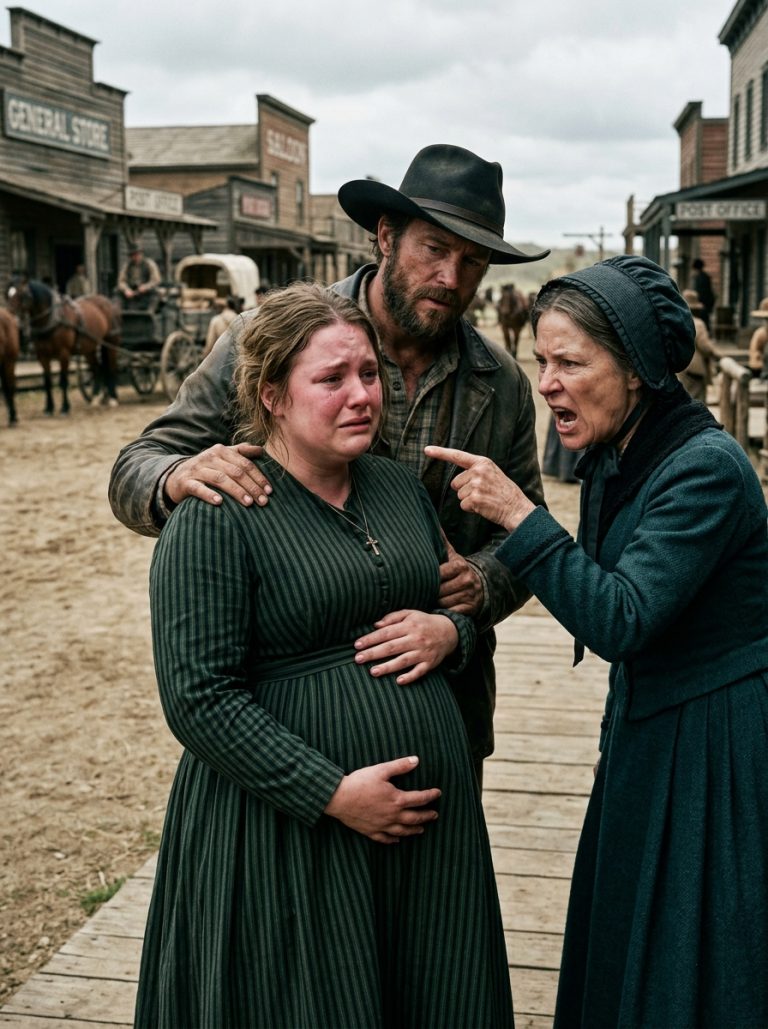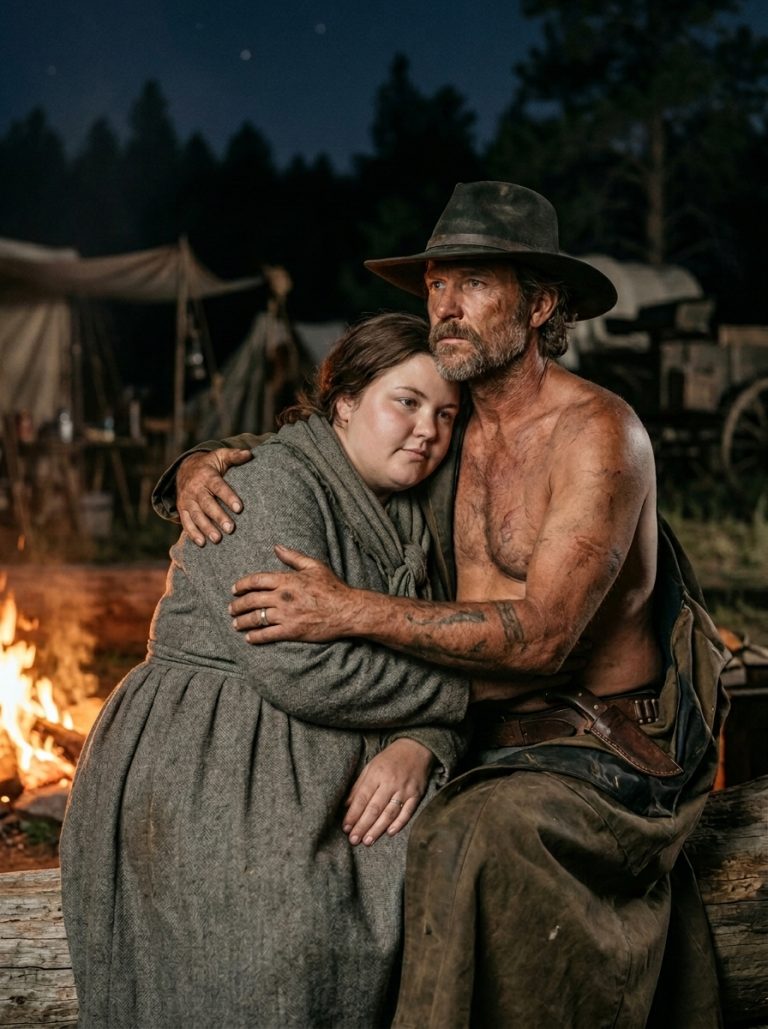
A SMALL BOY APPEARED AT THE RECLUSE RANCHER’S DOOR IN A BLIZZARD AND WHISPERED “MY MAMA IS DYING” — WHAT HAPPENED NEXT CHANGED EVERYTHING

He almost didn’t hear it.
The wind that night was loud enough to swallow a grown man’s shout, so a child’s knuckles against weathered wood barely registered as anything at all. Cord Briggs had been about to bank the fire and go to bed. He’d had no reason to expect anything from the night except more of the same — more silence, more cold, more of the particular dark that settled over the Gallatin range in November like a hand pressing down. But something made him stop. Some frequency in that sound that the wind couldn’t quite cover. Small. Desperate. Trying so hard not to be loud that the trying itself was what he heard.
He picked up the shotgun without thinking. Set it down. Picked it up again.
And opened the door.
What was standing on his porch was not what he’d prepared himself for.
PART 1
Cord Briggs had lived alone in the Gallatin range for six years, and in that time he had become, by the valley’s general consensus, something between a landmark and a warning.
The town of Ridgecreek, population four hundred on a generous count, had a story for every man who’d chosen the high country over neighbors. For Cord, the story was this: he’d come up from Wyoming after his wife and young son died in a fire that burned their ranch house to the foundation in less than an hour, and he’d come up here because up here there was nothing left to lose. He was six foot four, two hundred and forty pounds, had the kind of face that had been handsome once and had since been rearranged by weather and grief into something harder to read. He kept a hundred and sixty acres, ran cattle in the summer months, cut timber in the winter, and spoke to people only when the alternative was impolite.
The valley understood this about him. The valley left him alone.
What the valley did not know — what no one knew, because Cord had not told anyone and did not intend to — was that the silence did not get easier. It had been six years of it and he still woke some mornings reaching toward the other side of the bed, and still had to remind himself why it was cold. The ranch work helped. The physical dailiness of it, the absolute requirement of your body and attention, was the closest thing he’d found to relief. There was nothing you could do about grief when your hands were busy, when the fence needed mending and the cattle needed moving and the winter needed to be prepared for.
So he kept his hands busy and his door closed and his expectations close to nothing.
And then, on a November night with snow coming down in sheets and the temperature dropping toward single digits, his door produced that sound.
He almost convinced himself it was a branch.
The pines around the cabin were old and heavy-limbed and in wind like this they hit the structure from time to time — a hard, flat knock that could startle you if you weren’t expecting it. He’d learned to identify that sound. He’d learned to identify most sounds up here because silence was only safe when you understood everything inside it.
But this sound came again, and branches didn’t pause between strikes. Branches didn’t hesitate.
Cord set down the tin mug he’d been holding and looked at the door.
Three more knocks. Small and unsteady, like someone trying to be careful about how much trouble they were asking for.
He crossed the cabin floor and lifted the shotgun from its place beside the doorframe — not to point it, just to have it, the same way you pull on a coat before you go out, as reflex rather than intention. He unlatched the door and opened it four inches.
Wind drove snow against his face.
And on the porch, backlit by the white chaos of the storm, stood a boy.
Eight years old, maybe. Small even for that. He wore a canvas jacket that had been outgrown by whoever owned it before him, the sleeves stopping well above his wrists, and on his hands a pair of work gloves so large they’d been folded back at the cuffs to stay on his fingers. His face was raw with cold — cheeks gone deep red, lashes and brows frosted — and his dark eyes, when they found Cord’s face, carried an expression that Cord had not seen on a child’s face before.
Not fear. Fear had a kind of uncertainty in it, a wondering about what was coming.
This was past fear. This was a boy who already knew exactly what was coming and had decided to stand up in front of it anyway.
“Sir.” His voice broke on the word — not from cold, though it was cold enough, but from the specific fracturing of a person who has been holding themselves together through pure will and has just reached the absolute limit of it. “Sir, they’ve hurt my mama. She’s — she won’t wake up right. I didn’t know where else to go.”
Cord stared at him for a half second that felt longer.
“Who hurt her?”
The boy swallowed. His jaw worked. “Men from the Dellwood outfit. Down the valley.” He said it the way children said things they’d been told not to say — quickly, like removing a splinter, getting it done before you could think better of it. “They came to the cabin. They wanted her to sign a paper. She said no. And they—” He stopped. His throat moved again. “She told me to hide under the floorboards and not come out. But she got real quiet. And then it got real quiet. And I waited as long as I could and then I—” His breath fractured. “I ran.”
Cord looked at the boy’s face. Then at his wrists where the jacket rode up.
Bruises. Not fresh ones. The old, yellow-brown bruises of repeated acquaintance with someone’s hands, layered over with newer ones still purple at the center.
These had not happened tonight.
These had been happening for a while.
Something shifted in Cord’s chest — something that had been dormant and still for a long time, some mechanism he’d thought had rusted permanently into disuse. It moved with a slowness that was almost painful, like a lock turning that hadn’t been opened in years.
He lowered the shotgun and set it against the wall inside the door. Then he crouched down — slowly, keeping his movements deliberate, the way you moved around animals that had been frightened into their reflexes — until he was at eye level with the boy.
“What’s your name?” he asked, and his voice came out quieter than he’d intended. Softer.
“Denny,” the boy said. “Denny Marsh.”
“All right, Denny.” Cord held the boy’s gaze. “How far is your cabin?”
“Half mile, maybe. Through the south tree line.”
Half a mile. In this snow, in this dark, for a boy this size, in those gloves. Half a mile was a very long way.
“Is there anyone else in the cabin with your mama?”
Denny shook his head.
“The men — did they stay, or did they leave?”
The boy’s eyes cut to the side — that involuntary sideways look of a child checking a space they’re afraid of. “They left. I heard the horses. But I don’t—” He hesitated. “I don’t know if they’re coming back.”
Cord straightened. He looked out past the boy at the dark and the snow and the wall of pines beyond the clearing, and he made, in approximately three seconds, a decision that he understood would cost him something. He didn’t know yet what. But something.
“Stay here,” he said.
Denny’s face shifted — a flash of something that might have been panic. “No, sir, please don’t leave me, I—”
“I’m not leaving you.” Cord moved back into the cabin, pulled his heavy coat from the hook, his hat, his boots. “I’m getting dressed. You’re coming with me.” He looked at the boy over his shoulder. “Get inside and close the door behind you. It’s cold.”
Denny stepped across the threshold like a person crossing a line they weren’t sure they were allowed to cross.
Cord laced his boots and buttoned his coat and took the shotgun from the wall. He looked at the boy standing in the center of his cabin floor, dripping snowmelt onto the boards, still braced for something that hadn’t stopped being about to happen.
“You did right,” Cord said, “coming here.”
Denny looked at him. Something moved through his face — complicated and quick, there and gone.
Then Cord opened the door and the night came back in, and they walked out into it together.
PART 2
The half mile through the south tree line took twenty minutes.
The snow was knee-deep in places, hip-deep on Denny, and the wind came through the pines in long, battering pulses that stole your breath if you weren’t ready for them. Cord broke the trail. The boy followed in his wake, stepping in each compressed footprint, his face down and his arms pulled tight against himself. He didn’t complain. He didn’t speak at all. He just moved, steadily and with a grim endurance that no eight-year-old should have had to develop.
The cabin appeared through the trees without warning — dark, low, a thin line of smoke from the chimney the only sign of anything living inside.
The door was hanging open.
Cord put his hand back to stop Denny without looking. The boy went still behind him.
Cord studied the clearing for a long moment. No horses. No movement. No tracks in the new snow that weren’t already filling in. Whoever had been here was gone, or had been gone long enough for the storm to begin erasing them.
He moved forward, keeping the shotgun up, and went through the open door.
The smell hit first. Iron and cold and something else — an overturned lamp, kerosene soaking into the floorboards near the far wall. In the low, guttering light of the dying hearth fire, the cabin resolved into pieces: a table on its side, two chairs scattered, a shattered clay jug, papers flung across the floor.
And in the corner, half-propped against the wall as if she’d been trying to stand and hadn’t made it, a woman.
She was in her late twenties. Dark-haired. She had a face that in other circumstances would have been pretty and was now just a record of what had been done to it — a cut above her left eyebrow that had bled considerably down the side of her face, a swollen jaw, one eye beginning to close. Her breathing was audible from across the room. Shallow and rapid, the kind of breathing that meant the body was working too hard at something it should have been doing without effort.
But she was breathing.
Cord crossed to her in four strides and crouched down and put two fingers to the pulse in her neck. It was there — fast and unsteady, but there.
“Mama.” Denny had come in behind him. His voice was very small. “Mama, I brought someone.”
The woman’s good eye opened. It moved, unfocused, and then found her son’s face, and something in her expression changed — some layer of bracing let go at the sight of him.
“Baby,” she whispered. Then her gaze moved to Cord and the bracing came back, harder.
“I’m not with them,” Cord said immediately. Plainly. “My name is Cord Briggs. My cabin is half a mile north. Denny came and got me.” He held her gaze and kept his voice level. “I need to know if you can tell me what’s broken.”
She blinked. Breathed. Organized herself with a visible and painful effort. “My ribs,” she said. “Left side. And my head.” Her jaw tightened — not from the pain, or not only from it. “They’ll come back. They said—they’ll come back tomorrow to get the signature. If I don’t sign by morning they said they’d—” She stopped. Her gaze went to Denny and she stopped.
She didn’t have to finish.
Cord understood what the end of that sentence was. He understood it with a clarity that moved through him like cold water, stripping everything down to the essential facts.
The Dellwood outfit. He knew that name. He’d known it for two years without involving himself, which he now understood was a position he was no longer going to be able to maintain.
He stood. “Can you walk if I help you?”
“I don’t know,” she said honestly.
“We’re going to find out.” He looked at Denny. “Son, I need you to hold the door.”
The boy moved to the door without hesitation. He was good at following instructions, Cord noted. Too good. The kind of good that came from needing to disappear on command.
He got his arms under the woman — carefully, mindful of the ribs — and lifted her. She made a sound that she immediately suppressed, biting down on it, and he registered that suppression and what it meant about what she was used to enduring without anyone nearby to hear it.
Outside, the storm had thickened.
Somewhere down the valley, behind the wall of snow and dark, was the Dellwood outfit. Their horses. Their men. Their plan to return at dawn.
Cord looked at the boy standing in the doorway of the ruined cabin with his too-large gloves and his old bruises and his face that had learned too early to brace for impact.
He made a second decision. This one he understood immediately. It was going to cost him more than the first, and he was going to make it anyway.
“Stay close,” he said.
They walked back into the dark.
PART 3
He got them to the cabin in forty minutes.
Longer than the trip out — the woman, whose name was Sadie, could walk with assistance but not quickly, and every uneven patch of ground sent a shockwave through her left side that she absorbed with a silence so practiced it made Cord’s teeth ache. Denny stayed tucked to her other side the whole way, not holding her hand exactly but maintaining contact, his shoulder against her arm, as if he were a small ballast keeping her vertical by proximity alone.
Inside, Cord built the fire back up and got the lamp lit and helped Sadie onto the cot in the corner that had been his, and stood back while she caught her breath.
She was more coherent now than she’d been in the cabin. The cold had sharpened her, or the movement had, or the simple fact of being somewhere that didn’t smell like what had just happened. She sat propped against the wall with one arm cradled across her ribs and watched him move around the cabin with an expression he recognized. It was the expression of someone doing a rapid, experienced assessment of a man — cataloguing details, weighing outcomes, calculating whether this was better or just differently dangerous.
He recognized it because he’d seen it before, in other circumstances, in other women who’d learned that the danger in a room was not always visible from the door.
“I’m not going to hurt you,” he said. Not to reassure. Just to say it plainly, the way you stated a fact.
“You said that,” she said.
“I know. I’m saying it again.”
She looked at him for a moment. “Why?”
“Because you’re still deciding whether to believe it. So I’ll keep saying it until you decide one way or the other.”
Something shifted in her expression. Not trust — not yet — but the first faint movement toward the possibility of it, which was a different thing entirely.
Denny had found the stool near the fire and had sat on it without being invited, close enough to the heat that Cord could see the frost melting from his hair. The boy was watching everything with the quiet attention of a child who’d learned that watching carefully was one of the few forms of power available to him.
Cord got water boiling. Found the cloth and the tin of salve he kept in the cabinet above the stove. Brought them to the cot.
“I’m going to look at that cut,” he said. “And the ribs if you’ll allow it.”
Sadie held still while he cleaned the wound above her eye. It was deep enough to need closing — he had no proper suture materials, but he had a needle and thread and had used them on himself before, which was either reassuring or not, depending on how you looked at it. He told her this. She said go ahead in the flat tone of someone who had stopped keeping track of indignities.
He worked slowly. Carefully. Without speaking except when he needed her to do something — hold still, lean forward, breathe out. She followed every instruction. She was, he was coming to understand, a woman of considerable internal architecture. What was visible on the outside — the damage, the exhaustion, the wariness — was only the surface layer. Underneath it was something that had not been broken, though he suspected it had been worked on for some time.
When he was done with the cut, he looked at her. “The ribs.”
“They’re cracked, not broken,” she said. “I’ve had both. I know the difference.”
“Still need wrapping.”
“I know.” She paused. “I can do it myself if you—”
“You can’t reach the angle right-handed with cracked left ribs.” He kept his voice neutral. “But I’ll turn around while you get the shirt loose and you can guide my hands if that’s easier.”
She looked at him for a long moment.
“You’re not what I expected,” she said.
“What did you expect?”
She glanced around the cabin — the order of it, the spareness, the quality of a space arranged by someone who’d been alone with it long enough to understand every corner. “A man hiding from something,” she said.
“That’s not wrong,” Cord said.
“But also this.” She gestured, vaguely, at the space between them. At the cleaned wound and the hot water and the way he’d lowered the shotgun and crouched down on the porch to put himself at a child’s eye level in the middle of a blizzard.
Cord said nothing. He didn’t have anything to say to that yet.
He spent the remaining hours before dawn thinking about the Dellwood outfit.
Sadie slept — finally, fitfully, with Denny curled beside her on the cot in the way children attach themselves to the people they love when those people have been endangered. Cord sat at the table with cold coffee and let himself think through what he knew.
The Dellwood outfit was the largest cattle operation in the valley, run by a man named Warren Dellwood who had come into the region eight years ago with Eastern money and a very particular kind of patience. He acquired land the way some men collected grievances: slowly, methodically, with the long view. He used attorneys where he could and other means where he couldn’t, and the county sheriff had been on his payroll for at least three years, which was an open secret in Ridgecreek that no one had yet found a way to make into a closed problem.
Sadie’s cabin — Sadie’s land — sat at the western edge of the valley on a corridor that Dellwood needed for his spring cattle drive. Without it, his herd had to go the long way around, which cost him time and money. He’d been trying to buy it for two years. Sadie had refused. Her late husband had built that cabin, had worked that land, and she was not going to sign it over to a man who thought persistence and intimidation were synonyms.
Last night was what happened when persistence ran out.
Cord turned his coffee mug in his hands and thought about the men who would come back at dawn. He thought about what they’d do when they found the cabin empty. He thought about whether they’d follow the tracks north through the snow — the tracks that led directly to his door.
He thought about six years of keeping his head down and his expectations low and his losses in the past where he’d put them.
He thought about a boy with too-large gloves and old bruises who had walked half a mile through a blizzard because he didn’t know where else to go.
At four in the morning he put on his coat and walked to the barn and saddled his horse. He came back inside and stood in the middle of the cabin floor and looked at the woman asleep on his cot and the boy asleep beside her.
He thought about his wife. He thought about his son. He thought about a house that had burned to the foundation in less than an hour and what he’d lost in that fire and whether losing it had been the end of something or just a long, terrible intermission.
He thought about the fact that this boy had knocked on his door because something in him had believed, in the middle of a blizzard, that the man on the other side of it might help.
Children were wrong about things all the time. But they were sometimes right in ways adults had stopped being able to be.
Cord went to the cabinet above the stove. He took out the deed box he’d kept locked since the year he arrived. Inside it were documents he’d never shown anyone — the land survey, the water rights, the records of what he owned and where its edges were. He sat at the table and laid them out and looked at them for a long time.
Then he took out a pen and began to write a letter to the county land office in Bozeman. And then another to the circuit judge. And a third to a lawyer he’d known in Wyoming, a man with a particular reputation for taking cases that nobody else in the territory wanted to touch.
He wrote until the light changed.
The men from the Dellwood outfit arrived at seven in the morning.
There were three of them, which was one more than he’d expected. They came up the trail from the south without particular caution — the tracks in the snow made a readable story, and they’d followed it to its conclusion.
Cord was on the porch when they came into the clearing.
He was not holding the shotgun.
He was holding a coffee cup, standing with his shoulder against the porch post, watching them come.
The man in front — older, hat pulled low, the particular ease of someone accustomed to being the most dangerous person in a given space — pulled his horse up twenty feet out and looked at Cord with an expression that was trying to be neutral and wasn’t quite succeeding.
“Briggs,” he said. He knew the name. They’d done their preparation. “We’re looking for a woman. Sadie Marsh. We have reason to believe she came this way.”
“That right,” Cord said.
“We have a legal matter to settle with her. A document she needs to sign.”
“A document,” Cord said. “That’s what you call it.”
The man’s expression shifted slightly. “Step aside, Briggs. This doesn’t need to involve you.”
“It already does.” Cord took a slow sip of coffee. “I wrote to Judge Haskell in Bozeman last night. I wrote to the land office and to Tom Reedy, who is a lawyer out of Laramie with an interesting history of taking cases involving fraudulent land acquisition and the men who arrange it.” He held the man’s gaze. “I also wrote out a full account of what Sadie Marsh’s injuries looked like when she was carried into my cabin at midnight, which I signed and witnessed and which is currently in an envelope on its way to three separate addresses, one of which is a newspaper in Helena.”
The silence in the clearing was the particular silence of a situation recalculating.
“You can’t prove—”
“I don’t need to prove anything right now,” Cord said. “I need those letters to arrive. Which they will.” He set his coffee cup on the porch railing. “You should also know that the woman you’re looking for is not going to sign anything. Not today, not under pressure, not ever. That land was her husband’s and it’s hers now and it’s going to stay hers. What Warren Dellwood is going to do, if he has any sense left, is find another route for his cattle drive and leave this valley alone.” He paused. “And you three are going to ride back down that trail and tell him so.”
The man in front looked at him for a long moment. His eyes moved to the cabin door. To the two men beside him. Back to Cord.
“You’re making enemies,” he said.
“I’ve had enemies,” Cord said. “I’ve had worse than Dellwood.” He picked up his coffee again. “Ride back.”
The three men sat their horses for another long moment that felt very full.
Then the front man turned his horse. The other two followed.
Cord watched them go until they were into the trees and the sound of hooves faded into the wind and the morning quiet came back over the clearing.
He stood on the porch for a while after that, not thinking anything in particular. Just standing. Just breathing.
The door opened behind him.
Denny came out first, still in his oversized gloves, and stood beside Cord at the porch railing and looked out at the empty clearing the way children look at places where something scary was and isn’t anymore.
“Are they gone?” he asked.
“Yes,” Cord said.
“Will they come back?”
Cord thought about this honestly. “Maybe. But it’ll be different if they do. There are people who know now. It’s harder when people know.”
Denny considered this. He looked down at his hands. “I didn’t think you’d help,” he said. “I almost didn’t knock.”
“What made you knock anyway?”
The boy was quiet for a moment. “I didn’t have anywhere else to go,” he said. “But also—” He stopped. Started again. “My mama always said the best way to find out what a person is made of is to need something from them. She said most people are better than they look like from the outside.” He glanced up at Cord. “I thought maybe that was true about you.”
Cord looked at the boy.
He thought about six years of making himself into a closed door. A kept distance. A man you left alone because he looked like he’d already been taken apart once and wasn’t interested in reassembly.
He thought about a knock. Small and unsteady. Knuckles on wood in a blizzard, trying so hard not to be loud that the trying itself was what you heard.
“Your mama’s right,” he said.
The legal proceedings took four months.
Tom Reedy came up from Laramie in February with a case file that was, as he described it to Cord over a supper of venison stew, a prosecutor’s dream and a county sheriff’s nightmare. The letters had done what letters sent to the right places tended to do — created a paper trail that Dellwood’s attorneys couldn’t quietly make disappear, in a political climate that had been looking for exactly this kind of documented grievance. By March, Warren Dellwood was facing three separate inquiries and had retracted his claim to the Marsh property in the kind of formal, lawyerly language that meant: we know this is over.
The sheriff retired in April. Nobody was surprised.
Sadie stayed at the cabin through February while her ribs healed, because the trail to her property was impassable and because Cord had asked her to stay in the plain, factual way he asked for things — not pressuring, not performing, just stating what seemed sensible and leaving the decision entirely with her.
She stayed.
They found a rhythm. She cooked — better than he did, which he acknowledged freely. He kept the firewood and the stock and the trail cleared. In the evenings they sat on either side of the fire and talked, sometimes for hours, in the way of two people who had both been alone long enough to have things stored up that they hadn’t had anyone to say them to.
She told him about her husband, who had been a good man and a hard worker and had left her the cabin and the land and a boy who had his eyes. She told him about the years after, managing on her own, learning what she could do and what she had to figure out, the loneliness of it and the strange pride that came from getting through anyway.
He told her about Wyoming. About the fire. He told it plain, without leaning into the pain of it, the way you tell a thing you’ve finished being destroyed by and are now simply carrying. She listened with the quality of attention he’d noticed in her from early on — complete, quiet, not hurrying toward the end or trying to fix anything.
“I stopped letting people in,” he said one evening, looking at the fire. “After. I thought it was self-preservation.”
“And now?” she asked.
He thought about that knock in the blizzard. The small, hesitant knuckles. The boy on the porch trying not to ask for too much.
“Now I think there’s a difference between protecting yourself and just being unavailable,” he said. “I confused them for a long time.”
She was quiet for a moment. “Denny trusted you,” she said. “Before I did. He’s usually a good judge.”
“He’s a good kid.”
“He’s a remarkable kid.” A pause. “He hasn’t had the easiest—” She stopped. Her jaw worked. “His father wasn’t a cruel man. But he wasn’t steady. And Denny learned early to watch and wait and read a room. That’s not a skill children should need.”
Cord thought about the boy’s braced posture on the porch. The too-practiced way he followed instructions. The careful, measuring quality of the way he watched adults.
“He also knew to come find help,” Cord said. “That’s a harder thing to hold onto than the watching.”
Sadie looked at him. In the firelight her face was healed now, the cut above her eye a thin pink line that would probably fade to something barely visible in a few months. She looked, Cord thought, like a person who had survived something and was working out what that meant for what came next.
He recognized that look. He’d worn it for six years.
“What happens in the spring?” she asked.
“The trial in Bozeman,” he said. “Reedy thinks it settles before it gets to a jury. Dellwood will pay fines and that will be the end of it.”
“And the land.”
“Stays yours.”
She nodded, slowly. “And what happens to us?” she asked.
The question sat in the air between them. Simple, direct, the kind of question that could only be asked by someone who’d stopped having the energy for anything other than plain speech.
Cord looked at her.
“That,” he said, “is entirely up to you.”
She held his gaze for a long moment.
“I’d like to stay through spring,” she said. “If that’s—”
“It is,” he said.
“And then we’ll see,” she said.
“We’ll see,” he agreed.
In April, when the snow was coming off the ridge and the first pale green was showing in the meadow below the cabin, Denny found an injured hawk in the south tree line — a red-tail with a damaged wing, sitting on the ground with the furious, baffled dignity of a creature unaccustomed to being grounded.
He carried it back to the cabin in his jacket, which was a new jacket now, one that fit.
Cord made a splint from two straight sticks and a strip of cloth, talking Denny through each step, letting the boy’s hands do the work under his guidance. It took an hour. The hawk bore the process with impressively concentrated outrage.
Sadie watched from the doorway.
When it was done — the wing splinted, the bird settled into a crate lined with straw in the barn, Denny kneeling beside it with the expression of someone who has just taken responsibility for something and understood the weight of it — she came and stood beside Cord in the barn doorway.
“He needed someone to teach him things,” she said quietly.
“He needed someone to show him what a man who isn’t afraid looks like,” Cord said.
She looked at him sideways. “Is that what you are?”
“Not always,” he said. “But I’m working on it.”
The hawk flew in May.
Denny released it from the meadow on a clear morning when the mountains were showing their full height above the treeline, and it rose with a directness that looked effortless from the ground — wings spread, angling up into the thermals, becoming in seconds something very far away and then very small and then gone.
Denny watched it go with an expression that Cord had learned to read. Not loss. Something more complicated than loss. The face of a person who has helped something get back to what it was supposed to be, and is discovering that this is a different and in some ways larger feeling than keeping it.
He looked up at Cord.
“Will it be okay?” he asked.
“Yes,” Cord said.
“How do you know?”
Cord watched the empty sky where the hawk had been. “Because it knew it wasn’t meant to stay on the ground,” he said. “Some things, when you give them back to themselves, know exactly what to do.”
Denny thought about this with the seriousness he brought to most things.
Then he looked at Cord, and at his mother standing a few feet away with her face turned up to the same sky, and back at Cord.
“Are we staying?” he asked.
It was the first time he’d asked directly. He was the kind of boy who waited until he was sure of the answer before asking the question — which meant, Cord understood, that he already knew.
“If you want to,” Cord said.
Denny looked at the sky one more time.
“Yeah,” he said. “I want to.”
They stayed.
Not because they had nowhere else to go. Not because the situation required it or circumstances demanded it or there were no other options.
Because Denny had knocked on a door in a blizzard and the man behind it had crouched down to his eye level and said you’re safe on my porch and had meant it. Because Sadie had looked at a man she had every reason to distrust and had chosen, slowly and with full awareness of the risk, to believe him. Because Cord had spent six years mistaking unavailability for protection and had been shown, by a small boy in too-large gloves, that some locks exist not to keep things out but to keep you from what’s waiting on the other side of the door.
That summer he put a new roof on Sadie’s cabin. Denny helped carry the materials, asking questions about every step with the inexhaustible curiosity of a child who has recently discovered that the world will answer him when he asks.
That winter the three of them sat around the table in the evenings and the fire held and the storm did what it always did up here — came down hard and didn’t apologize — and inside the cabin it was warm and lit and full of the ordinary, irreplaceable sounds of people who have chosen to be in the same place together.
Sometimes Denny fell asleep at the table over his schoolbook, and Cord carried him to his cot the way he had once, a long time ago, carried another small boy to another bed in another life — gently, deliberately, with the specific care of someone who has learned what it means to hold something that can be lost.
He tucked the blanket around the boy’s shoulders.
He stood in the doorway for a moment, looking.
Then he went back to the fire, and to Sadie, and to the rest of the evening, and to the long, unexpected remainder of a life he had once believed was finished.
It wasn’t finished.
It had been waiting, patient as the mountains, for him to open the door.