SHE WAS SIX MONTHS PREGNANT WHEN HER MOTHER SOLD HER TO A MOUNTAIN STRANGER — WHAT HE SAID IN THE DARK TWO HOURS LATER LEFT HER SPEECHLESS

She didn’t scream. She didn’t beg. She didn’t even cry.
When Nora Vale realized her mother had already made the decision — had already written the letter, already agreed to the price, already set the date — she did the only thing she had left. She stood in the corner of that dim kitchen and memorized the room. The warped floorboards. The smell of lamp oil and old pine. The particular quality of silence that lives in houses where love ran out a long time ago. She memorized it the way you memorize a wound: not to treasure it, but so you never forget exactly how it was made.
She had seven minutes between learning she’d been sold and walking out the door.
She spent six of them completely still.
The seventh, she decided she would not give her mother the satisfaction of tears.
What she didn’t know — couldn’t have known, standing in that lamplight while a stranger waited outside in the dark — was that before the night was over, the man her mother had sold her to would say something that would crack open everything she thought she understood about what it meant to be worth something.
PART 1
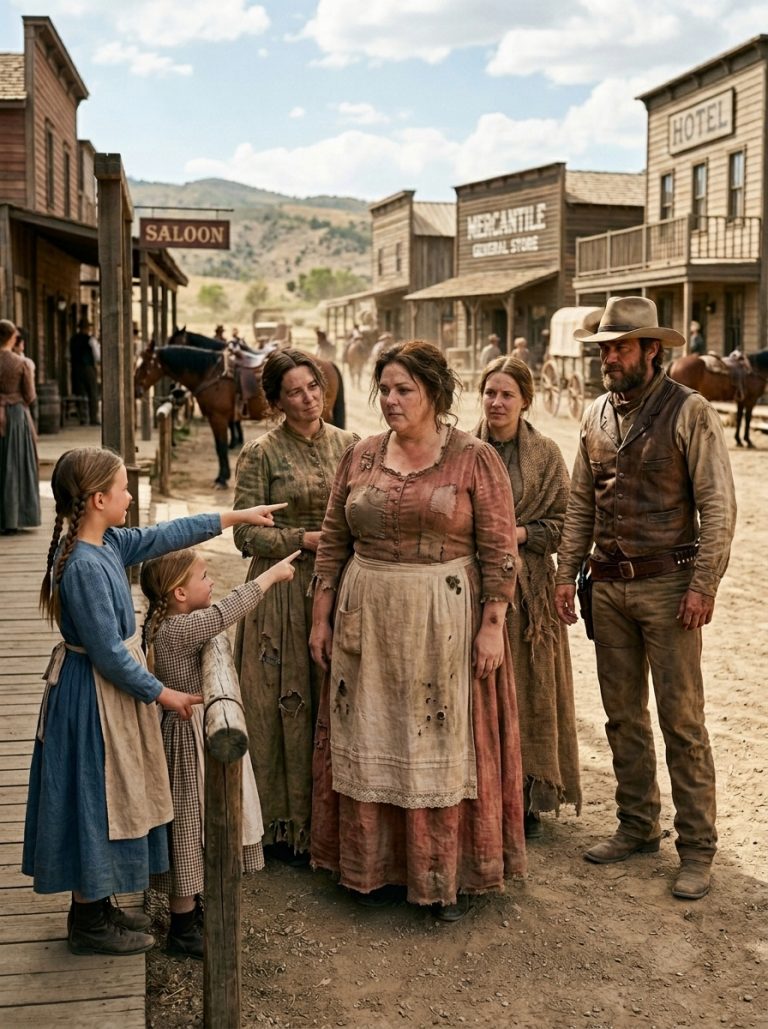
The town of Harlow sat at the foot of the Rockies like a sentence no one had finished writing — a main street, a church, a saloon, a general store, and enough judgment packed between those buildings to last a woman several lifetimes.
Nora had grown up there. She knew every face and what every face thought of her now.
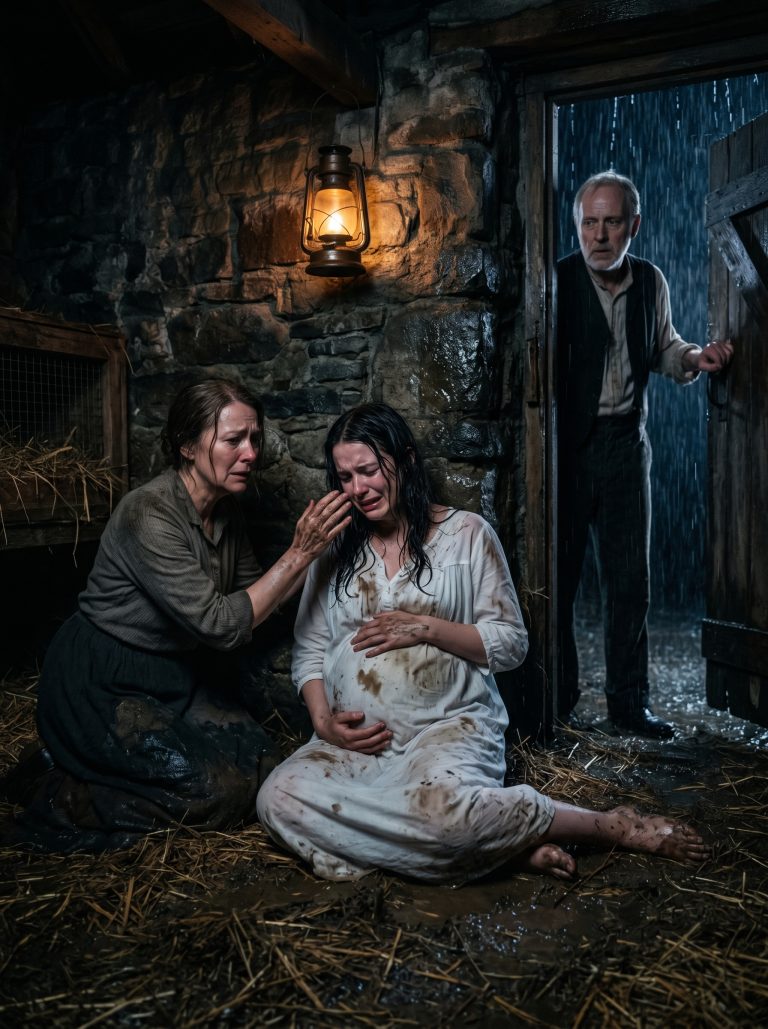
She was twenty-two. Unmarried. Six months along. In Harlow that particular combination made you either a cautionary tale or a topic of conversation, and Nora had long since understood that in her mother’s house, she was both.
Her mother, Iris Vale, had a particular talent for practicality. She was a small, sharp-featured woman who had been widowed young and had survived by running a tight boardinghouse on the eastern edge of town — renting rooms to miners and travelers and men passing through who needed a bed and asked no questions. She was not a cruel woman, Nora had always told herself. She was simply a woman who had been disappointed so many times that warmth had become a thing she could no longer afford to spend freely.
When Nora’s pregnancy became impossible to hide, Iris had given her daughter exactly two weeks.
“I can’t have this under my roof,” she said. Not angry. Not even cold, exactly. Just settled, the way people sound when they’ve already finished grieving something. “A boardinghouse runs on reputation. You understand that.”
Nora understood.
She spent those two weeks looking for exits that didn’t exist. No savings. No family beyond her mother. The man responsible had been gone from Harlow since July, leaving behind nothing but a note that said I’m sorry — which Nora had burned the same afternoon, because some apologies are not worth the paper they inhabit.
On the ninth day, Iris told her she’d found a solution.
“A man wrote to me,” she said, folding laundry at the kitchen table, not looking up. “Name is Holt. He lives up past the timberline, north of Miller’s Pass. He’s been looking for a wife. I wrote back. He’ll come Friday.”
Nora stood very still. “You wrote to him about me.”
“I arranged it.”
“Without asking me.”
Iris set down a shirt. Her eyes, when she finally raised them, were not unkind. They were something worse: certain. “You don’t have options left, Nora. This is an option.”
“And if I refuse?”
“Then Sunday you find somewhere else to sleep.” She picked up the shirt again. “I have boarders to think about.”
Nora opened her mouth. Closed it. There were things she had prepared to say — she’d had nine days to prepare them — but every one of them dissolved in the particular atmosphere of that kitchen, the one that had always had a way of making her words feel like they didn’t quite exist.
She walked out without speaking.
She was learning, slowly and at great cost, that some rooms were not built to hold her voice.
Friday came with grey skies and the smell of early snow.
The man named Holt arrived at seven in the evening.
Nora had constructed versions of him in her mind over the preceding days. Most of them were bad. She’d braced for old, or mean-mouthed, or the particular way certain men looked at women they’d acquired — that inventory look, the one that moved over you like you were a thing being assessed for usefulness. She had prepared herself for that look specifically. She knew it. She’d been practicing, quietly and without assistance, the art of letting it pass through her without leaving a mark.
What she had not prepared for was stillness.
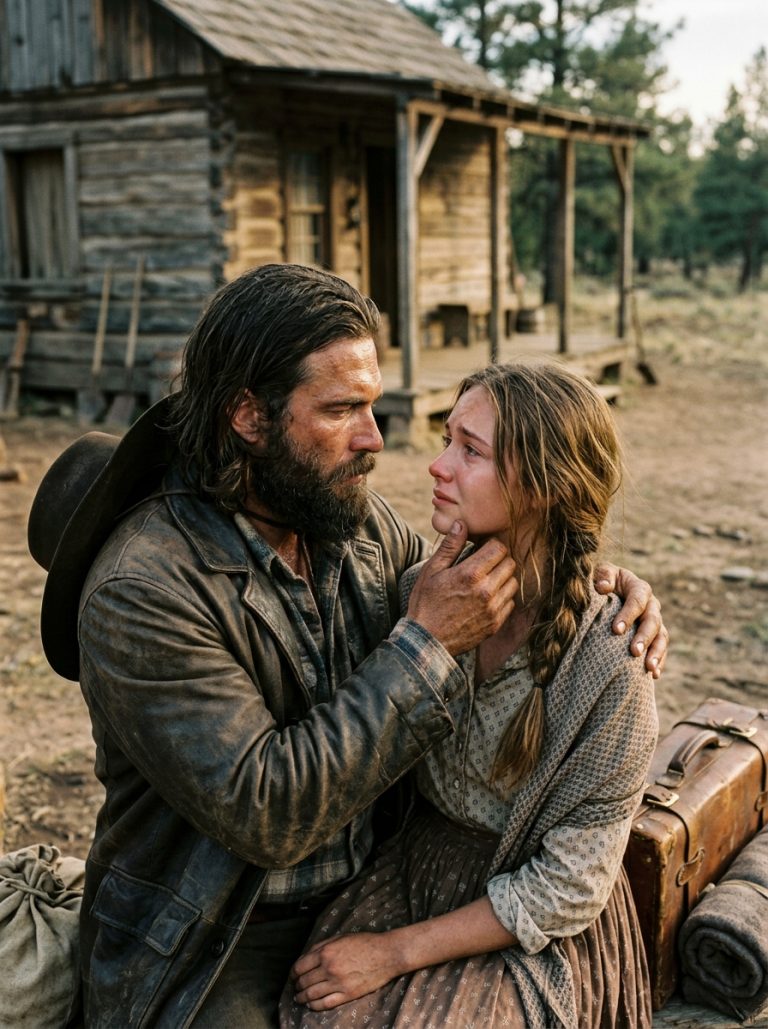
He was somewhere in his mid-thirties, weathered past easy reading. Tall and built lean in the way of men who work outdoors in all seasons, not for appearance but because the work demands it. Dark wool coat, worn at the elbows. Jaw unshaved. Wide-brimmed hat carrying the dust of a long road. He entered the house and removed the hat, and that small, automatic courtesy surprised her more than anything she’d imagined.
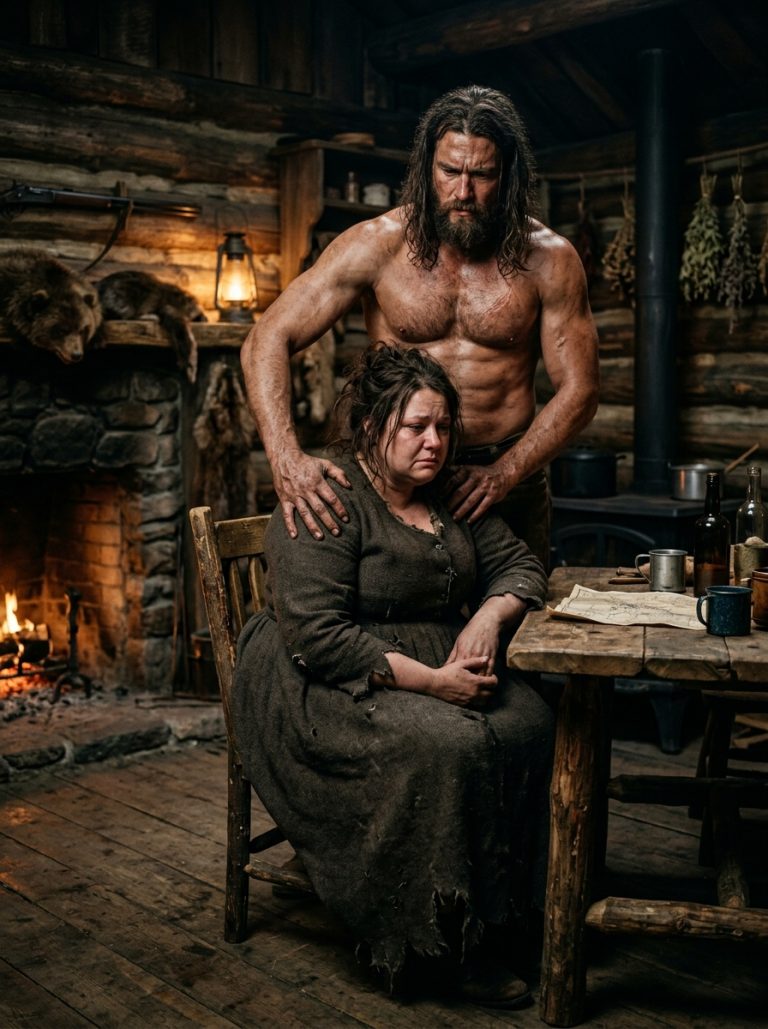
Iris had set up the kitchen table as if for a transaction — two chairs, a lamp, the surface cleared of everything except purpose. Nora stood near the cold hearth with her hands folded over her belly, watching while her mother and this man discussed the terms of her life as if she were a problem with a documented solution.
“She’s healthy,” Iris said. “She works hard. She’s not difficult.”
Holt listened without interrupting. He asked no questions about the father. Asked nothing at all, in fact, that might have required treating Nora as a participant in the conversation.
Then Iris named her price.
The kitchen went so quiet that the lamp flame’s small flutter was audible.
Holt reached into his coat. He set a leather pouch on the table.
The sound it made — soft, deliberate, final — filled the room like a word no one said aloud.
Iris’s hand moved toward it before the sound had finished. She opened the pouch. Her lips moved as she counted.
Then she counted again.
Not checking the amount. Nora understood that distinction with a precision that settled somewhere deep in her chest, below the reach of tears. Her mother wasn’t checking. She was confirming. Making certain she had extracted every last coin she was owed.
Iris pulled the drawstring closed. Her fist wrapped around the pouch and held it.
“The agreed sum,” Holt said.
“Yes.” Iris stood. Her gaze moved to Nora — brief, transactional, and then gone, the way you glance at something you’ve already finished deciding about. “She can go tonight. I’ll have her things ready.”
Nora’s things took less than three minutes to gather. A wool shawl. A book. A small tin her father had given her the winter before he died, which she kept not because it held anything but because he had held it once.
When she passed through the kitchen, Iris was standing at the counter with her back turned, folding the empty leather pouch into her apron pocket with neat, economical movements.
Nora stopped.
She waited.
Iris did not turn.
“Goodbye, Mama.”
The word Mama cost something — Nora wasn’t sure what exactly, only that it was real and that she paid it willingly, for her own sake rather than her mother’s. Because some things you say not to be heard but to keep a record, somewhere inside yourself, of who you chose to be in the worst moment.
Iris’s shoulders moved slightly. A breath released.
“Travel safe,” she said. To the counter.
Nora walked out.
The night air struck her face like cold water — immediate, clarifying, real. Above her the sky was sealed with cloud, starless, the darkness complete in a way that felt less like absence and more like something waiting.
Holt’s horse stood tied at the fence post — a big bay gelding, solid and unbothered. Holt was already in the saddle. He looked down at her.
She was standing in the dirt in a thin dress with a wool shawl and a book and a small tin, and nothing else.
He looked at what she was carrying. Then he reached back into the saddlebag behind him and pulled out a heavy canvas coat and held it down toward her.
“It’ll drop hard before midnight,” he said. “You’ll need this.”
Nora stared at the coat.
She had braced for so many things. She had not braced for this — for a coat offered before she’d asked, before she’d proved anything, before he knew a single true thing about her. Before he had any reason at all.
She took it. Put it on. It was enormous, smelling of pine resin and woodsmoke and cold air and something underneath those things that she had no name for yet.
He helped her mount — efficiently, without ceremony, as if this were simply a problem with a practical solution. She settled behind him, wrapped her arms around his coat, felt the solid reality of a person who had decided, for reasons she didn’t yet understand, to be here.
The horse moved forward.
Nora looked back once. Her mother’s house was already dark — the lamp extinguished, the door shut, the windows black and closed as eyelids. Not a light. Not a shadow moving. Nothing that looked like hesitation.
She pressed her forehead against Holt’s back.
She did not cry.
She was past crying. She was in some country beyond it, cold and clear and strange, riding into a darkness she couldn’t read, holding onto a stranger she didn’t know, carrying a child who deserved better than all of this.
And then — two hours into that ride, deep in the timber country where the pines pressed close on both sides and the only sound was hoofbeats and wind — he spoke.
And what he said was not what she had been preparing herself to hear.
PART 2
Two hours of silence, and then his voice came out of the dark ahead of her, low and even, like something he’d been turning over for a long time before releasing it.
“You don’t have to be afraid of me.”
Nora said nothing immediately. The trees moved around them. The horse kept its pace.
“You don’t know what I’m afraid of,” she said finally.
“No.” A pause that felt considered rather than empty. “But I can imagine some of it.”
She waited.
“I’m not going to touch you,” he said. “Not without — not ever, unless you wanted that. Which you won’t. And that’s all right.”
The plainness of it stopped her. Not gentle, not reassuring in the way of men who say soft things to get what they want — just flat and factual, like a man stating the weather or the distance to the next town. She didn’t know what to do with plain.
“Then why,” she said. And stopped.
“Why take a wife I’m not going to—” He said the word she’d left out, simply, without embarrassment. “Why make that arrangement at all.”
“Yes.”
The pines thinned briefly. A gap in the clouds showed two stars, then closed again.
“I had a wife,” he said. “Two years back. She died in childbed. The baby with her.”
Nora felt the weight of that settle into the air between them. She didn’t offer condolence. She had a sense he wasn’t telling her for condolence.
“I have a house,” he continued. “Good house. Work enough to keep it. What I don’t have is—” He paused, and she heard in that pause something that was neither performance nor self-pity. A man trying to say something accurately. “The winters up here run long. Seven months. I come in from work and the house is dark and it’s been dark for seven months and I am—” He stopped. Started differently. “I needed a person in the house. Not a servant. Not a—just a person. Someone at the table. Someone I could talk to in the evenings. That’s most of it.”
“And the rest?”
“Your child needs a name.” Straightforward. No flourish. “I can give it that. I’m not asking for anything in return except that you stay. Run the house. Be there. That’s all.”
The horse climbed a shallow rise. Below them, somewhere in the dark, water moved over rocks — a creek she couldn’t see.
“Why didn’t you say this at my mother’s house?” Nora asked. “Before — before the money. Before all of it.”
A beat. “Your mother wanted it done fast. And I didn’t think you’d believe me if I said it in front of her.” Something crossed through his voice when he mentioned her mother — not contempt exactly. The tone of a conclusion already reached and filed away because holding onto it served nothing. “I thought you might believe me better out here.”
“I’m not sure I believe you now.”
“I know,” he said.
“But you’re saying it anyway.”
“Yes.”
The darkness pressed close. The horse’s breath misted in the cold air.
“I’m not asking you to trust me,” Holt said. “I’m asking you to come to the house. Sleep somewhere warm. Have your baby safe. After that—” A pause weighted with something that felt, impossibly, like respect. “After that you decide.”
“Decide what.”
“Whether you stay.”
Nora felt something move through her chest — not hope, she was too careful for hope, had learned at significant cost to ration it — but something in the same neighborhood. Something that felt like a door she hadn’t known existed swinging slightly open.
“And if I decide I don’t want to stay?” she asked.
“Then I’ll get you back to somewhere you can go. I’ll make sure you have enough to start.”
“You’d do that.”
“Yes.”
“Why.”
He was quiet long enough that she thought he’d decided not to answer. Then: “Because you’re not a thing that gets sold. Whatever your mother thinks. You’re a person. And I’d rather spend thirty more winters alone in that house than have someone inside it who doesn’t want to be there.”
Something broke open in Nora’s chest — quiet, internal, the way ice breaks in early spring, not with drama but with a slow and irresistible shift in the whole weight of things.
She didn’t answer.
She pressed her lips together and looked at the dark trees and breathed the cold air and held the words inside her, turning them over, feeling for the catch, for the place where the trick was hidden.
She couldn’t find one.
Which was either the most dangerous thing she’d encountered in years, or the first true thing.
She didn’t know yet.
But for the first time since her mother had said a man came asking, Nora Vale was not simply bracing for what came next.
She was, very carefully, beginning to wonder about it.
PART 3
The house appeared at dusk on the second day, and Nora had not expected it to look like that.
She’d built it in her mind as functional. Spare. A structure erected against the cold rather than for any warmer purpose — four walls, a roof, the minimum requirements of survival assembled without sentiment.
What she found instead was a house that had known love, and still carried it in its bones.
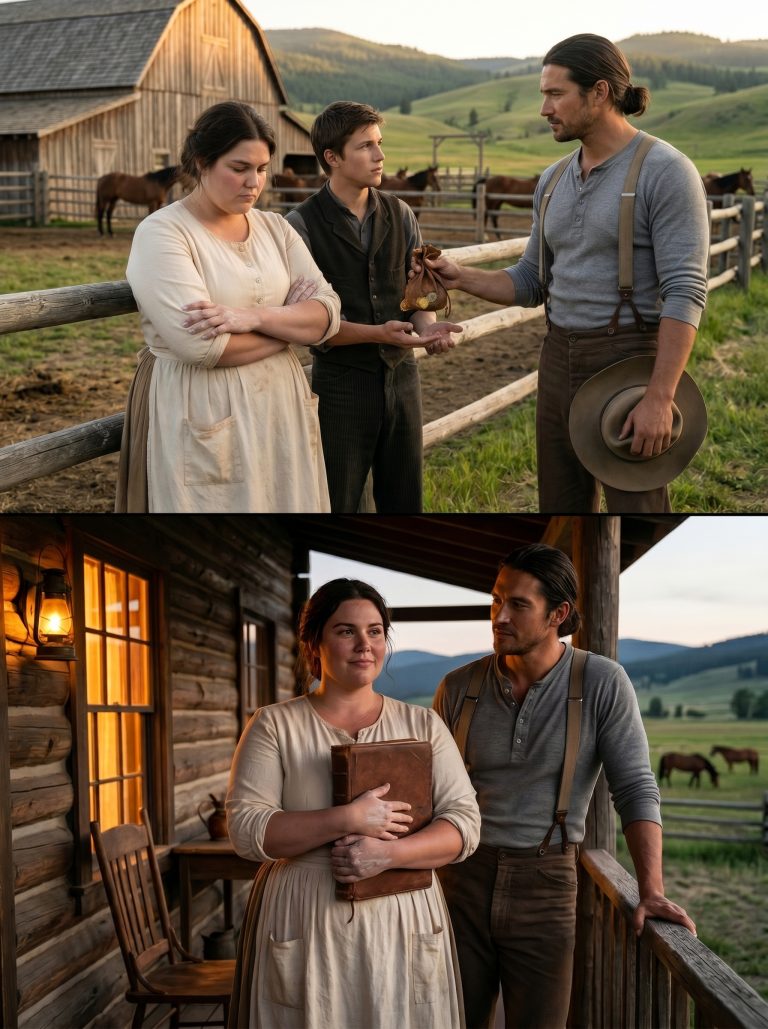
Two stories of timber and stone set in a wide clearing against a granite ridge, with a porch running the full length of the front and firewood stacked taller than a man along the south wall and — she realized this only after she was through the door, after the warmth had already reached her face — a fire already burning in the hearth. Lit before they arrived. Because someone had come to light it. Because Holt had thought, days ago when he left to go down to Harlow, to ask a neighbor to make sure there would be warmth waiting when he brought someone home.
Someone had made sure she wouldn’t walk into a cold house.
She stood in the middle of the front room and felt the heat and smelled the woodsmoke and looked at the fire, and the word that came to her was not relief or safety or any of the things she’d been bargaining toward for months.
The word was possible.
This felt possible.
The first weeks were quiet in the manner of two careful people learning to share a space — not hostile, not strained, but measured. Thoughtful. Like people who understood that whatever was being built here was fragile at the start and needed to be treated accordingly.
Holt rose before first light. By the time Nora came down to the kitchen he was already gone to the timber work, his coffee cup rinsed and set on the draining board — she noticed that detail on the second morning and found that it told her something, though she couldn’t have said exactly what. He returned at dusk, hung his coat on the same hook each evening, washed his hands at the basin with the same quiet efficiency, and sat down to supper without demanding anything from the meal except food and, occasionally, conversation.
He said please. He said thank you. He knocked before entering any room where she might be. These things were not nothing.
Nora ran the house with the competence she’d spent years building in her mother’s boardinghouse — the thousand small ongoing tasks that keep a structure livable. She cooked and mended and kept the fire and learned where things belonged and put them there. She was good at this. She had always been good at this. It was one of the things that hadn’t been ruined.
On the fourth evening, after supper, he told her about his wife.
Her name was Ruth. She had come from Ohio, followed her brother west, and stayed when the brother went back because she’d looked at the mountains and decided that was where she was meant to be. She’d loved music — had a small lap organ she’d hauled two hundred miles — and she’d had a laugh that could be heard from the woodpile. The organ was still in the back room. He mentioned it without offering to show her, and Nora understood without being told that it was not a thing to be moved or asked about.
“I’m not asking you to be her,” he said. He was looking at the fire, his forearms resting on his knees, his voice carrying the particular quiet of a man saying something he’d thought about how to say. “I want to be clear about that.”
“I know,” Nora said.
“I don’t think a person can be replaced.”
“No,” she said. “They can’t.”
He looked at her then — direct, unhurried — and she met his eyes. She was getting better at that. In the first days it had felt like standing in something with a current. Now it felt more like simply looking at a person, which was what it was.
“How are you feeling?” he asked. “The baby.”
“Heavy,” she said, and then surprised herself by almost smiling. “Tired. I think that’s normal, but I’ve never done this before so my sense of normal might be wrong.”
“There’s a woman at the settlement,” he said. “Mrs. Aldeen. She’s brought half the children in this territory into the world. I’ll take you to meet her when you’re ready.”
“All right.”
“Next week if the trail holds.”
“All right,” Nora said again.
Later, washing the supper dishes with her hands in warm water and the lamp throwing soft light across the kitchen, she turned the exchange over in her mind. Next week if the trail holds. A small, practical plan. The kind of sentence that contains a future inside it, that assumes one, that treats tomorrow as a thing worth arranging around.
She had not been able to make plans like that in a long time.
She stood at the basin and let the warmth soak into her hands and thought: this is what it feels like when someone assumes you’ll still be here next week. It was a small thing. It was not a small thing at all.
Mrs. Aldeen was compact and iron-haired and moved through the world with the unshakeable authority of a woman who had seen every possible version of a human being’s worst day and remained standing through all of them. She examined Nora with brisk, unsentimental efficiency, told her the baby was well-positioned and healthy, instructed her to eat more red meat and sleep on her left side, and then poured tea as if this concluded the medical portion of the visit and the social portion could now begin.
“You settling in all right up at the Holt place?” she asked.
“Yes,” Nora said.
Mrs. Aldeen looked at her steadily for a moment, in the manner of someone deciding how much plain speech the situation called for. “He’s a good man,” she said. “Took Ruth’s death hard — harder than he let anybody see, which is its own kind of hard. But he came through it right. There are men who go bitter after that kind of loss and men who go quiet, and he went quiet.” She wrapped both hands around her cup. “I say that not to push you toward anything. I say it because you have the look of a woman who’s learned to be careful about what men tell her, which is a reasonable thing to learn. I thought an outside opinion might be worth something.”
Nora felt the truth of that land without ceremony. “Thank you,” she said.
“Just the facts.” Mrs. Aldeen topped up their cups. “Come back in three weeks. And eat more meat.”
Trust, Nora discovered, did not arrive as a single event. It arrived the way spring arrived at altitude — not one warm day but a gradual accumulation of them, each one barely distinguishable from the last, until one morning you looked up and understood that something had fundamentally changed without your having witnessed the exact moment of change.
She began to notice small things. He never entered the kitchen while she was working without a word of announcement — not loudly, not performatively, just a step and a sound that said I’m here before he was. When she offered opinions — about the arrangement of the kitchen stores, about the loose board on the porch step, about anything — he listened and responded as if her words had arrived in a room that was built to receive them. He brought her a book from the settlement store one afternoon and left it on the kitchen table without comment. He brought back a jar of preserved pears the following week because she’d mentioned once, in passing, that she liked them — just the once, without emphasis, not thinking anyone was listening.
She was learning that he was always listening.
She was learning what it felt like to be listened to.
One evening in late November, the week before her due date, she found him on the porch after supper watching snow come down across the clearing. She pulled his canvas coat around her — she still wore it sometimes; it still smelled like the first night — and stood beside him without either of them feeling the need to explain why.
“Can I ask you something?” she said.
“Yes.”
“When you came to Harlow.” She watched the snow fall through the dark. “You knew what kind of arrangement it was. You knew what my mother was.”
“Yes.”
“Did you know before you went?”
A pause. Considered. “I’d heard enough.”
“And you went anyway.”
“I went because of how she’d described you in her letter.” His voice was even, but she could hear something underneath it — something that had been held quietly for a while and was being let out carefully. “Everything she wrote was about what you weren’t. What you’d failed at. What you’d cost her.” He was quiet for a moment. “That told me more about her than it told me about you. It told me that whatever you actually were, she’d spent a long time making sure you didn’t know it.”
The snow came down between them and the treeline — soft, unhurried, indifferent to everything beneath it.
“My mother counted the money twice,” Nora said. “I watched her do it. Not once to check. Twice, to make sure she hadn’t left anything on the table.”
Holt said nothing. His jaw tightened slightly — she knew that small movement now, had learned to read the weather in his face — and she understood that something in him had responded to this and was being held in check because he’d decided holding it in check was the useful thing to do.
“She turned out the lamp before we reached the end of the road,” Nora continued. “I looked back. The house was already dark.”
“Nora.” His voice was quiet. Not pitying. Something more careful than pity. “You deserved better than that.”
“I know,” she said. “I’m learning to know it.”
The snow settled on the porch railing and on the woodpile and on the granite ridge above the house, making everything white and clean and new-looking.
“I want to stay,” Nora said. “I want you to know that it’s not because I have nowhere else. I want to be clear about that.”
He exhaled — slow, deliberate. The air between them shifted in a way she felt more than heard.
“I know,” he said. “I know that’s not why.”
“It’s because you handed me a coat before we’d left my mother’s fence post. Before you knew a single thing about me. Before I’d given you any reason at all.” She looked at him. “That was the first thing you did. And I’ve been thinking about it ever since.”
He didn’t say anything. But she saw, in the low light of the snow-reflected dark, the corner of his mouth move — not much, just enough — and she understood that some things did not need to be said to be fully heard.
Her daughter arrived on a Wednesday in December during a storm that shut the trail and kept the horses in and turned the world outside the windows into a moving wall of white.
Mrs. Aldeen was there. She had come two days early on instinct, she said, the way she always came early in December — the mountains had a way of making their own schedule, and a woman who’d been at this for thirty years learned to move before she was called.
Holt stayed in the front room.
Nora could hear him through the wall — his boots on the floorboard, back and forth, the particular rhythm of a man whose stillness had run out. She found that sound, in the hours when everything hurt and nothing was certain, more steadying than she’d expected. He was there. He was pacing because he was afraid for them. Fear, she had learned, could be a form of love in the bodies of people who didn’t know how else to show it yet.
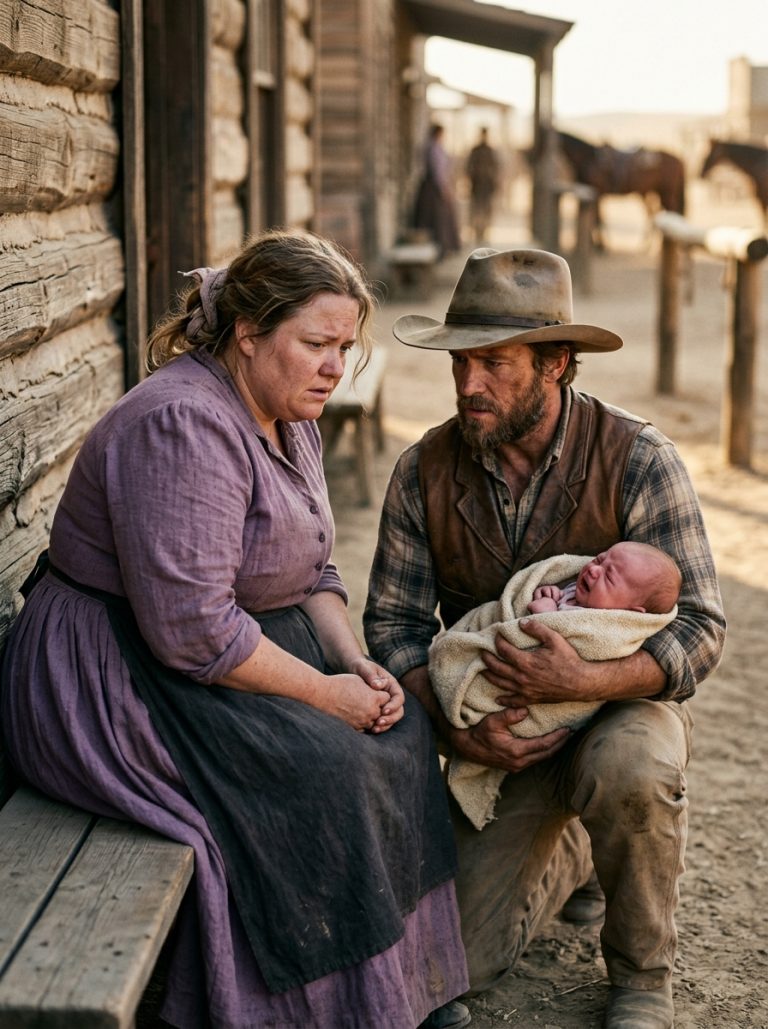
When it was done — when the baby’s voice first filled the room with that shocking, furious announcement of existence — Nora heard him go completely still on the other side of the wall.
Then she heard him say, in a voice she had never heard from him before — low and raw and unmade, stripped entirely of the containment he wore like a second coat: Thank God.
She held her daughter. Small and red-faced and outraged by the cold and the light and the enormous indignity of being new, just as every person is new and outraged and perfect.
Nora looked at her and thought of all the roads that had led here — the note burned in July, the two-week countdown, the coins counted twice, the lamp extinguished, the starless road, the coat handed down in the dark. Every terrible thing that had been meant to end her had instead delivered her to this room, this fire, this child, this life.
Holt appeared in the doorway. He stood there the way he’d stood at the door of this house the very first night — uncertain of his welcome, unwilling to assume.
“Come in,” Nora said.
He came to the bedside. He looked at the baby with the expression of a man who has spent a long time being careful and has just encountered something that refuses to be held at careful distance.
“She’s all right?” he asked.
“She’s perfect,” Nora said. “She’s absolutely furious, and she’s perfect.”
The corner of his mouth moved. Then — slowly, completely — his whole face opened into a smile she had not seen before, the kind that lives below all the layers a person builds up and only surfaces when they’ve been caught entirely off guard by something good.
It changed his face entirely. She filed it away.
“What will you name her?” he asked.
Nora had been thinking about this for weeks. “Ruth,” she said. “If you’d allow it.”
He went still.
“Not to replace anyone,” she said carefully. “Not to—I only thought that your Ruth sounds like a woman who would have recognized this particular baby. What she came through to get here. I think she would have known her.”
Holt looked at his daughter — she saw him do it, saw the word form in his mind before he’d decided whether to say it — and his throat moved.
“Yes,” he said. His voice carried the particular roughness of a man who is feeling something large and has not yet found all the room for it. “Yes, I think she would have.”
They married in April, when the snowmelt had turned the clearing into something green and astonishing and the first birds were returning to the ridge.
It was a small ceremony. Mrs. Aldeen stood witness. Three men from the timber crew who had known Holt for years and had, Nora gathered, been quietly relieved on his behalf for months. The circuit pastor who came through every spring and performed his rites with the efficient warmth of a man who understood that love in frontier country didn’t require ornamentation.
Nora stood in the clearing in a dress she’d made herself from fabric she’d chosen — blue, the color of the sky on the first morning she’d woken in this house and looked out the window and thought I’m still here with something that felt like wonder. She held Ruth in the crook of her left arm, and Ruth observed the proceedings with the serious, evaluating expression of a four-month-old who was reserving judgment.
Nora said her vows looking at the man beside her — this quiet, careful, pine-scented man who had come down a mountain to buy a woman from her own mother and had spent every day since proving that what he’d actually come for was something her mother didn’t have the language to sell.
She had arrived at this house with a wool shawl, a book, a small tin, and a coat that wasn’t hers.
She had built everything else from what was already in her.
Iris wrote once, in August.
The letter arrived in the settlement mail, Nora’s name in her mother’s small, precise hand. Nora left it on the kitchen table for a full day before opening it. She read it in the morning, sitting by the window with Ruth in her lap and sunlight coming through the clean glass and the ridge green and bright above the tree line.
Iris hoped she was well. Had heard through a passing traveler that the baby had come safely. Was glad things had worked out.
I did what I thought was necessary, she wrote near the end, in the tone of a woman who has been rehearsing a line until it stopped sounding like a question. I hope someday you’ll understand that.
Nora sat with the letter for a long time.
She thought about what it meant to be sold and what it meant to be chosen and the vast, uncrossable distance between those two experiences. She thought about a woman counting coins twice — not to check, but to confirm — and what that double-count revealed about what the coins represented to her, and what Nora had represented to her, and whether those two things had ever been very different in Iris’s accounting.
She thought about a lamp extinguished before her daughter had reached the road.
Then she folded the letter. Set it down. Picked up her daughter and held her in the good morning light and felt the solid, particular, irreplaceable weight of a person who was entirely hers.
She didn’t write back.
Not from cruelty. The anger had burned down months ago to something quieter — something more like grief for a woman who had never learned to tell the difference between protecting yourself and spending the people who loved you, and who would probably never know what she’d lost in that kitchen on the night of the coins.
There was nothing in the letter that required an answer.
And Nora had learned — was still learning, would probably spend the rest of her life learning — that she was allowed to put down the things that had always needed her to carry them. That some doors, once closed, did not require reopening. That you could love the memory of what a mother should have been without owing anything to the woman who hadn’t been it.
That evening Holt came in from the timber, hung his coat on its hook, washed his hands at the basin, and sat down at the table. Nora put supper on. Ruth sat propped in her basket near the hearth, conducting a serious conversation with the ceiling that neither of her parents could fully follow.
They ate. They talked — small, ordinary, theirs. The trail conditions. The neighbor’s new calf. Whether the back porch board needed replacing before winter.
The fire held. Outside the window the ridge went gold in the last of the evening light, the way it did at the end of days that had been, without requiring anything remarkable of themselves, quietly good.
Nora looked at the ridge and then at the man across the table and then at her daughter holding court with the ceiling, and she thought: This is mine.
Not given. Not sold. Not assigned by someone else’s calculation of what she was worth or what she could be exchanged for.
Built. Chosen. Hers.
She had come through a door she hadn’t known was a door and arrived somewhere she hadn’t known to want, and every hard and terrible thing that had pushed her through it had served, in the end, only to get her here.
Outside, the last light faded from the ridge.
The fire crackled. The baby reached for something invisible and almost caught it.
And Nora Vale — who had stood in a dark kitchen and memorized a wound and walked through a door into a starless night with nothing but a borrowed coat and the fierce, unextinguished certainty that she was more than what she’d been sold for — sat in the warm light of a house that was hers, and was, for the first time in longer than she could measure, exactly where she was meant to be.