SHE WAS SOLD AS WORTHLESS—THEN A WIDOWER WITH EIGHT ORPHANS TURNED HER WORST DAY INTO A FAMILY NO ONE EXPECTED

PART 1
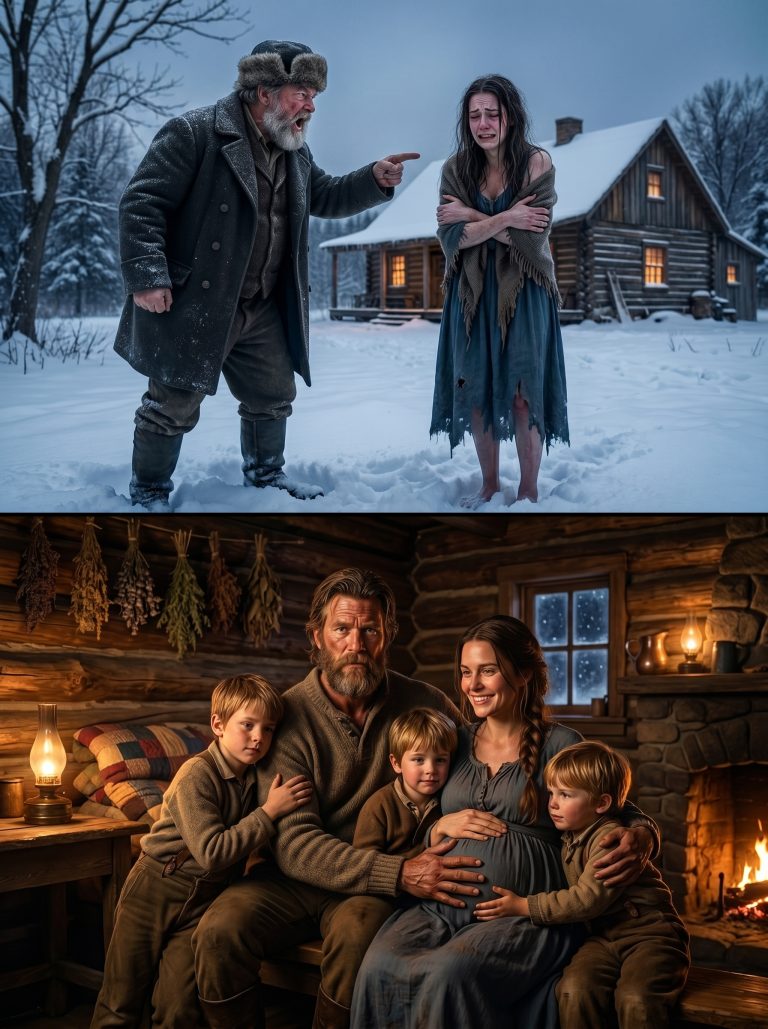
The auctioneer’s hammer slammed down, echoing across the square like a verdict. My name was called next. I stood on the crude wooden platform, the crowd’s eyes sharp and judging, weighing me as if I were nothing more than livestock. My father’s shadow loomed behind me, rigid with disdain, while murmurs rippled through the townspeople. Worthless… barren… useless… the words didn’t need voices. I could feel them piercing my chest, and a strange, hot shame rose in my throat.
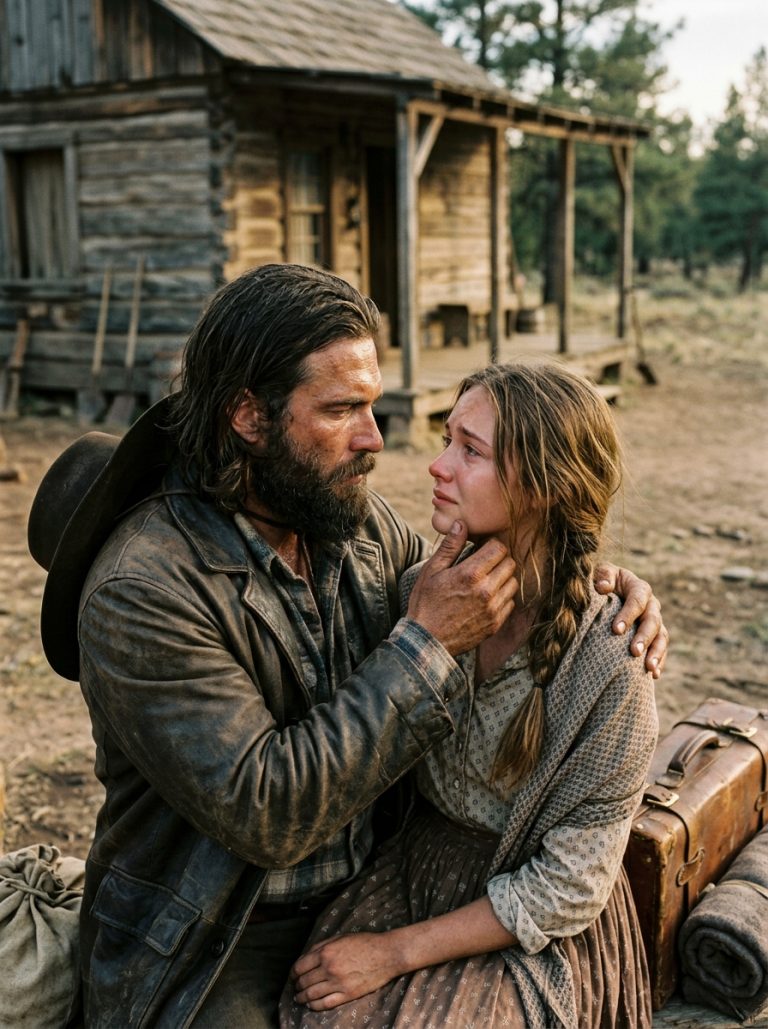
I had worn the same dress for months, faded and patched, and my hands trembled, gripping the rails. Then, from the corner of my eye, I saw him—tall, lean, with eyes the color of storm clouds and a calmness that unnerved me. He didn’t flinch at the crowd, didn’t waver when I was named and sold. He only stepped forward and laid coins on the table.
“Wait,” I whispered, though no one seemed to hear. “Why you?”
He didn’t answer immediately. Instead, he studied the horizon as if the prairie itself held the answer. Finally, in a voice quiet but resolute, he said, “I bought a chance.”
A chance. The words made no sense. But then he began to speak of the children—eight motherless souls whose grief still clung to the walls of his home, their lives stitched together by stubborn love and half-hope. “Little ones need gentleness. The older ones need truth,” he said. “I needed help, yes, but I didn’t want to bring cruelty home.”
A bitter laugh escaped me before I could stop it. “So, you bought yourself a soft-hearted stranger,” I said.
“No,” he replied. “I paid to end a public wrong.”
Silence settled over me.
By the time we turned toward his ranch, the sun had dipped low, painting the land in copper and gold. The house came into view: crooked chimneys, wind-bent fences, and a barn that smelled of hay and hard work. Chickens scattered, their clucks shrill in the evening air. My heart pounded as we approached the door.
When he opened it, eight children filled the frame. Their eyes—cautious, guarded—followed my every move. The oldest boy, tall and solemn, stood at the front like a sentinel. A girl clutched a smaller child’s hand, and behind them, more eyes watched. No one smiled. Not one.
“This is Eleanor,” he said, matter-of-factly. “She’ll be staying with us.”
The word “staying” felt strange. Not belonging, not serving—but not leaving either.
The boy’s gaze cut through me. “For how long?”
“Long enough,” he answered.
That night, lying in the narrow upstairs bed while the house groaned and the prairie wind tugged at the boards, I listened to their breathing. The terror from the auction square still lingered, but it was tempered by something unfamiliar: the first glimmer of hope. Hope, sharp and terrifying when you’ve lost everything once.
Morning arrived with chaos. Biscuits burned, coffee spilled, and eight grieving children observed every failure with the meticulous judgment of saints. Judah, sixteen, wore grief in his jaw. Rebecca, fourteen, hid a scrap of her mother’s dress in her pocket. Marcus, twelve, spoke fast when nervous. Levi, ten, pretended fearlessness. Mary, nine, watched silently. Timothy, eight, was energy and bruises. Nathan, seven, loyal to shadows. Samuel, five, eyed me as if deciding whether I was storm or person.
Before noon, I had learned them all, not through words, but through the wild, unguarded language of children. Rebecca took over the skillet, correcting my every misstep with clipped authority. Judah leaned against the wall, arms crossed, evaluating me. “Pa could’ve hired help,” he said.
“Could have,” he said.
“But he didn’t.”
The tension was a living thing. I waited for an explanation, a defense. Bo—he was called Bo—only said, “Eat before the eggs get cold.”
The next days were a parade of small humiliations. Bread refused to rise. Shirts mended crookedly. Wooden horses lost their paint. By the third day, I convinced myself he would regret every coin.
Then came the fourth evening. A cast-iron pot slipped from my hands, crashing to the floor. Stew splashed the planks, my dress, Rebecca’s shoes. Samuel screamed. Marcus recoiled. Silence swallowed the room.
I braced for fury.
Instead, Bo entered, crouched, and began cleaning. “It was just stew,” he said. And left.
I pressed my wrist to my lips, absurdly close to tears over lentils and beef.
Later, a whimper drew me upstairs. Mary burned with fever. By the time I reached her, Bo was at the doorway, calm but attentive. “She was coughing at supper,” he said. “Willow bark, mint, cool water, clean cloths.”
We worked through the night. I whispered old songs, coaxed water, held her hand. Trust grew in the silence, strange and intimate. By dawn, the fever broke. She slept.
Hours later, a mug of tea waited, alongside a simple note: Thank you.
It had been years since a man thanked me for anything.
And yet, the house remained quiet. The children still uncertain. The prairie wide and indifferent. Somewhere, the wind carried a sense that everything had changed, though nothing yet was certain.
Because nothing in that world prepares you for the moment a family begins not with birth, not with law, not with expectation—but with a chance, a coin, and a stranger who chooses to stay.
But that was only the beginning.
By mid-morning, the oldest boy, Judah, appeared at the top of the stairs, his expression unreadable. “Mama,” he said, voice low, “there’s someone outside… asking questions about you.
PART 2
The footsteps outside had been too deliberate to ignore. Judah’s warning still echoed in my ears as I descended the stairs. Through the window, I saw them—three figures, stiff-backed, moving with purpose. My father, flanked by Silas Mercer and a woman I recognized from town, all faces set with the smug confidence of people who think they can measure worth in coins and contracts.
Bo stepped into the room behind me, silent but unwavering. His hand brushed the counter, fingers steady, as if daring anyone to challenge him here. I felt the old panic rise, the same as when I’d stood on the auction block, but it collided with something unfamiliar: the quiet certainty that I would not be alone this time.
The visitors called my name. I remained by the window, feeling the children behind me—eyes wide, holding one another, trusting me to act. I drew in a breath, trying to shape courage out of trembling bones.
“Sarah,” my father began, voice measured, almost casual. “We need to discuss—”
“Don’t,” Bo interrupted, his voice low, sharp, carrying authority that silenced the room. “You’ll speak when we say it’s safe. Not a moment sooner.”
The square outside must have noticed the tension. A few townspeople paused on the street, curious, whispering. The audacity of the gathering made my stomach twist.
My father’s eyes darted to the children, then to Bo. “You bought her? Without our approval?” he hissed.
“Not for approval,” Bo said. “For decency.”
A jolt of anger rippled across my father’s face. “Decency? You think that cancels a legal arrangement?”
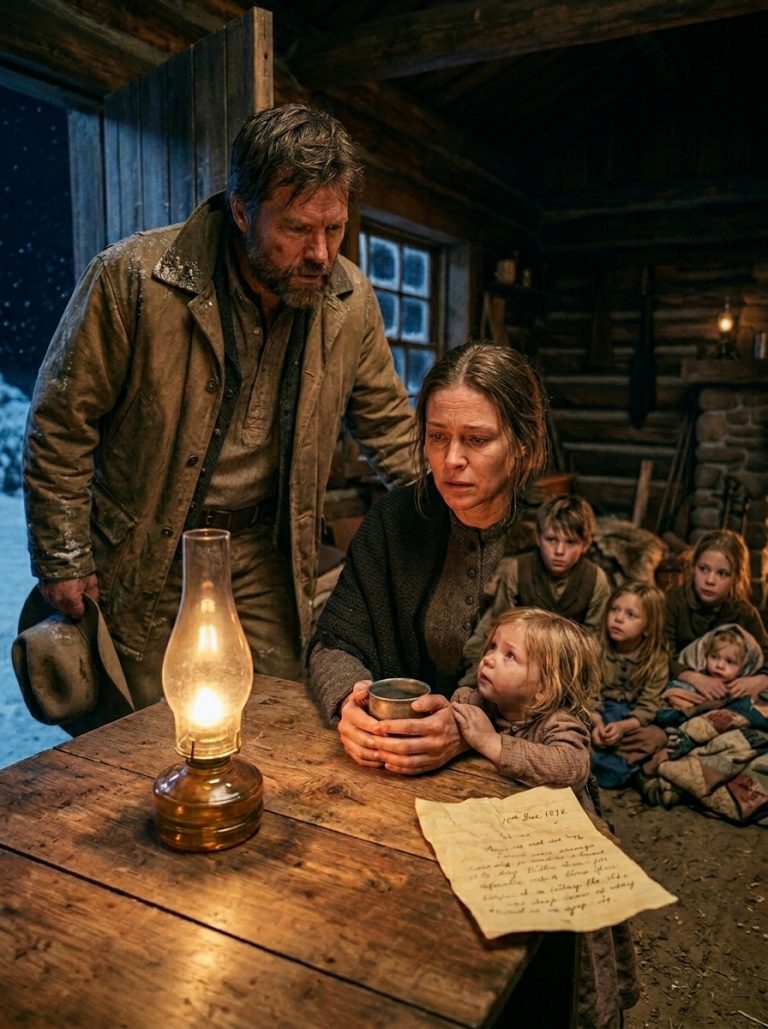
Silas stepped forward, brandishing a folded document. “This woman has a certificate—proving she is barren. Legally unfit for your household’s needs.”
The words cut through me like cold steel. I could feel the children stiffen behind me. Rebecca clutched Mary’s hand. Marcus froze mid-step. The document felt like a knife, but Bo’s eyes were steady.
“Burn it,” he said.
A silence so dense it pressed against my chest filled the space. My father’s jaw clenched. Silas faltered, the paper trembling in his hand. My heart pounded, the children’s collective breath waiting for me to falter.
Then a voice broke through—unexpected, trembling, yet resolute. “It’s not true.”
Every head snapped toward the speaker. The doctor, sweating and pale, stepped forward. “The certificate… it was never valid. There was no proof. Mrs. Mercer paid for certainty, not truth.”
The square outside erupted in murmurs. Shock, disbelief, and whispers filled the air. My father’s face drained of color. Silas’s hand shook. The woman behind him went rigid, mouth open in horror.
Bo didn’t move. He only looked at me. My breath caught. I realized then the children were no longer afraid—not of me, not of the world. They had watched me survive, and they had learned that I would fight for them.
But the moment of relief was shattered when a new figure appeared at the edge of the square—a stranger, tall, wrapped in a cloak, their face obscured by shadows. They moved with an unsettling precision, and the crowd seemed to part instinctively. My pulse accelerated.
“Who is that?” I whispered to Bo.
He didn’t answer immediately. His eyes narrowed. “I don’t know. But they’re coming for you. And for this house.”
The wind picked up, tossing loose papers into the air. The children clung together, fear flashing across their faces. My stomach sank. Everything we had built, fragile and hard-won, was about to be tested in ways I could not yet imagine.
And then, the stranger lifted their head, revealing eyes that chilled the marrow of my bones. Recognition, and a threat, wrapped in one glance.
I wanted to run. But the children needed me. Bo stood beside me, silent, ready.
The square seemed to hold its breath.
And in that moment, I understood: the fight for this family was far from over.
The shadowed figure stepped forward, a smirk curving beneath their hood. “I’ve been waiting for you,” they said, voice cold enough to cut through the tension like a knife.
PART 3
The shadowed figure’s voice sliced through the square. “I’ve been waiting for you.”
I stiffened, instinctively stepping in front of the children. Bo’s hand found mine, firm and grounding. The figure removed their hood slowly, revealing a face I knew too well—someone from my past whose grudge had never faded. Their eyes held the weight of every cruel word I had endured, every auctioned moment that had stripped my dignity.
“You,” I whispered, disbelief choking the syllable.
“Yes,” they said, lips curling in a cold smile. “All these months, and you’ve built a little kingdom. Let’s see how strong it really is.”
Bo’s stance tightened, protective and unyielding. The children huddled closer, but not behind me—they were no longer shadows of fear. They were part of the house, part of this fragile fortress of love.
I took a breath, letting memories of despair sharpen my resolve. “This house, these children—they are not yours to threaten.”
The figure laughed, cruel and hollow. “Oh, but they are, in the eyes of law and custom. They are yours only because no one has questioned it—yet.”
Then, from the crowd, a voice rang out. Doctor Caldwell stepped forward, unwavering. “The certificate of barrenness was fabricated. There is no legal basis to question her, her presence, or the children. Your claims are null.”
The shadowed figure faltered, confusion flashing across features hardened by malice. Mrs. Mercer and my father paled. Even Silas Mercer’s composure cracked.
Bo straightened, releasing my hand only to fold his arms. “You will leave. Now.”
The figure glared one last time, then disappeared into the murmuring crowd, their power undone not by force, but by truth and the quiet courage of the house they underestimated.
A collective exhale swept through the square. The children, still holding hands, slowly relaxed. Judah, the oldest, stepped forward and stood beside me, pride and relief mingling in his expression.
“Everything’s okay?” he asked softly.
I knelt to their level, brushing a strand of hair from Rebecca’s face. “Yes. Everything’s okay. Because here, we are safe. Together.”
The rest of the day passed in a haze of triumph, laughter, and cautious joy. Bo guided the wagon back to the ranch, the children riding in the bed with the wind tugging at their hair, faces flushed with excitement and relief. I walked beside him, hands brushing, hearts aligned without words.
Weeks passed. Seasons shifted. Spring rains returned to the dry fields, and the garden we tended together flourished under our care. Samuel discovered the thrill of tracking chickens; Mary’s giggles returned; Judah’s steady presence softened into warmth rather than suspicion. Marcus and Levi found comfort in shared chores and whispered secrets, Timothy in the sweetness of newfound attention, Nathan in small victories of courage, and Rebecca in the pride of teaching the younger ones.
Bo fell ill briefly one summer, fever burning through him like wildfire. Yet, when I tended to him as he had to me, the house pulsed with a rhythm of care that needed no words. Trust had taken root deeper than fear had ever touched.
One afternoon, nearly twenty years later, a woman arrived at our gate with a little girl no older than six. She had run from loss, just as I had once stood on that auction platform, and yet, here was a home that chose to welcome, not to bind.
“They get welcomed,” I said, holding out my hand. And the child’s eyes, wide with tentative hope, found reassurance in the same way my own children once had.
Life did not become perfect. Crops failed, winters were harsh, and not every day carried laughter. Yet the house thrummed with belonging. Children grew, marriages formed, grandchildren filled the rooms, and the echoes of old cruelty faded into insignificance.
I never bore a child from my own body. Some losses linger, yes, like shadows at dusk. But the house was full. Love, chosen and nurtured, had filled the spaces where bitterness once lived.
I stepped onto the porch one evening, Bo at my side. The wind carried the sound of children playing, of dishes clinking, of life asserting itself against past shadows. He reached for my hand—not in claim, but in partnership—and I took it.
It was not rescue. It was not obligation. It was the quiet, radical act of choosing each other, of building a family in defiance of cruelty and expectation.
And for the first time, I understood that the finest revenge of all is a life overflowing with care, laughter, and the undeniable truth that your worth is never dictated by the world, but by the courage to stand, and stay, and love.