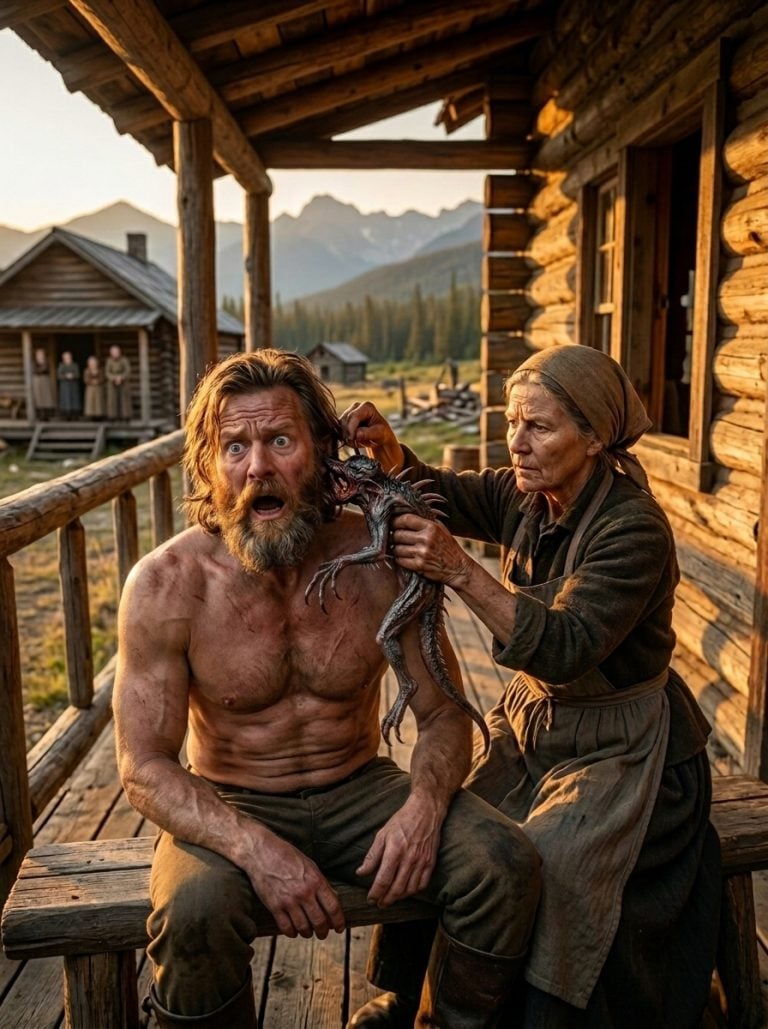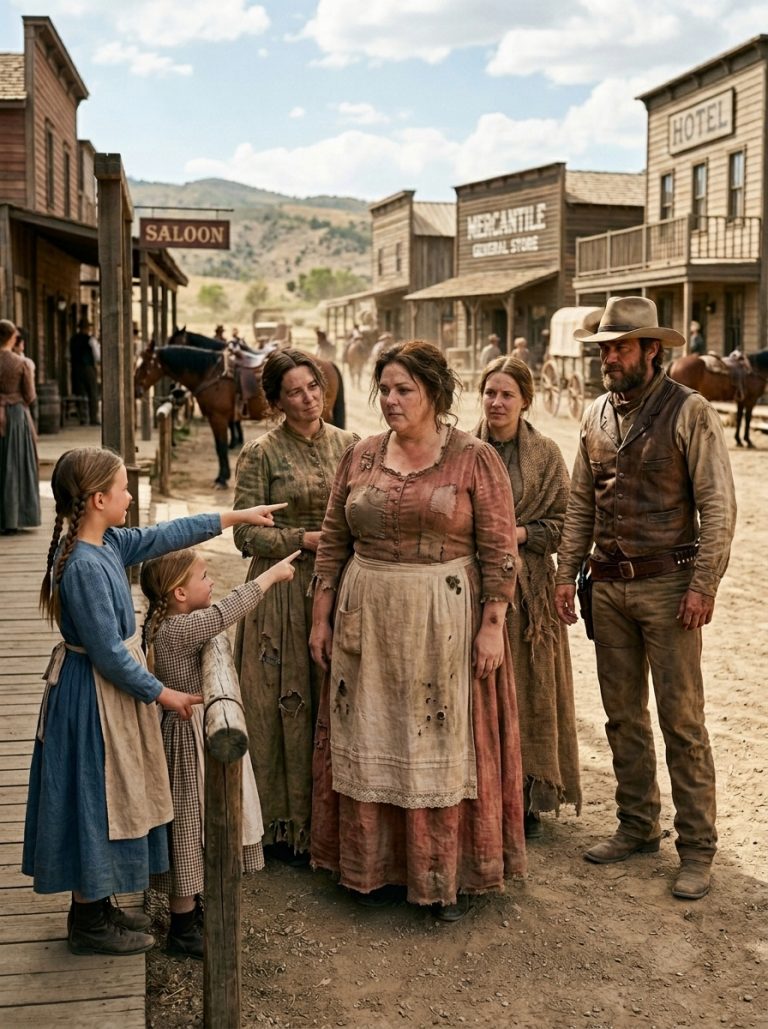
Her Family Called Her Barren And Left Her In The Snow — The Mountain Giant Who Found Her Said “By Spring You’ll Give Me 3 Sons” And He Was Right

The word her father used most often was burden.
Not aloud — he was too careful for that, too practiced in the particular cruelty of men who understood that what was never said could never be held against them. He used it in the way he divided portions at supper, in the extra beat of silence before answering her questions, in the precise manner he turned his head when she entered a room, as if registering an inconvenience he had long since stopped being surprised by. Hannah Voss had grown up fluent in that language. She could read the grammar of dismissal in a man’s posture before he opened his mouth. She had been reading it since she was nine years old and a doctor in Cedar Falls had told her father something in a low voice while she waited in the hallway outside, and her father had come out of that office with his face arranged in the particular way of a man who has just received confirmation of something he already believed.
She had never been told directly what the doctor said.
She had been told everything else. In portions. Over years. Through the accumulated weight of a family’s expectations contracting around her like a house slowly losing its air.
By the time her brother drove the wagon into the San Juan foothills on the coldest January on record and told her to get out, she had been carrying the word barren for eleven years.
She got out.
She didn’t beg. She had learned, at considerable cost, that begging only confirmed in certain men’s minds that they had been right about you all along.
She walked into the snow.
What she didn’t know — couldn’t have known, walking into that white silence with nothing but the clothes on her back and the particular calm of a person who has finally stopped being surprised by the worst — was that a mile up the ridge, in a cabin built by one pair of hands over one stubborn winter, a man had been dreaming the same dream for three nights running.
And that the dream had her in it.
PART 1
His name was Caleb Mast, and the valley called him various things depending on what they needed from the telling.
The Giant of Black Ridge. The hermit. The man who’d been involved in the death of Frank Dillard six years back and had moved up the mountain afterward, which either meant he was guilty of something terrible or had simply grown tired of defending himself against people who’d already decided, and the valley had never quite resolved which interpretation it preferred.
He was thirty-four. Six foot five and built in the manner of men for whom the outdoors had been less an environment than a ongoing negotiation — every inch of him shaped by altitude and labor and the specific discipline of a life where softness had nowhere to lean. Dark hair with the first threads of gray at the temples. A beard kept neat because he had his standards, even alone. Hands that could split a log or stitch a wound with equal precision, because the mountain had required both.
He had come up here after Frank Dillard. After the inquest. After the months of being looked at in Millhaven with the particular expression townspeople reserved for men who had become inconvenient to their existing story about themselves. He had built the cabin with no help and no company and had found, to his cautious relief, that solitude did not destroy him. It only changed him — into something quieter, slower, more attentive. He listened to weather the way other men listened to conversation. He read Scripture by lamplight not out of performance but out of the genuine need for something larger than his own interior to push against.
He had been, in the three weeks before Hannah Voss walked out of the trees at the edge of his clearing, troubled by dreams.
The same valley each time. Same spring light. Same creek sound. Three boys running the lower meadow with the unself-conscious joy of children who had never had cause to run from anything. He could never see their faces clearly. Only knew, with the dream-certainty that requires no evidence, that they were his. That they were meant to be his. That something was coming toward him that he needed to be ready for.
He had mentioned this to no one because there was no one to mention it to, and because a man who talked about prophetic dreams to himself had gone a certain direction that Caleb had no interest in going.
On the morning of January fourteenth he had gone down to split wood by the creek, and he had found her.
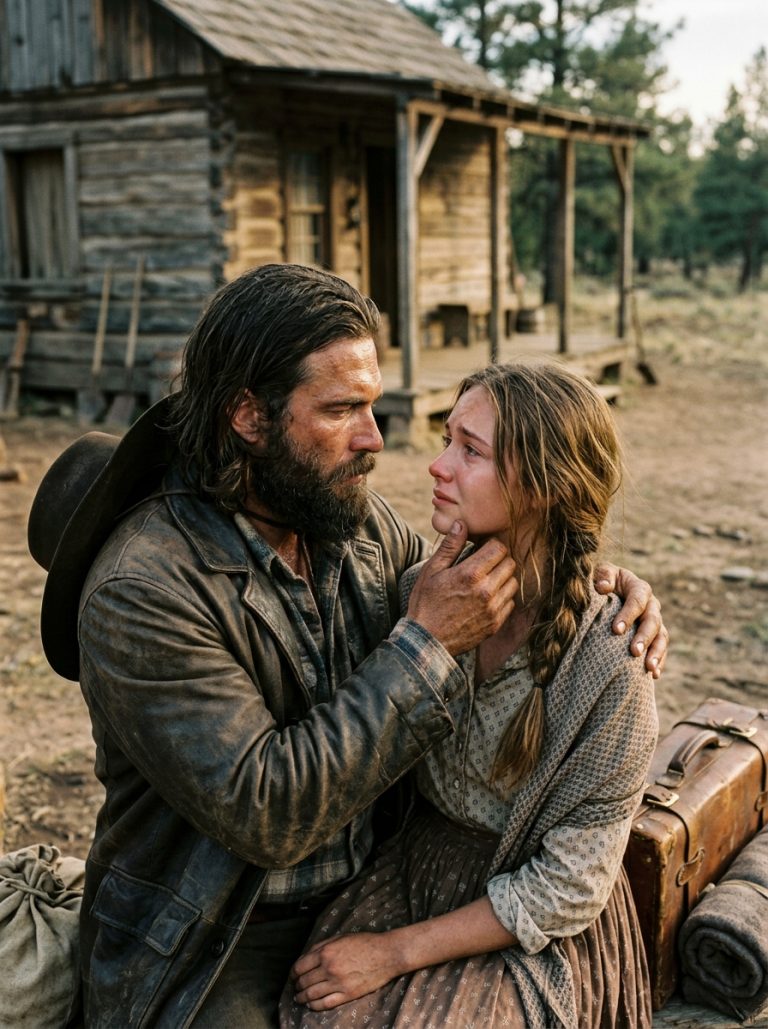
She was in the snow at the base of the ridge trail. Not lying down — she had not fallen. She had sat down deliberately, with the posture of a woman who had made a decision about how much further she was going to walk, and that posture alone had told him something about the quality of what had happened to her before she arrived here.
He had heard stories about big men frightening women simply by existing near them. He had always tried to be careful about this — about the way his shadow moved, about the space between himself and anyone smaller. So he stopped a full ten feet away and said her name — not her actual name, which he didn’t know yet, but ma’am in the way of a man announcing his presence rather than his authority.
She had looked up.
Her face was wind-burned and pale beneath that, and there was frost in her dark hair and her hands were bare and purple with cold, and her eyes — when they found his face — had done the thing that eyes did when a person had been bracing for the worst and then encountered something that didn’t immediately confirm it. They went uncertain. Watchful. Not yet relieved.
“You need to come up,” he said. “Out of this cold.”
“I don’t know you,” she said. Her voice was steady. That steadiness told him something too.
“No,” he agreed. “My name’s Caleb Mast. I have a cabin up the ridge. If you’d rather freeze here with the certainty of knowing I’m a stranger, I’ll go back up and leave you to it.”
A pause.
“That’s a very direct way of putting it,” she said.
“I find direct is faster,” he said. “And you’re losing feeling in your hands.”
She had looked at her hands as if she’d forgotten about them. Then she had looked at him again with the particular assessment of a woman deciding not whether to trust a man but whether the risk of trusting him was smaller than the risk of not.
She stood. “All right.”
He had reached out without thinking to steady her — she was unsteady, the cold having done what cold did — and she had flinched hard before his hand reached her arm. He stopped. Let her find her own balance.
“Sorry,” she said.
“Don’t be,” he said.
They had walked up the ridge in silence, and he had matched her pace rather than his own, and when she slipped once on an icy patch he offered his arm without closing his hand around hers, so that she could take it or not as she chose. She took it.
In the cabin, he had put water on and given her a blanket and set a stool near the fire and stood at the far side of the room while she thawed, which was as much distance as the cabin allowed.
Her name was Hannah Voss. She was twenty-six. Her brother had driven her into the foothills and told her to get out, and she had — these were her exact words — declined to make a scene about it.
The evenness with which she said this was the saddest thing he had heard in six years of mountain solitude, and that was a high bar.
He had given her the back room with the latch that worked from inside, and the hot bricks under the blankets, and said he’d be by the fire if she needed anything.
What he did not say — what he had no business saying to a woman he’d found in the snow four hours ago — was that he had dreamed this. Not her face specifically. But the shape of this. Someone arriving. Someone needing room. The cabin becoming something other than the place where one man was surviving alone.
He went to the fire and he sat with that and he prayed, low and unpolished, the way a man prayed when he didn’t have elegant language for what he was trying to say.
Whatever You sent her here for — let me not fail it.
In the morning she was still there.
She was up before him, which surprised him, standing at the window with her hands around a cup she’d found and filled herself, watching snow fall through thin winter light. She had the bearing of a woman who had learned to occupy space carefully, to take up only what was offered and no more. He recognized that posture. He had seen it in his sister once, before his sister learned she didn’t have to apologize for existing.
He set oats on the stove without asking.
“I’ll need to repay you,” she said, without turning.
“You’ll need to eat first,” he said.
She turned then and looked at him — really looked, the way she hadn’t had quite the capacity to the night before when she was still half frozen. He met her eyes and didn’t look away, because looking away from a woman’s direct gaze was something men did when they were afraid of what she might see in them, and Caleb had decided long ago that he was done hiding.
“Hannah Voss,” she said.
“I know,” he said. “You told me yesterday.”
“I wanted to make sure you still knew it in daylight.” A beat. “Some men remember less of what a woman says when she’s not useful to them immediately.”
“I remember everything,” he said. “It’s a curse more than a gift.”
She almost smiled. “Caleb Mast.”
“Yes.”
“They say things about you in the valley.”
“What things?”
“That you’re dangerous. That Frank Dillard is dead because of you.”
He set the spoon down. “Frank Dillard is dead because he fell off an embankment above Mineral Creek after I hit him for going after my younger sister. He fell. I climbed out.” He looked at her steadily. “I don’t know if I would have done worse if I’d had the chance. I’ve thought about it. I’m still not certain. What I know is the mountain finished it.”
Hannah looked at him for a long moment.
“Your sister,” she said. “Is she—”
“She married two years later. Died in childbed. The baby with her.” He said it flat because there was no other way to carry it that didn’t make the weight heavier. “After that I came up here.”
Hannah was quiet.
“I’m sorry,” she said. And it sounded, unlike many sorries he had received, as if she meant exactly that and nothing more complicated.
He nodded once.
He set the bowl of oats before her and sat across the table, and they ate in a silence that had stopped being uncomfortable and become something else — the silence of two people who had both been carrying large things alone for a long time and were resting, just briefly, in the presence of someone who wasn’t requiring an explanation.
The storm sealed them in by noon.
By afternoon, Caleb had done something he would later struggle to account for rationally.
He had told her about the dreams.
Not all at once. Not with flourish. He had been at the table mending a harness when she stopped in front of the mantelpiece and looked at the three small carved horses sitting there, and asked who he’d made them for.
He had rubbed his jaw. He had felt genuinely foolish. And then he had told her.
“Three boys,” he said. “Running the lower meadow. Same dream three nights. I carved those the morning before I found you.” He met her eyes. “I know how that sounds.”
Hannah had looked at the horses for a long time.
“It sounds like either lunacy or something I don’t have a word for yet,” she said.
“That’s about where I’ve landed too.”
“You said by spring I’d give you three sons when you found me.”
“I did.”
“That was an extraordinary thing to say to a woman you’d just pulled out of the snow.”
“I know.” He looked at his hands. “I have very little practice talking to women. I said the thing that was in me without the usual — softening.”
Hannah looked at him with an expression he couldn’t quite read. “My family told me I couldn’t have children,” she said. “They had it from a doctor, years ago, after a fever. They’ve been telling me ever since.” She said it plainly, as if the plainness were a form of armor. “If what you wanted was sons of your own blood, you found the wrong woman.”
The room was quiet except for the fire.
“What I found,” Caleb said carefully, “was you half frozen at the base of my ridge trail. I don’t know yet what that means. I know it doesn’t mean nothing.”
Hannah looked at the three small horses on the mantel for a long time.
Then the storm shuttered the windows completely, and the mountain sealed them in, and neither of them said anything else about dreams or sons or what the future might hold.
But that night Hannah lay in the back room listening to Caleb move quietly in the main cabin — feeding the fire, setting things right for morning — and she thought about three carved horses made by a man who lived alone and had no particular reason to make them except that something in him insisted.
She didn’t understand it.
She also couldn’t dismiss it.
And when sleep finally came, it came without the bracing that had accompanied it for as long as she could remember — that constant low-level readiness for the next thing to be taken away.
For the first time in years, she simply slept.
PART 2
The first week passed in the particular rhythm of two careful people learning to share a space that had been built for one.
Caleb lived plainly but not carelessly — his tools were maintained, his accounts kept in a small ledger by the stove, his boots mended properly rather than endured until they failed. What the cabin lacked was softness, the kind of softness that required a second person to notice it was missing. Dust in corners. A stool with a broken rung propped against the wall because one man’s hands couldn’t hold it steady and fix it simultaneously. Curtains measured and half-hemmed, then abandoned.
On the third morning Hannah asked for needle and thread.
He produced an entire tin of notions with a reverence that made her almost laugh.
She fixed the curtains, patched two shirts, and repaired the stool before supper. He noticed each thing and commented on almost none of them, and the restraint made his gratitude feel larger than if he’d spoken every thought.
That night he thanked God not only for food and shelter but for another soul under this roof, and Hannah had to look at the fire for a moment afterward because the simple phrasing had undone something in her that she hadn’t known was still capable of being undone.
On the fifth day he set a parcel on the table and stepped back.
Inside: a pair of women’s boots, sturdy and new, her size.
“Your old ones were splitting through,” he said quickly. “Figured you’d want them when the thaw came.”
Hannah stared at the boots.
No one had made anything for her in years that was not first measured against its usefulness to someone else.
“They’re too good for me,” she said, which was not what she meant to say and was instead what her father’s house had trained her to say automatically.
“They’re boots,” Caleb said. “Not a reward.”
She laughed — genuinely, the kind of laugh that catches a person off guard — and his whole face changed when he smiled back. He became, in that moment, something she hadn’t anticipated from the sum of his parts. Handsome was the wrong word for it. More honest than that. Every line in his face looked like it had been earned rather than granted.
There were other moments. Small ones that built a life around themselves without either of them deciding to build it. They read Scripture by lamplight, his voice low and rooted in the Psalms. She learned he could read weather in the smell of the air and identify birds by the pattern of their wingbeats. He learned she hummed when nervous and preferred bread crust dipped in stew over buttered plain. Once she burned her fingers on a pot handle and he seized her hand and plunged it into cold water and held it there with a focused intensity that left her aware of the shape of his hands for the rest of the evening.
By the end of the first week, her fear had become something else.
She did not have a clean name for it yet. But it was warmer than fear and considerably more frightening.
Then the mountain sent them.
The storm had broken in the night and Caleb had gone down to check his trapline while Hannah stayed behind with the bread dough. She had just set the loaves to rise when the door flew open — too soon, the wrong sound — and Caleb came in with snow still in his beard and his breath coming hard and fast.
“Tracks,” he said.
She straightened. “What kind?”
“Children.” He was already at the wall reaching for the rifle. He stopped, seeing her face, and said: “For wolves. Not for people.”
“I know,” she said.
And because she knew, she moved before he asked. Broth in a canteen. Hot bricks wrapped in wool. Spare blankets from the chest. She pressed them into his arms.
“Bring them back,” she said.
He looked at her for one second — just one, but it held more in it than some conversations — and then he was gone.
The wait was worse than the storm had been.
She paced. She fed the fire. She said prayers so many times they stopped being words and became the simple act of breathing in a particular direction. Every sound from the trees arrived as possibility.
When the door burst open again, Caleb came in carrying a child so small he looked swallowed by the coat around him. Two more stumbled in behind — older, wide-eyed, snow crusted in their dark hair.
Hannah didn’t ask questions.
“By the fire,” she said, already crouching to pull off the smallest one’s frozen boots. “Caleb, close the door. They’re frozen through.”
The oldest flinched when she reached for his sleeve but did not pull away. He was perhaps eleven, with the particular expression of a child who had been required to become the adult too quickly and was now, in the sudden warmth of a cabin that smelled of bread and fire, uncertain whether to believe it. The middle boy was perhaps eight. The smallest, whom Caleb had carried, reached for Hannah’s dress the moment she lifted him to a chair and did not let go.
“There now,” she said, rubbing warmth back into his small feet. “You are safe. Do you hear me? You are safe.”
His mouth moved. Nothing came out.
Caleb crouched before the older two with cups of broth, handing them one at a time.
The oldest straightened with painful dignity. “My brothers first.”
“All three drink,” Caleb said. “That is the rule in this house.”
Something in the boy’s face shifted. Not trust — not yet. But the first crack in the wall that despair builds.
Their names came slowly as the shaking eased and the warmth reached them.
The oldest: Eli Runningwater. Middle: Thomas. Smallest: Joseph.
Their father, a white timber worker named Samuel, had been killed under a collapsed loading frame near a lumber camp the previous fall. Their mother, a Ute woman named Bright Feather, had kept them moving ever since — always west, always away from the men with papers who came to take mixed-blood children to boarding schools for civilization. Three weeks before, two men and a preacher had arrived at their camp with an official document. Bright Feather had fled with the boys into the foothills. In a night storm, with the horses panicking, she had vanished. Eli believed she had been caught. The last thing she had told him was: Keep your brothers together. Find mountains. Find someone who still fears God.
At that, Eli’s voice broke for the first time.
Joseph had not let go of Hannah’s sleeve since he warmed enough to feel. He had tucked his face under her chin with the absolute, exhausted trust of a child who had run past terror and arrived at pure need. Hannah held him and felt Thomas lean against her other side, and across the room she met Caleb’s eyes over Eli’s head.
Three boys.
Neither of them said it aloud.
They didn’t need to. The impossible thing Caleb had said by the creek — the thing that had sounded like lunacy, or prophecy, or sincerity too raw to categorize — unfolded between them in the quiet of that cabin with the particular quality of a door that has finally opened to show you the room it was always concealing.
That night the boys slept by the hearth in a row, bellies full, so wrapped in blankets that only their dark heads showed. Joseph would not release Hannah’s hand until sleep took him. Thomas turned twice in his dreams and pressed closer to Eli each time. Eli woke once with a sharp jerk — the reflex of a child who had learned that safety required monitoring — and Hannah murmured something low and formless until his breathing settled.
When the room finally stilled, Hannah and Caleb stood by the dying fire and watched the boys breathe.
“You were right,” she said softly.
He shook his head. “I was warned. Didn’t understand what about until now.”
“Which is more frightening?”
His mouth moved. “Depends who’s listening.”
A long quiet.
“Whether they stay three days or forever,” he said, “no man is taking them back to whatever cold they came from.”
Hannah turned to him. In the firelight his face was all rough edges and old restraint — the face of a man who had been shaped by loss and solitude into something that looked hard from the outside and was not. She had been learning the difference.
“No,” she said. “No one is.”
She didn’t know yet what the next morning would bring. She didn’t know that the danger was already riding toward them — that even on this mountain, the world had long arms and official papers and men who preferred categories to people. She didn’t know that the next weeks would require everything she had.
What she knew, standing in firelight with three sleeping boys between her and the door and a man beside her who had built a home large enough for need he hadn’t yet understood, was that something had ended and something had begun, and she was not afraid of either.
She should have been.
Because three days later, trouble arrived wearing her brother’s face.
PART 3
She saw the sleigh through the front window before anyone knocked.
A dark line crossing the lower meadow with the purposeful directness of someone who had been told exactly where to go and had decided the journey itself was beneath him. Caleb was at the table. The boys were outside — Eli and Thomas stacking wood with the absorbed efficiency of children who had decided competence was their best available currency, Joseph narrating their work from a snowbank with the authority of a child who understood none of it and felt qualified to comment anyway.
When the horse halted at the fence and her brother Marcus climbed down, Hannah felt something in her chest go very still and very cold — not fear exactly, but the specific preparation of a person about to receive something they have been expecting for a long time.
Marcus looked the same. Harder around the mouth. He took in the smoke from the chimney, the woodpile, the boys in the yard, and then Hannah in the doorway.
“So it’s true,” he said.
No greeting. No relief that she was alive. Not even the pretense of it.
Caleb came to stand half a step behind her — close enough that she could feel his presence, not so close that he crowded her. The boys had gone still in the yard. Eli had stopped stacking and was watching with the expression of a child who recognized this particular kind of adult.
“What do you want?” Hannah said.
“Father sent me.” Marcus’s voice had the quality of a man delivering a message he had practiced into smoothness. “You’ve made enough shame for one winter. You will come home.”
Hannah looked at her brother.
“You left me in the snow,” she said.
His nostrils flared. “The Lord preserved you despite your pride.”
“A man you would not look at preserved me,” she said. “You drove away.”
At that, Caleb stepped forward — just enough to become impossible to ignore. He did not raise his voice. He simply occupied the space with the particular quality of a man who has decided that his presence is the answer to this particular question.
“She’s answered you,” Caleb said. “Now you answer me. Leave.”
Marcus lifted his chin. “You are not her husband.”
“No,” Caleb said. “But I am the man standing here.”
The moment Marcus registered the full reality of Caleb’s size was visible in his face — a small recalibration, quickly hidden. He had heard the valley’s stories. The stories were apparently accurate.
He recovered badly, which was how Hannah knew he was frightened.
“If she stays here, the authorities will hear about those Indian children,” he said. “You think county men will look kindly on a violent hermit and a barren castoff playing house with mixed-blood children who belong under proper supervision?”
The word barren hit the air like something thrown.
Hannah stepped past Caleb before he could move.
“My barrenness,” she said, and her voice had a quality she hadn’t heard in it before — not anger, exactly, but the opposite of apology, something that had been accumulating for eleven years and had just found its opening, “was never the most shameful thing in my father’s house. The most shameful thing was the way men used God’s name to excuse their smallness.” She held her brother’s gaze. “Look at this house, Marcus. I am warm. I am fed. I am spoken to as if my words carry weight. I have been here three weeks and been treated with more genuine respect than I was in nineteen years of being my father’s daughter.” She took one breath. “If you ride back down and tell Father anything, tell him this: his judgment lost its power the day he got in that wagon.”
Marcus’s face drained and flooded.
He looked at Caleb. At Hannah. At the boys watching from the woodpile with old, careful eyes. He was doing the calculation that men like him always did — measuring whether there was still something to win here, whether insult or authority or the right combination of threat might shift the room in his direction.
The room did not shift.
He spat in the snow beside the porch and drove away without speaking again.
That night Caleb cleaned the rifle twice. The boys were subdued at supper. Joseph ate close against Hannah’s side and said nothing, which was unusual enough to hurt. Eli went to bed without argument, which was worse. Only after the three of them were down did Hannah and Caleb sit at the table with the lamp between them, and Caleb said, plainly: “Your brother will report the boys.”
“Yes.”
“He may file something against me too.”
“Yes.”
His jaw tightened. “I should have—”
“Proven him right?” Hannah said.
He exhaled.
“I dislike when you make sense while I’m angry,” he said.
“I dislike when you are worth admiring about it,” she said.
That startled a short laugh from him, there and gone. Then the laugh faded and his face changed into something she had not seen from him before — something underneath the restraint, more vulnerable than anger. He looked at her across the table with the expression of a man who has decided that the cost of continued silence is higher than the cost of speaking.
“Hannah,” he said. “I have waited too long in my life to say things plainly. I won’t wait now because other men are circling what matters to me.”
Her breath caught.
He rose from the table slowly and crossed to her side and stood before her with his hands — those large, careful, careful hands — trembling slightly, which was the most honest thing she had ever seen from him.
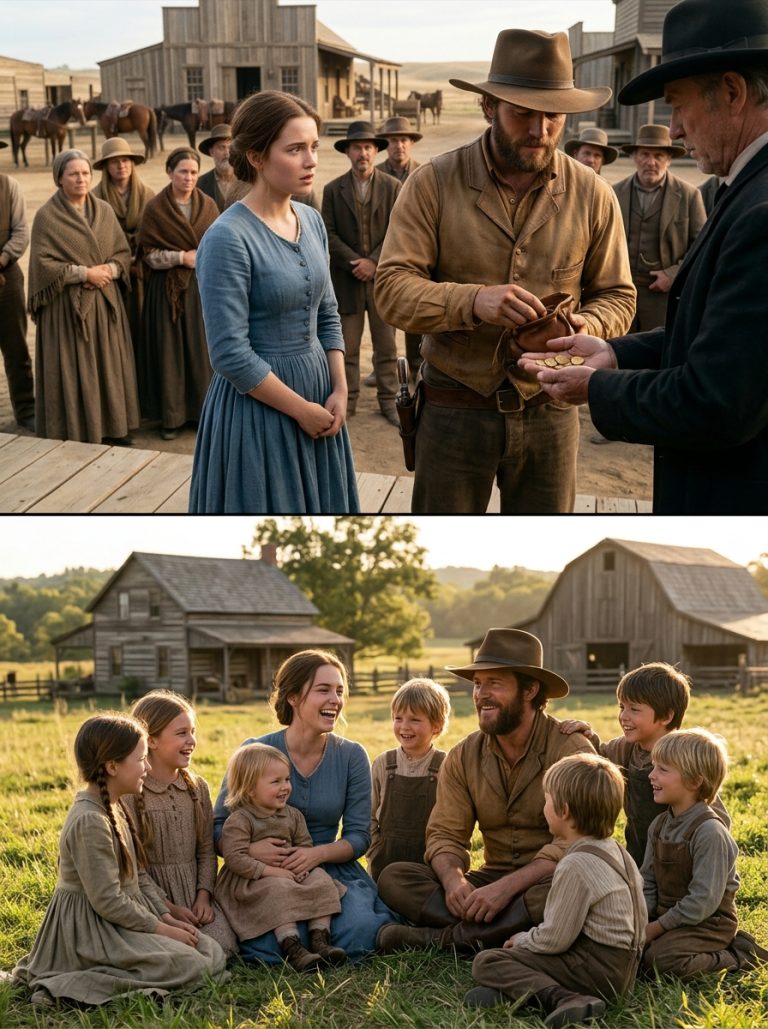
“I know my first words to you were half lunacy,” he said. “I know I am rough in speech and rougher in history. I know I cannot offer you the kind of courtship women deserve. But I love you. I love what this cabin becomes when you are in it. I love how you speak to the boys — the truth in it, the steadiness. I love hearing you sing while you work even when you think no one can hear. I would rather face every official in Colorado than spend one more day letting your brother’s voice have more claim on your future than mine.” He paused. “If you can bear a fool who has never courted properly, and never courted at all — marry me.”
Hannah looked at him.
“Never at all,” she said.
“That is also true,” he said, ears reddening.
She stood. She put her hand against his chest, over his heart, and felt it hammering against her palm with the speed of a man who understood that this was the most important question he had ever asked and could not make himself less afraid of the answer.
“Yes,” she said.
He blinked. “Yes.”
“Yes, Caleb Mast.”
He took both her hands and pressed them against his chest and did not sweep her up or perform his feeling. He only held on, with the careful fierceness of a man holding something he had not expected and intended to deserve.
“Then I will spend the rest of my life proving the mountain did one good thing in keeping me here long enough for you to arrive,” he said.
They might have had longer in that moment if not for what came the following morning.
The men arrived before breakfast.
Two of them. One was Deputy Garrett from Millhaven — a lean man who looked uncomfortable in his own authority, which Hannah registered as potentially useful. The other wore city wool and carried a leather satchel and introduced himself as Edwin Crane, Territorial Liaison for Native Affairs Placement.
Crane carried a document.
Three minor males of mixed native descent, currently housed without legal guardianship, subject to immediate transfer to approved educational institution pending placement with appropriate reservation authority.
Micah had been standing in the kitchen doorway. He heard the words transfer and placement and went the color of chalk. Joseph crossed the room without instruction and stood against Hannah. Eli, who had been bringing in wood, set down the armload and planted himself in the middle of the room with his fists at his sides and looked at Crane with the specific expression of a child who has learned that adults with official papers were one of the primary forms of danger in the world.
“You will not take them,” Caleb said.
Crane folded the document precisely. “Whether this proceeds peacefully is the only remaining question, Mr. Mast.”
Deputy Garrett shifted. He looked at the boys. He looked at the cabin — the Scripture on the wall, the mended curtains, the bread dough rising on the counter, the three small pairs of boots by the door. Something moved through his face that Crane did not appear to notice.
“There’s a hearing,” Garrett said. “Judge Whitmore is in from Durango. If you present yourselves by ten o’clock and there’s testimony as to the welfare of the boys, there’s provision in the statutes for provisional guardianship.”
Crane shot him a thin look. “The law does not operate on sentiment.”
“No,” Hannah said. “Men with documents simply find cleaner ways to be unkind.”
Crane’s attention moved to her with the specific precision of a man cataloguing an obstacle. “And you are?”
“Hannah Voss.”
A pause. “The unmarried woman currently residing in the household.”
Caleb went hard beside her.
“Not for long,” he said.
Crane ignored him. He produced a second document — sworn statements from Hannah’s religious community, gathered with an efficiency that meant Marcus had been busy. According to those statements, Hannah Voss was mentally unstable, physically intemperate, medically barren, and temperamentally unsuited to the supervision of minors.
Her father had signed it. Marcus too.
Crane folded the papers away with the practiced economy of a man for whom other people’s pain was administrative. “Tomorrow. Ten o’clock. Present yourselves. Or I return with additional authority.”
After they left, the cabin fell into the kind of silence that a house produced after something bad had entered it and was only temporarily gone.
Thomas started crying first, which was what Thomas did when the fear got large enough that pretending otherwise took more energy than he had. Joseph folded against Hannah without speaking. Caleb went to the wall for the rifle.
“No,” Hannah said.
“They’ll take them if I stand here—”
“They will certainly take them if you give them what they already think you are.”
He turned. His face was controlled and barely.
The boys were watching.
Hannah lowered her voice. “You told me once that people saw your size and decided who you were before you opened your mouth. My family did the same with my body. Crane looked at those boys and saw a category, not children. Let us not give him the ending he already wrote for us.”
A long moment.
He rehung the rifle.
That night no one slept well. Near dawn Hannah sat at the table with a dead candle stub between her fingers when Caleb came in from outside with a folded paper.
“Deputy Garrett left this in the door,” he said. “Said if there’s any hope at the hearing, we’ll need more than anger.”
Hannah opened it.
It was a letter from Dr. Amos Fletcher of Cedar Falls.
Her hands went cold halfway through the first paragraph.
Dr. Fletcher had examined her at her father’s request eleven years ago, following the fever. He wrote now, in the careful script of an old man making peace with something he had left undone too long, that he had never declared Hannah Voss barren. He had said only that the illness might make childbearing difficult and would require careful management. He had warned, not closed the door. Her father had asked him, in his words, to phrase the matter decisively, so that no false expectations should be cultivated in the household.
Hannah read the letter twice.
The second time she understood what it meant.
Not misunderstanding. Not medical uncertainty passed through the filter of a worried parent. A deliberate sharpening. A man who had looked at the uncertainty in a doctor’s words and decided to convert it into sentence, because a daughter who believed herself diminished was a daughter who did not ask for too much.
When she looked up, Caleb’s face had gone the way mountain faces went before weather — still on the surface, everything building underneath.
“They lied,” she said.
“Yes.”
“They built my whole life on it.”
“Yes.”
“Eleven years.”
“Yes.”
His answers were steady enough to lean on. She did.
Then she pressed the heel of her hand to her mouth, lowered it, and said: “Tomorrow I will not go to that courthouse asking for mercy.”
“No,” he said.
“I will tell them what was done to me.”
“And I will stand beside you while you do.”
Morning arrived bright and unforgiving, the way mornings arrived in the mountains when they had decided to be witnesses.
Hannah wore her mother’s dark blue dress — hers now by inheritance rather than love. She braided her hair firmly and laced the boots Caleb had made for her. He trimmed his beard closer than usual, which made him look both fiercer and more exposed. The boys wore their cleanest shirts and patched trousers and had the ceremonial seriousness of children who understood that something important was being decided about their lives.
Reverend Aldrich from the lower settlement rode up before they left, removed his hat, and said he had heard.
“Towns have eyes,” he said. “Today I pray that becomes a witness rather than a weapon.”
Millhaven was smaller than Hannah remembered. Small towns rarely needed much space to shame people, and this one had been practicing on her for years. The courthouse steps were crowded when they arrived — storekeepers, church women, freight workers, people who had left their ordinary morning to see what kind of day this would become.
Marcus was there.
Her father was there too.
Abram Voss had not climbed the mountain when his daughter was freezing to death in the snow. He had come to Millhaven in his best coat to make sure strangers believed the story he had been telling about her.
A clean anger moved through Hannah, clean enough to feel like clarity.
Inside, Judge Whitmore presided with the tired authority of a man who had seen enough nonsense to recognize its shape early. Crane stood with his papers. Deputy Garrett with his discomfort. Reverend Aldrich with his Bible. Caleb with his size and his silence. The boys with their fear. Hannah’s father with his certainty.
And Hannah, at the center of her own life for perhaps the first time in it.
Crane spoke first. Jurisdiction. Federal authority. Appropriate placement. The welfare of minor children in informal custody headed by an unmarried woman and a man with a known history of violence. He used words like civilizing and proper supervision as covers for something considerably less civilized than what he was describing.
Then Abram Voss rose.
He did not look at Hannah.
“My daughter has always been a difficult case,” he said, with the measured sadness of a man performing grief for an audience. “Large in constitution. Prone to attachment unsuitable for a modest life. The physician told us years ago she was unlikely to bear children. We maintained our Christian duty to her for as long as was reasonable, but when she began to reject authority and proper limits, we feared for the example she might set.” He paused. “Her current situation — living unmarried with a violent man, keeping wild children — confirms our concerns.”
Hannah did not remember standing.
She only became aware that she was on her feet.
“You kept me,” she said, and her voice had a quality she had not heard in it before — not raised, not shaking, simply iron all the way through, “the way you keep a plow horse. Because I worked.”
The room shifted.
Judge Whitmore lifted a brow. “Miss Voss—”
“With respect, Judge,” Hannah said, “I have waited nineteen years for this turn.”
A murmur through the gallery.
Whitmore studied her. Then: “Proceed.”
She faced her father fully.
“You told everyone the doctor declared me barren. You told my mother. My sisters. Our neighbors. You told it so many times and in so many ways that I began to tell it to myself, and eventually I stopped understanding the difference between what he said and what you needed him to have said.” She held up the letter. “This arrived yesterday. In Dr. Fletcher’s own hand.”
The room sharpened. Her father’s face moved for the first time.
Whitmore took the letter. Read it. Set it down with the careful deliberateness of a man who understood what he was holding.
“Mr. Voss,” he said, “it appears the physician did not say what you have consistently represented.”
Abram’s mouth tightened. “The precise language is immaterial.”
“It was my life,” Hannah said. “It was not immaterial to me.”
And then, because years of swallowed truth had finally found its opening, she told them everything.
She told them about the fever and the ride to Cedar Falls. About the way her portions grew smaller after the diagnosis, quietly, so gradually it took years to notice the pattern. About watching her sisters marry while her own labor increased to fill the space their departures left. About the morning Marcus drove her into the foothills and told her to get out, because their father had decided the Lord was wasting provisions on an empty womb. About Caleb finding her. About broth before questions. About boots made to fit her before she had given him any reason to. About three boys arriving half frozen with the terror of children who had been running from civilization’s generosity for weeks. About Eli still sleeping with one ear open. About Thomas hiding bread crusts under his mattress for the first days, until trust slowly taught him there would be more tomorrow. About Joseph saying safe for the first time, with the careful wonder of a child learning that a word he had been told was real.
When she finished, the room was very quiet.
Then Eli stood.
No one asked him to. He simply rose, eleven years old and thin as winter pine, and faced the judge with his hands in fists and his chin level.
“My mother told me keep my brothers together,” he said. “She told me find mountains and find people who still fear God. I don’t know if I found the right people or if God pointed me to the right ones. But Mr. Caleb found us when we were three days from nothing. Hannah fed us and taught Thomas his letters and taught Joseph to sleep without his boots on because she said children who are safe don’t need to be ready to run.” He stopped. Started again. “If you take us from them, you are not saving us. You are just making us lose our family a second time.”
No one in the room moved.
Thomas stood because Eli had stood.
“I burned the biscuits four times,” he said, voice cracking. “She ate the worst one every time and said it tasted like practice. Mean people don’t do that.”
A sound moved through the gallery — brief, wet.
Joseph did not stand. He slid off the bench, walked to where Hannah was standing, and wrapped both arms around her skirt and buried his face against her without a word.
Whitmore removed his spectacles and pressed his hand over his mouth.
Crane recovered first. “Emotional display does not establish legal claim.”
Reverend Aldrich stood from the back. “Perhaps legal men ought to be embarrassed by what it does establish.”
Whitmore looked at him.
“I have visited the Mast cabin twice this winter,” the reverend said. “I have seen Scripture taught there, labor shared, and mercy practiced with more daily seriousness than in many homes that have all the proper documents and very little love in them. If Christian concern is being claimed here today, let it not be claimed selectively.”
A widow near the back — Millhaven Hannah didn’t know well — stood without being recognized. “Those boys chopped my woodpile during my coughing spell and would not take a cent for it. Hannah sat with me when my own family was away and spooned broth into me for three days. If any official calls her unfit, he can explain why half this town has leaned on her while looking away.”
Others. The storekeeper. The schoolteacher, who said Thomas could already read simple sentences and Joseph had better table manners than boys twice his age. The blacksmith, who said nothing but stood, which was its own form of testimony.
What Hannah remembered most was her father’s face as the room continued to turn.
Not grief. Not regret.
Confusion.
Cruel men were always confused when the world refused the version of reality they had been repeating the longest.
Crane made his final attempt — federal statute, appropriate placement, documented risk — and Deputy Garrett interrupted him.
“There’s provision in the statutes for provisional guardianship where removal would cause immediate harm, Your Honor. You know it and so does he.”
Whitmore leaned back. His fingers steepled. The room held its breath.
“This court grants immediate provisional guardianship of Eli, Thomas, and Joseph to Caleb Mast and Hannah Voss, pending formal petition and continued testimony of welfare.” He looked at Crane over his spectacles with the expression of a man who had made his last accommodation of nonsense for the day. “Furthermore, given the contents of Dr. Fletcher’s letter and the testimony regarding abandonment, I advise any party considering further action against this household to first consult their conscience and then their legal standing.”
Hannah’s knees nearly failed.
Caleb’s hand came to the small of her back — firm and warm and there.
The boys did not cheer. It was too serious for cheering. Eli closed his eyes and let out a breath that seemed to belong to someone older than eleven. Thomas wept openly. Joseph looked up at Hannah and said, in the smallest possible voice: “So we stay?”
She knelt and took his face in her hands. “Yes, sweetheart. You stay.”
He nodded, very serious. Then burst into tears so complete he hiccuped.
Reverend Aldrich cleared his throat. “There remains the matter of certain people having used the unmarried nature of this household as a tool of slander. If Miss Voss is willing and if Mr. Mast has not reconsidered, I see no reason a courthouse should not serve good purpose twice in one morning.”
A ripple through the gallery.
Caleb looked at Hannah. Not a question. An offering. The same one he had made at the table — hers to take or decline.
She looked at her father standing against the wall with his lies around his feet like broken timber. She looked at the boys, at the people who had chosen witness over convenience, at the man beside her who had found her frozen and asked nothing before feeding her.
“Yes,” she said.
They married on the courthouse steps in snowmelt and thin March sunshine, with women producing flowers from somewhere because women always did when joy broke through difficulty, and Reverend Aldrich reading from Ruth and Boaz until Widow Jensen wept openly and declined to be embarrassed about it.
When asked whether he would have Hannah Voss, Caleb answered loud enough for the whole square: “With everything I am.”
When asked whether she would have him, she looked up into that rough and finally open face — the face of a man who had been misread for years and had chosen to become legible only to the people worth it — and said: “I already do.”
His kiss was not practiced. One expected that from a man who had spent most of his adult life in conversation with weather and woodpiles rather than women. It was careful at first, almost reverent. Then she touched his jaw and did not pull away, and something in him that had been held for a very long time let go, and the whole watching town disappeared for the length of one breath.
Eli looked away and failed to hide that he was moved.
Thomas whooped.
Joseph clapped with the absolute authority of a child who understood he had just witnessed something important and was prepared to take full credit for attending.
Hannah’s father left before the vows were complete.
Marcus stayed long enough to understand he had lost.
She let them both go without following.
There were women in her life who might have called that cold. They were not women who had lived inside what she had lived inside. Mercy and reconciliation were not always the same thing. Sometimes the most merciful thing a woman could do for herself was let unrepentant people carry their own weight back down the mountain they’d climbed to shame her.
Spring came to Black Ridge the way spring always came at altitude — reluctantly, then all at once, as if it had been gathering itself for weeks and finally decided delay was costing more than arrival.
Snow pulled back from the lower meadow in patches. The creek came up over its winter banks and ran cold and loud through the clearing. Caleb turned the garden soil with Eli and Thomas working alongside him, both of them trying to match his pace with the focused ambition of boys who had decided that competence was the primary form of belonging available to them. Joseph planted beans in a crooked row and named each seed before covering it, presiding over the proceedings with the ceremonial gravity of a child who had decided this was his responsibility.
The formal petition went through in May.
Deputy Garrett brought the papers himself and stood awkwardly in the yard while Joseph offered him a biscuit and Thomas asked whether deputies ever accidentally arrested themselves. Garrett said no. Caleb covered a smile with his hand. Eli watched the document being signed with the expression of a boy watching his own life being put back together by the proper authorities, which was a thing he had not expected to live to see.
After Garrett rode away, the boys wanted to know if that meant official.
“It means,” Hannah said, “that the law has finally caught up with what winter already knew.”
Eli absorbed this in silence. Thomas grinned. Joseph launched himself at Caleb’s leg with such force he nearly knocked himself backward, which Caleb absorbed without moving and which became, in the retelling, the moment everyone agreed Joseph had always been the most committed of the three.
A week later, when the apple tree behind the shed put out its first small white blossoms, Hannah stood at the edge of the lower meadow and watched the boys where the creek ran clear.
Eli was showing Thomas how to read the water for fish — where current slowed against stone, where shadow meant depth. Thomas was attempting to apply this knowledge with the focused inexactitude of a boy who understood the theory and had not yet reconciled it with the practice. Joseph was narrating the entire enterprise from a boulder with the confidence of a commentator who had never attempted the activity personally.
Caleb came and stood beside her.
“You came out without your shawl,” he said.
“It’s warm.”
“It’s fifty degrees.”
“For April that’s warm.”
He said nothing to that, which was his way of acknowledging she was right without abandoning his position.
They stood in the kind of quiet they had built between them over months — inhabited, easy, the silence of two people who had stopped performing comfort and had arrived at the actual thing.
“You know,” Caleb said, with a note in his voice she had learned to read as the precursor to something that mattered, “I told you by spring you’d give me three sons.”
Hannah looked at him sideways. “Your phrasing still needs work.”
“Likely always will.”
“But you were right.”
He shook his head slowly. “I was early. The right words would have been: by spring, three sons will find us. The giving was never mine or yours to do.”
There was mountain wisdom in that. The kind that didn’t announce itself.
She slipped her hand into his. He closed his fingers around hers with the careful firmness of a man who had learned that the things worth holding required both grip and gentleness, and that the skill was in knowing which the moment needed.
Below them, Eli pulled Thomas back from a slippery bank with a hand on his collar, then let him go, which was the most brotherly motion Hannah had ever witnessed — part rescue, part release. Joseph applauded from the boulder.
The word barren had once felt like a verdict inscribed in her bones.
Standing here, it felt small. Almost laughable beside the noise and warmth of what the mountain had given her. She did not know whether her body would ever carry a child of her own blood. Perhaps it would. Perhaps it wouldn’t. She had discovered, somewhere in the long winter between finding and being found, that she had stopped caring in the way she once had. Motherhood was not only what the body did. It was the daily choosing — to feed, to steady, to remain. To wake in the night because someone smaller trusted you would. To make a home solid enough that frightened children dared to believe in tomorrow.
Inside the cabin, bread was rising.
Outside, Joseph had fallen from the boulder into the shallows and was protesting this development to heaven with considerable volume. Thomas was laughing too hard to help. Eli had already waded in and was pulling his youngest brother upright by the back of his shirt.
Hannah squeezed Caleb’s hand.
“Come on,” she said. “Our sons need us.”
He looked down at her with the expression she had first seen by the frozen creek when he looked at the three carved horses and didn’t know yet what they were for — that grave, astonished tenderness that had nothing in it of performance and everything in it of a man encountering something he had not known he was still capable of.
“Yes, wife,” he said.
They walked down the meadow together.
Joseph launched himself at her the moment she was in reach. Thomas grabbed her other hand. Eli fell into step beside Caleb with the careful pride of a boy practicing belonging — moving close enough to touch but not quite touching, in the way of children who have loved before and lost it and have not yet fully trusted that the floor will hold.
Caleb’s hand found the boy’s shoulder. Steady. Unhurried.
Eli leaned into it.
Hannah watched and felt the thing she had spent most of her life being told she didn’t deserve settle into her chest like light coming through a window that had finally been unshuttered.
She had been abandoned in the snow.
She had been declared useless, empty, less than.
She had walked into a white silence with nothing but the clothes on her back and the refusal to beg and a small, stubborn belief — damaged but not dead — that she was more than what her father had made of her.
And the mountain, which had asked nothing of her except that she keep walking, had given her back everything.
Not the life she had been told she deserved.
Something larger.
Something that had been waiting on the other side of the cold for a woman stubborn enough to survive the crossing.
By the time summer came, by the time the beans climbed their poles and the creek ran clear and the meadow went green all the way to the ridge line, the cabin on Black Ridge no longer felt like the place where a man had been surviving alone.
It felt like the place where a family had begun.
And that, as it turned out, had been the dream all along.