THE WHOLE PLATFORM CHANTED “TOO HEAVY TO KEEP” — THEN TWO LITTLE GIRLS PUSHED THROUGH THE CROWD AND GRABBED HER HAND

PART 1
The door didn’t slam so much as it exhaled — a single heavy sound that ended everything Mabel had ever known as home.
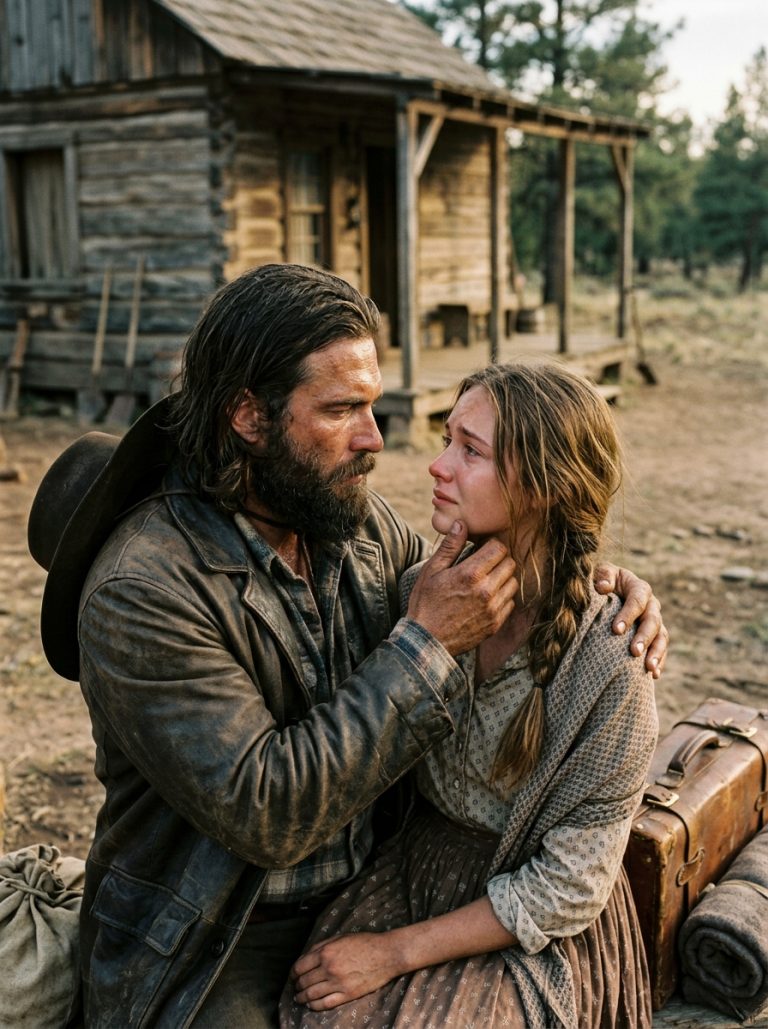
She stood on the other side of it with her bag at her feet and her mother’s last words still warm in her ear, delivered without heat, without regret, the way a person announced the weather: nobody will have you, so find work somewhere that takes what it can get. Her father hadn’t even bothered to say that much. He had gripped her elbow the way you gripped a piece of furniture you were moving out of a room, steered her to the threshold, and let go. The morning was pale and cold. The street was empty. A dog barked somewhere on the far side of town, and the sound had the quality of something that didn’t know it should be quiet.
Mabel picked up her bag.
She had been a widow for eight months. Before that, she had been a wife for three years to a man who looked at her body the way a disappointed customer looked at something he’d ordered wrong — not with active hatred, just with the low, grinding resignation of someone stuck with merchandise that didn’t match the catalog. He had died of a sudden fever in October, and the town had mourned him with more feeling than he had ever extended to her, which told Mabel everything she needed to know about whose story this had been.
At twenty-six years old she walked to the station because there was nothing else to do with her feet.
The platform was already crowded. She heard the other women before she saw them — three of them, dressed in the kind of colors that assumed the world would be glad to see them, gathered near the station master’s booth like a small bright advertisement for optimism. Mabel moved to the far end of the boards and set her bag down and looked at the train.
She didn’t look at the women.
She already knew what looking would get her.
What she didn’t expect was the man behind her, a rancher with mud on his boots and an audience he wanted to impress, who said it loud enough for the whole platform to benefit from his observation: “You sure that train can carry all of that?”
The laughter came fast. The kind of laughter that had been waiting for exactly this kind of invitation, gathered in the throats of people who had decided before they woke up this morning that the day would be better if someone else had a worse one.
Mabel’s face went hot from her jaw to her hairline. She did not turn around. Turning invited a second act, and she had no intention of giving anyone a second act. She fixed her eyes on the locomotive, on the iron and steam of it, on the absolute indifference of machinery, and she breathed.
“All brides boarding for Harrow County!” the station master called, and the platform reshuffled.
The three young women moved first, elegant and certain of their welcome. Mabel followed at the back, bag in hand, and from somewhere in the crowd a voice she couldn’t place took the rancher’s joke and refined it into a rhythm, the way cruelty always sharpened itself when it found good company.
Too heavy to keep. Too heavy to keep.
Not shouted. Just murmured, passed mouth to mouth like something contagious, until it had infected enough voices to become a chant that traveled down the platform behind her like a second shadow.
Mabel climbed the train steps. Her vision blurred slightly at the edges, the particular blur of tears she was refusing to allow. She found a seat in the last car and pressed her shoulder against the cold window and watched the town slide past — the baker’s sign, the church steeple, the well in the square where she had drawn water every morning for three years — and she let all of it go without ceremony because holding on to things that hadn’t wanted you was a special kind of foolishness she had practiced long enough.
The train carried her west through open country that had no opinion about her at all.
Fields. Sky. The occasional dark line of a river. She watched it all with the hollow attentiveness of someone who had just been emptied and didn’t know yet what would fill the space. The three brides sat up front, voices bright, comparing expectations. Mabel listened without meaning to and felt no envy — only the dull, specific grief of a person who understood that other people’s certainty was a country she did not hold a passport for.
Harrow County, she thought. A sister in Millstone Creek. The plan was thin, but it was a direction, and direction was more than she’d had when she left the platform.
The train rolled into Harrow Station in the late afternoon, when the light had gone gold and horizontal and made everything look more significant than it was.
The platform was crowded.
Ranchers, townsfolk, a preacher in a dark coat, children in their good boots. Everyone had turned out for the brides, and the brides descended the steps first to exactly the reception they had anticipated — tips of hats, widened eyes, the small approving murmurs of a community taking inventory and finding the numbers favorable.
Then Mabel stepped down.
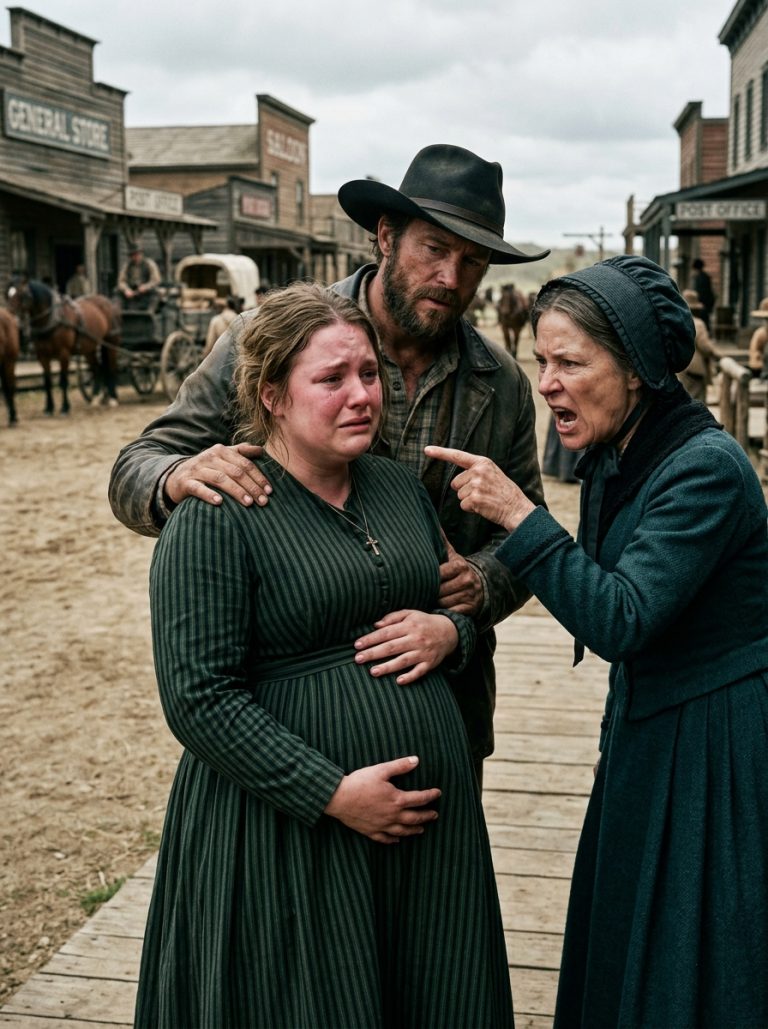
The silence that followed was a different species from quiet. It had weight. It moved through the crowd the way a stone moved through water, and the ripples were looks, then whispers, then the gathering of something Mabel recognized before it had fully formed because she had felt it behind her on the departure platform an hour ago.
“Not on the list,” the station master said, loud enough to carry, squinting at his clipboard.
“I’m not a bride,” Mabel said, and her voice came out smaller than she’d intended, a voice that had been reduced by use. “I’m traveling to my sister in Millstone Creek. I just needed to stop—”
“Too heavy to keep!” a man called from somewhere in the middle of the crowd, and the laughter that followed had teeth.
The chant hadn’t followed her here. It had arrived ahead of her, or perhaps it lived in every crowd waiting to be activated, the same syllables in different mouths. Too heavy to keep. A rhyme. A verdict. Both at once.
Mabel’s hands found each other at the center of her body, fingers lacing, knuckles whitening, the way hands moved when there was nothing else to hold onto.
She would not step back. The train was already pulling out behind her. There was only forward, into the press of a crowd that had decided her story before she had even spoken a sentence of it.
Too heavy to keep—
“HER.”
The word cut through everything.
Not a man’s voice. Two voices, exactly matched, high and certain, the kind of certain that had no idea it was supposed to be uncertain.
The crowd turned as one body.
Two small girls in yellow dresses had broken loose from somewhere near the back of the gathering and were running — genuinely running, ribbons lifting, shoes striking the boards hard — past the three brides without a sideways glance, as if the brides were fence posts. They ran with the directness of people who had already made a decision and were simply arriving at the location where the decision lived.
They stopped in front of Mabel.
They looked up at her with identical faces and the solemn, absolute conviction of judges who had reviewed all available evidence and reached a verdict.
“Her,” the first one said again. “Daddy, we want her.”
The second one reached up and took Mabel’s hand.
Mabel looked down at the small warm fingers wrapped around hers, and she thought: this is the strangest thing that has ever happened to me, and she was twenty-six years old and had lived a life that contained several candidates for that title.
“Please,” the first girl said, louder, turning toward the back of the crowd. “Daddy. Her.”
The crowd parted.
Not dramatically, not all at once, but steadily, the way crowds parted for a person who did not appear to require them to move but simply made remaining in the way seem like a choice that would need explaining later. He was broad and unhurried and wore his hat pulled low against the afternoon light. His boots on the boards made a sound that was neither fast nor slow but entirely sure of itself.
He stopped in front of Mabel.
He looked at her — not the way the rancher had looked at her on the departure platform, not the inventory assessment of a man calculating deficits. He looked at her the way a person looked at something that had been described to them incorrectly and they were now determining what it actually was.
“You need somewhere to be tonight?” he said.
His voice was the kind that had been shaped by long winters and short conversations and the particular economy of a man who had learned that most words were unnecessary.
Mabel’s pride made a brief attempt to organize itself. It failed. Pride was a muscle that required regular feeding, and hers had been on short rations for eight months.
“I was going to find my sister—”
“Tonight,” he said. Not unkind. Just precise.
Mabel swallowed. Around her the crowd had gone quiet again, but differently — not the cruel quiet of people gathering to mock but the breathless quiet of people watching something they hadn’t expected and couldn’t look away from.
“Yes,” she said. “I suppose I do.”
The man nodded, once, the way a man nodded when a question had been answered and there was nothing further to discuss. He looked at the crowd with a gaze that communicated nothing aggressive and required nothing from anyone and somehow accomplished more than a speech would have.
“All right,” he said, to no one in particular, and turned back toward the wagon.
The twins — still holding Mabel’s hand, or rather Mabel was now holding both of theirs, which had happened without her noticing the transition — pulled her forward.
“I’m June,” the one on the left announced. “That’s May. We’re twins.”
“I noticed,” Mabel said.
“We knew as soon as we saw you,” May said, serious as a small judge. “Didn’t we, June?”
“Right away,” June confirmed. “You looked exactly like someone who needed us.”
Mabel opened her mouth to say something practical about this and found she had nothing. Because the honest answer — you’re right, I did — was too large and too sudden to say out loud to a child she had known for forty seconds in the middle of a hostile crowd.
So she let herself be led to the wagon, and she climbed up, and the man whose name she did not yet know climbed up front without a word, and the wagon rolled out of Harrow Station while the crowd watched from the platform, and Mabel did not look back.
She was looking forward, at an unfamiliar road in unfamiliar country, flanked by two small girls who had run through a crowd of mockery as if it were nothing, as if they had somewhere important to be and the crowd was simply in the way.
She was thinking about the word needed.
She was thinking: what kind of man lets two little girls choose a stranger off a platform and then just — goes?
She was thinking: what happened to their mother?
And then May leaned against her side, warm and unselfconscious as a cat, and said quietly: “We haven’t had someone to braid our hair in a really long time.”
The sentence landed somewhere inside Mabel’s chest that had been empty for a considerable while, and the thing it landed with was not the dramatic crash of significance but the small precise sound of something setting down its weight after a long carry.
She looked at the back of the man’s shoulders — straight, deliberate, giving nothing away — and she thought: I don’t know this place. I don’t know him. I don’t know what I’ve walked into.
And the wagon rolled on into the golden afternoon, and the twin on her left fell asleep against her arm before they had left the town limits.
PART 2
His name was Ellis Crane.
She learned this from June, who delivered information the way she delivered most things — at volume and without preamble — approximately ten minutes into the journey. “Daddy’s name is Ellis. His middle name is James but nobody calls him that. Mama used to call him EJ when he was being difficult.”
From the front of the wagon, without turning: “June.”
“I’m just telling her facts,” June said, unrepentant.
May, awake again, added helpfully: “Daddy doesn’t like a lot of talking.”
“Then why do you do so much of it?” Mabel asked.
May considered this. “Because somebody has to.”
Mabel bit the inside of her cheek to keep from smiling.
The ranch appeared at the end of a long track that curved through dry grass and scattered pine, and Mabel’s first understanding of it was not visual but cumulative — the particular accumulated feeling of a place where someone had worked very hard for a very long time and then a significant thing had happened and the working had continued but something had gone out of it. The house was solid and the barn was functional and the fences ran in the right directions, but the garden was overgrown and the porch held a collection of things that had been set down and not picked up again, and the whole property had the quality of a man running at full capacity on half his usual fuel.
Grief did that. She knew because she had seen it from inside.
Ellis Crane unhitched the horses without speaking, and Mabel stood in the yard with the twins still bookending her and looked at the house and felt the particular vertigo of a person who has arrived somewhere without a map and is trying to determine, very quickly, whether the terrain is survivable.
“Come in,” June said, tugging her hand, and that was how Mabel entered the house of a man she had known for an hour and a half.
Inside: dishes in the basin. A coat over a chair. Floorboards that had been swept recently but not recently enough. A child’s drawing pinned to the wall beside the window — two stick figures with yellow circles for hair holding hands under a sun with too many rays, and underneath in a child’s deliberate printing: me and May with Mama.
Mabel looked at that drawing for a moment.
Then she looked at the rest of the kitchen and started moving, because standing still had never been something she could do in a room that needed work, and this room needed work, and work was the language she had been permitted to speak without interruption for as long as she could remember.
By the time Ellis came in from the barn, she had the stove lit and the basin clear and the smell of warmed water and clean iron sitting in the air like the beginning of something.
He stopped in the doorway.
He looked at the kitchen. He looked at her. He said nothing, which she was beginning to understand was not the same as having nothing to say.
“Sit,” Mabel told him, because the man looked like he had been refusing to sit for approximately two years. “There’s food coming.”
He sat. He ate. He didn’t tell her to stop or send the food back or explain to her that she was a guest and this was not her place, any of the things she had half-expected. He simply ate, and when he was done he said, “The girls’ room is at the end of the hall. Yours is next to it,” and walked outside.
Mabel stood in the kitchen with a dish towel in her hands and thought: this is either very simple or very complicated, and I don’t know which yet.
June appeared at her elbow. “He liked it,” she said, nodding sagely at the cleared table. “He’s just not good at the face part.”
“The face part?” Mabel repeated.
“The part where the face shows what’s happening inside,” May explained from the doorway. “He had a teacher for it. But she’s gone now.”
Their mother. Said so plainly, the way children said plainly the things adults spent great energy avoiding.
“I know,” Mabel said softly.
“Do you miss someone too?” June asked, with the direct invasiveness of a small person who had not yet learned that most adults preferred their grief unaddressed.
Mabel thought about this honestly. Not her husband — she had mourned the idea of the marriage more than the man himself, and she had long since made her peace with the meanness of that fact. But her mother, from before. And herself, the version she had been when she still believed the right person would find the shape of her and stay.
“Yes,” she said. “I miss a few things.”
June took her hand again, the matter settled. “That’s okay. We can miss things together.”
Three days passed.
Mabel cleaned. She cooked. She pulled weeds from the vegetable garden while the twins handed her things that were not weeds and explained at length why those things should be allowed to stay. She mended the pile of shirts that had been accumulating on the chair in the kitchen with the patient persistence of things nobody had time for. She worked from before dawn to after dusk and she did not complain and she did not ask for acknowledgment because she had never learned that acknowledgment was something she was allowed to request.
On the fourth morning, Ellis found her in the kitchen before sunrise.
He stood in the doorway in the grey early light, and she was at the basin with her back to him, and neither of them said anything for a moment, which she had learned was simply how he inhabited a room — fully present, minimal language, all the weight in the silence.
“You don’t have to do all of this,” he said.
“I know,” Mabel said.
“Then why—”
“Because I need to earn it,” she said, before she could organize the words into something less honest. She felt him go still behind her. She kept her hands in the basin. “A place. Staying. I’ve never had either of those things without earning them first and I don’t know how to behave like I’m owed them.”
The silence after this was different from his usual silence. More careful.
“My daughters chose you off a train platform,” Ellis said finally. “You don’t owe this house anything.”
Mabel turned around.
He was leaning against the door frame with his arms crossed in the way of a man who was holding himself careful, and his face was doing the thing June had described — not showing what was happening inside, but she was beginning to be able to read the edges of it anyway, the way you read weather not from the sky directly but from the way the grass moved.
“Your daughters are seven years old,” Mabel said. “That’s a generous basis for belonging.”
“They’re seven and they haven’t been wrong yet,” Ellis said, and his voice was so flat and so certain and so completely without irony that Mabel felt the sentence arrive somewhere behind her sternum with the weight of something true.
She turned back to the basin.
She was not going to cry in front of this man over a sentence about his children. She was not.
“There’s something I need to tell you,” Ellis said, and the quality of those words — the particular gravity of them — made her turn back around despite herself.
His jaw worked. His eyes, steady on hers, carried something she couldn’t read yet, something that had been stored in a cool dark place for a long time.
“Sunday,” he said. “I was going to take the girls to church. I’d like you to come.”
It was not what she’d been bracing for.
“All right,” she said.
“It won’t be easy,” he said. “This town has already decided things about you. About us.”
“Towns always do,” Mabel said.
“I know.” Something moved in his face. “I just wanted you to know I see it. And I don’t intend to let it stand.”
Mabel looked at him — this quiet, difficult man who had nodded once at a train station and turned a whole wagon toward home — and felt the specific terrifying warmth of someone who was beginning, against all reasonable instruction from her own history, to believe something.
She didn’t say that. She said: “What time does the service start?”
And Ellis almost — not quite, but almost — smiled.
PART 3
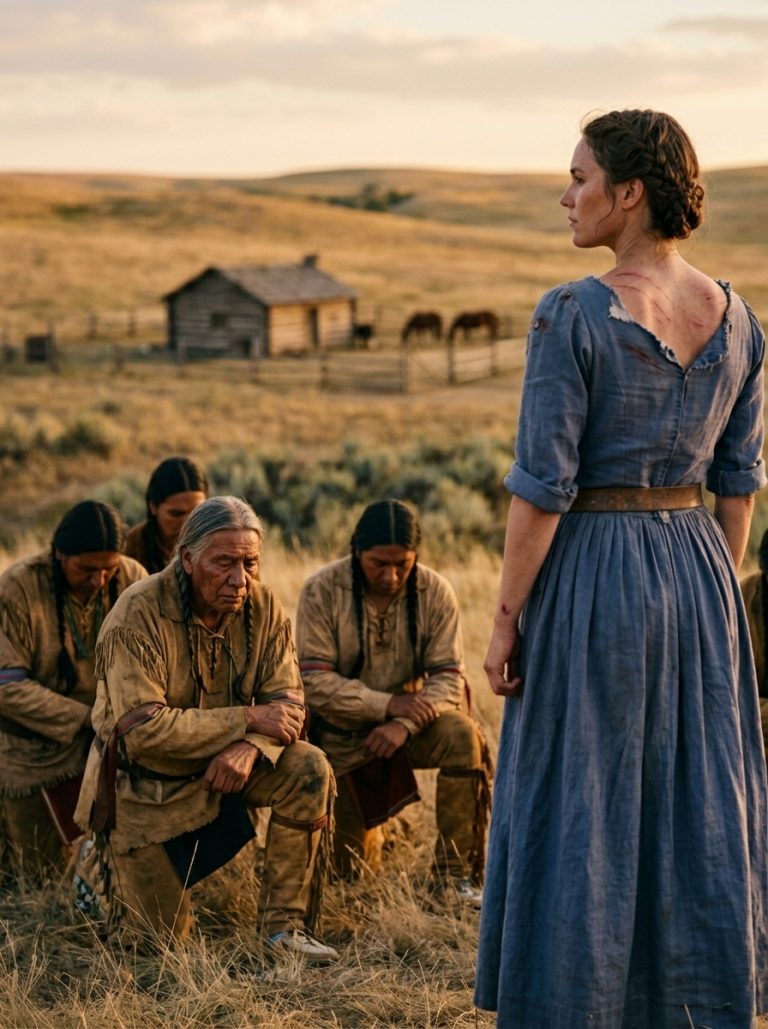
She wore her blue dress, the one that fit her as she actually was rather than as she might have been if she had been someone else, and she braided the twins’ hair at the kitchen table in the early morning while June narrated the process in real time and May held the mirror with great ceremony.
“Mama used to hum while she braided,” May said, watching Mabel’s hands in the mirror.
“What did she hum?” Mabel asked.
The twins exchanged a look — the specific wordless communication of children who shared everything, including memory. “Something slow,” June said. “We don’t remember the words.”
“Just the feeling of it,” May added.
Mabel continued braiding. After a moment, without making a decision about it, she began to hum. Nothing specific — a slow, shapeless melody, the kind that came from somewhere before words. The twins went quiet. The kitchen went quiet. Outside, a bird called once and then stopped, as if it too was listening.
When the braids were done, Ellis appeared in the doorway with his hat in his hands, and he looked at his daughters — bright ribbons, neat braids, faces turned up toward Mabel with the specific expression of children who had just been given something they had learned not to ask for — and he looked at Mabel, and whatever he was feeling he kept inside his face in the usual way, but his hands tightened on the brim of his hat.
The wagon ride into Harrow was cool and clear, the kind of autumn morning that smelled of wood smoke and dried grass and the season turning its page. The twins sat between Mabel and Ellis, close together, bumping against each side with the wagon’s motion. June pointed at things and named them. May occasionally confirmed the names with the authority of a fact-checker. Mabel watched the country move past and tried not to organize her anxiety into a specific shape.
She knew what towns did with women who didn’t fit neatly into their categories.
She had been a category since the moment she stepped off the train.
The church was white-painted and settled at the center of town with the permanence of a building that considered itself part of the landscape’s moral structure. People gathered outside — families, ranchers, the small clusters of women who managed a community’s social accounting. When the Crane wagon pulled up, heads turned.
The whispers began before Mabel had climbed down.
She heard them the way you heard things you’d trained yourself to hear — not with effort but with the tired recognition of someone who had been listening for this exact frequency for years. Still at his place. Unmarried. Those girls. What kind of man—
She kept her chin level. She took May’s hand on one side and June’s on the other. Ellis walked beside her and said nothing, but he walked close, and his presence on her left side was the kind of presence that communicated, without words, that he knew where he was standing and had made a choice about it.
Inside, the pews filled around them. The service began. Mabel focused on the stained glass above the altar — a simple pattern, amber and blue, the light coming through in colored columns the way light came through the trading post windows in her memory, except here it was beautiful rather than exposing. She let it settle her.
She almost succeeded.
Halfway through the sermon, the reverend stopped.
Not a pause. A stop. The kind that arrived with intention.
“Mr. Crane,” he said, and his voice carried to every corner of the room the way voices in large quiet spaces always did. “I’ve had members of this congregation come to me this week. With concerns.”
Ellis did not shift in the pew. He said: “Go on.”
“The woman living on your property,” the reverend said, and the phrasing itself was its own verdict — the woman, not her name, not your guest, just the woman, an object in a sentence. “There’s been talk. About propriety. About what example is being set for your daughters.”
The church was completely silent.
Mabel felt the twins’ hands tighten in hers, one on each side, simultaneous, the way they did everything.
“I see,” Ellis said.
“Surely you understand,” the reverend continued, his voice taking on the soothing tone of a man who believed he was offering reason, “how this arrangement appears to a community that—”
“What’s her name?” Ellis said.
The reverend stopped. “Beg your pardon?”
“Her name,” Ellis said. “You’ve said ‘the woman’ twice. What’s her name?”
A beat of silence. The reverend’s composure adjusted itself. “I don’t believe—”
“Her name is Mabel Ashford,” Ellis said, and he stood.
The twins rose with him, immediately, without being asked, as if standing were simply the natural continuation of what sitting had been. June on one side, May on the other, still holding Mabel’s hands, which meant Mabel stood too — not because she had decided to but because she was connected to these two small people who had already decided, and their decision pulled her upright the way a current moved something in water.
Ellis looked at the congregation. His voice when he spoke was not loud. It was the kind of voice that didn’t need to be loud.
“Mabel Ashford walked off a train at this station and this town called her names before she had spoken ten words,” he said. “She came to my ranch and in three days she put it back together in ways I had not managed in two years. She sat with my daughters when they were frightened. She braided their hair. She learned their stories.” He paused. “I don’t know what you’ve been discussing. But I know what I’ve seen.”
The reverend opened his mouth.
May’s voice arrived first.
“We want her to stay,” May said, clear and precise as a bell. “Forever.”
“She’s ours,” June added, with the absolute territorial certainty of a person who had never once in her life been ambiguous about what she wanted.
From the pew directly in front of them, an older woman — grey-haired, straight-backed, the kind of woman who had been defining the room’s moral weather for forty years — turned around. She looked at Mabel for a long moment. Her face was not cruel. It was the face of someone reckoning with the distance between what she had assumed and what she was looking at.
“I said unkind things at the station,” the woman said. “I owe you an apology.”
The silence that followed this was a different kind of silence. Not the silence of a crowd gathering to mock. The silence of a room recalibrating.
Another woman stood. “I repeated what others said without knowing you. That was wrong.”
Not everyone moved. Some stayed in their pews with the stillness of people who had decided their positions ahead of time and were not prepared to revise them in public. But enough people rose, or turned, or dropped their eyes in the specific way of people acknowledging something without quite being able to say it, that the air in the building changed character entirely.
Mabel’s throat was doing something she was managing with great effort. She kept her eyes on the amber light through the glass, on the steadiness of the color, on the thing that didn’t move.
The reverend cleared his throat. He had the appearance of a man whose sermon had arrived somewhere he had not planned. “I think,” he said slowly, “we might all benefit from some reflection.”
It was not an apology. It was the closest thing to one his position currently permitted, and Mabel understood that some distances were covered slowly and some were never covered at all, and that was the nature of the ground you had to walk on.
Outside, the sun had shifted while they were inside, had moved past the harsh overhead angle into the softer light of midday, the kind that made the town square look like something a person might not be afraid of.
The twins released her hands.
Ellis stood beside her. He turned his hat in his hands, a gesture she had come to recognize as the physical equivalent of organizing words.
“I want to say something,” he said.
“All right,” Mabel said.
“I am not a man who says things easily.” He looked at her. “You know that by now.”
“I’ve noticed,” she said.
“So when I say something, I’ve been thinking about it for a while.” He turned the hat once more. “I’ve been thinking about this for a while.”
Mabel waited. The twins had moved to the church steps and were sitting with their chins in their hands, watching with the unselfconscious intensity of people watching the best part of a story.
“My daughters chose you,” Ellis said, “and I have trusted their judgment about things that mattered since the day they were old enough to have judgment. But this isn’t only their choice.” He met her eyes directly, and in them was the thing that had been kept inside his face all this time — not cold, not empty, but stored, carefully, the way you stored something that mattered in a place where it would keep. “You are the strongest person I have watched in a very long time. Not because your life has been easy — it hasn’t, and that’s visible, and I won’t pretend it isn’t. But because you walk into rooms that are against you and you stay upright, and I have spent two years trying to do the same thing, and I know what that costs.”
Mabel’s mouth had stopped functioning in any useful way.
“I would like—” Ellis paused. Began again. “I am asking you to consider staying. Not as a housekeeper. Not as someone my daughters decided was necessary, though they did and they were right.” His voice was careful and deliberate and entirely without performance. “As my wife, if you’d have me. If you want that. On your own terms.”
The square was quiet around them. The twins on the steps had gone completely still, the way children went still when something important was happening and they understood instinctively that breathing wrong might break it.
Mabel thought about the train platform. About her parents’ door. About the chant that had followed her off a platform and arrived in a new town ahead of her. About the word keep and the specific violence of being told you were not worth it.
She thought about June taking her hand at the station with the absolute certainty of someone who had never learned that certainty required permission.
She thought about the grey light through a kitchen window at five in the morning and the smell of a stove being lit and the feeling — small and startling as the first warm day after winter — of doing a thing because she wanted to, not because she was afraid of what happened if she didn’t.
She thought about what it meant to be chosen. Not by a crowd that had been informed she was acceptable. Not by a system that had assigned her somewhere because she had nowhere else to go. But by a nine-year-old girl in a yellow dress who had looked at her across a hostile crowd and run through it without hesitation because she had already decided and she was not the sort of person who reconsidered.
“Yes,” Mabel said.
Ellis went still.
“Yes,” she said again, because her voice had been small for so long and it was not going to be small for this. “I will.”
A sound from the steps: June and May had collapsed into each other, laughing and crying simultaneously in the way that only children could do, as if joy and relief and love were all the same fluid and her body simply couldn’t contain the pressure. They tumbled down the steps and crashed into Mabel and Ellis from both sides, and Ellis’s arms went around all three of them with the slightly startled quality of a man who had forgotten how to be embraced and was learning again.
Behind them, from the churchyard, some people watched and smiled. Some turned away. Mabel did not track which was which, because it no longer organized her attention the way it once had. She was holding two small people who had run through a crowd of mockery with their ribbons flying because they had known something the crowd didn’t, and she was standing beside a man who had stood up in church and said her name.
The wagon home moved through the golden afternoon light. The twins sat between them and narrated the journey in detail and argued about whether the hawk they saw was the same hawk they’d seen before — June said yes, May said hawks were not in the business of following wagons — and Mabel listened and let the familiar bickering move through her like weather, like music, like the sound of a house that knew how to be a house again.
Ellis did not speak much. He didn’t need to. His shoulder was warm against hers on the wagon seat, and the horses moved steadily, and the ranch came into view at the end of the track as the light went amber and horizontal, and this time when she looked at it Mabel didn’t see the grief that had settled into the fences and the overrun garden and the collection of things set down and forgotten.
She saw what it could become.
What it was already becoming, quietly, without announcement, the way all the most important changes happened.
That evening, after the twins were asleep — June mid-sentence about something, May already gone before her head fully reached the pillow — Mabel sat on the porch in the last of the light with a cup of tea going cold in her hands. Ellis came out and leaned against the post and looked at the same dark line of trees she was looking at, and neither of them said anything for a while, which was no longer a silence that needed filling.
“June told me something last week,” Ellis said eventually.
“What did she tell you?”
“That you told her weeds thought they were flowers.” He was quiet for a moment. “She’s been leaving them in the garden ever since. The ones with yellow on them.”
Mabel looked at her tea. “I’ll pull them when she’s not looking.”
“Don’t,” Ellis said, and something in his voice was specific and careful and meant more than the word. “Let them stay.”
She looked up at him. He was looking at the trees, but the angle of his shoulders had changed in the way of a man who had arrived somewhere he had not expected and found it was where he wanted to be.
Mabel set her cup down on the porch railing. The sky above the trees had gone deep blue and the first stars were coming through, one at a time, taking their positions.
She thought about standing on a train platform with her bag at her feet and her mother’s last words still warm in her ear, watching a town decide her story before she had spoken a sentence of it. She thought about how certain she had been, in that moment, that this was the fixed and final shape of things — that too heavy to keep was a fact, the way weather was a fact, and the only question was whether you could survive it.
She had been wrong.
Not because the world had changed. The world had not changed; it still contained every man who had laughed on that platform, every voice that had known the rhyme. But somewhere between a pair of small girls running through a crowd and a kitchen at five in the morning and a man who stood up in church and said her name, she had understood something she should have been told much earlier and hadn’t been: that being chosen by the wrong people, or not chosen by people with the authority to make it mean something, or sent away by people who confused their own limitations for facts about you — none of that was the verdict.
The verdict was this. This porch. These stars. The sound of two children breathing in a room at the end of the hall, dreaming of whatever seven-year-olds dreamed about, certain in the way they had always been certain that they were exactly where they were supposed to be.
We want her, June had said, on a platform full of mockery, without hesitation, without doubt, without any sense that the crowd had any authority over the matter.
And she had been right.
She always had been.
“Come inside when you’re ready,” Ellis said, and pushed off the post and went in, and the door didn’t slam. It closed gently, the way doors closed in a house that had remembered how to hold people.
Mabel sat for a while longer with the cold tea and the darkening sky and the sound of the ranch settling into itself for the night — the horses in the barn, the creak of cooling wood, the faint wind in the grass. All of it ordinary. All of it, unremarkably and completely, hers.
She had arrived here with a bag and a direction and nothing else. She was leaving nothing the same.
She picked up her cup, cold tea and all, and went inside.