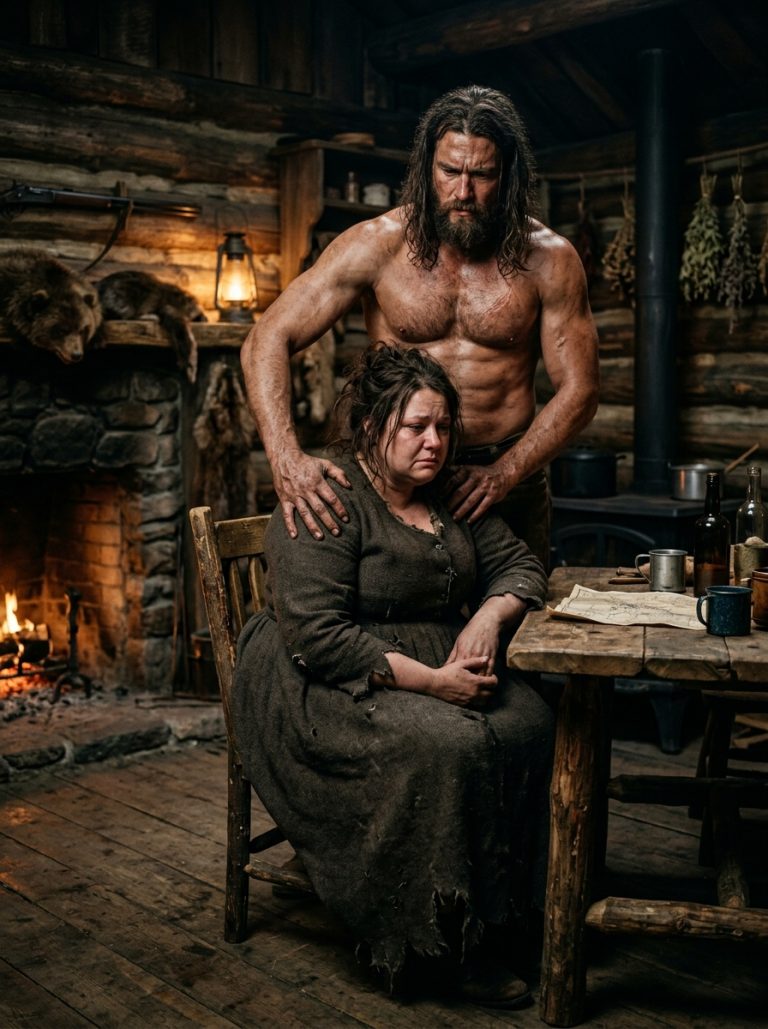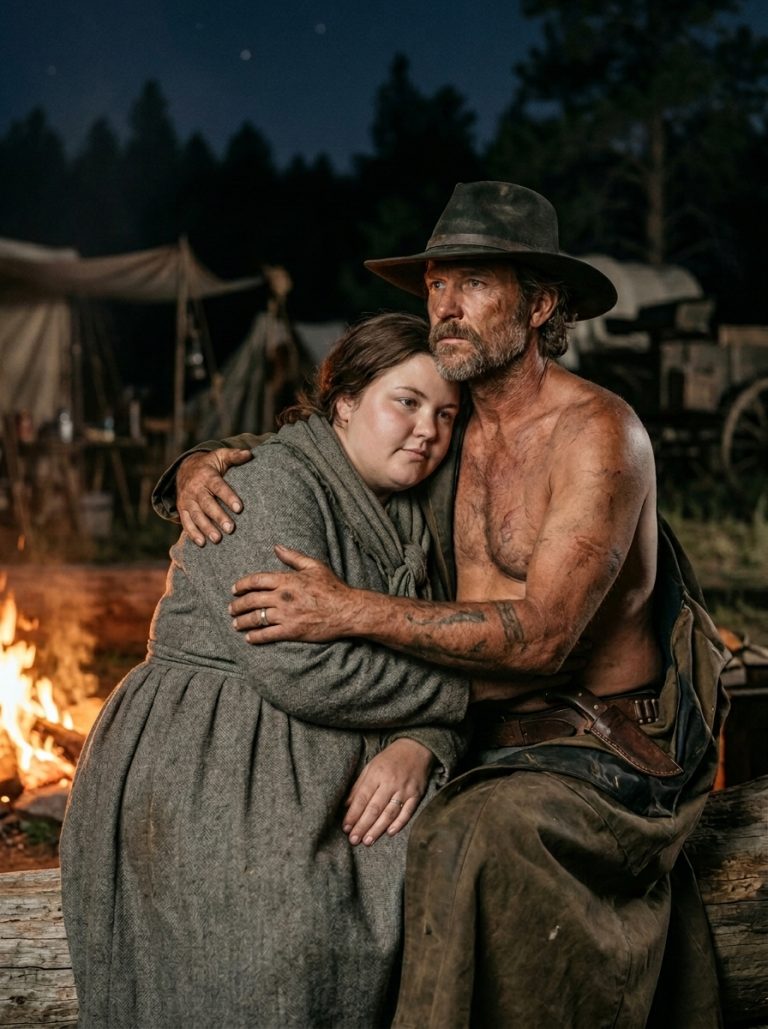
Her Brother Sold Her To A Montana Rancher Because The Town Said She Was Too Big To Love — Then She Saved His Entire Ranch And Became The One They All Answered To

The morning her brother told her she was being sent away, Agnes Crane was standing at the kitchen window watching two sparrows fight over a crust of bread in the mud below the fence.
She had been watching birds a lot lately. Small things with somewhere to go.
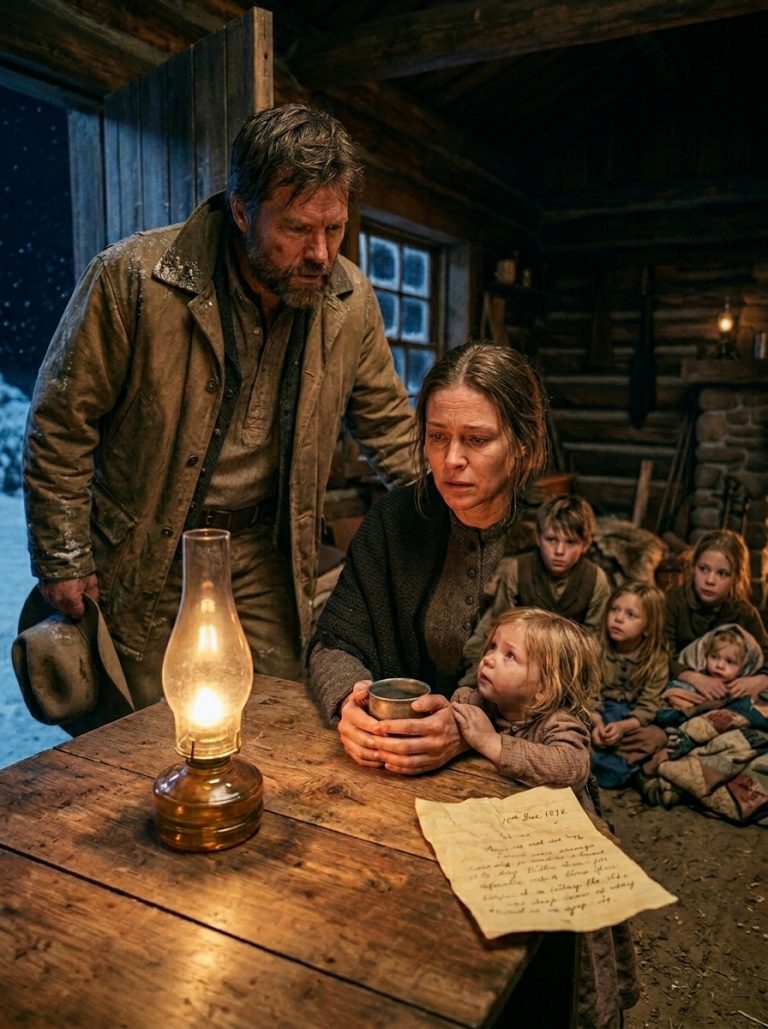
Daniel set the letter on the table the way men set down things they had already decided about — with the particular finality of someone who had arranged the conclusion before presenting the argument. He said the words carefully. Opportunity. Fresh start. A man who needs someone capable. He said them the way people said difficult things when they had worked very hard to make the difficult thing sound like a gift. But Agnes had grown up in Harmon, Iowa, where people’s mouths said one thing and their hands said another, and she had learned to read both simultaneously.
She picked up the letter. Read it. Set it down.
“You told him I’d come,” she said.
Daniel’s hands went still on the back of the chair. “I told him you might.”
“You told him I’d come,” she said again. Not louder. Just truer.
What she did not say — what she had no language for yet, standing in the kitchen she had run since her mother died, in the town that had spent twelve years arranging her into a lesson it told other women — was that some part of her, buried under everything the town had deposited on top of it, recognized the letter for what it also was.
A door.
Broken open by her brother’s cowardice, ugly in its framing, humiliating in its terms.
But a door.
She folded the letter and put it in her apron pocket and went back to watching the sparrows.
PART 1
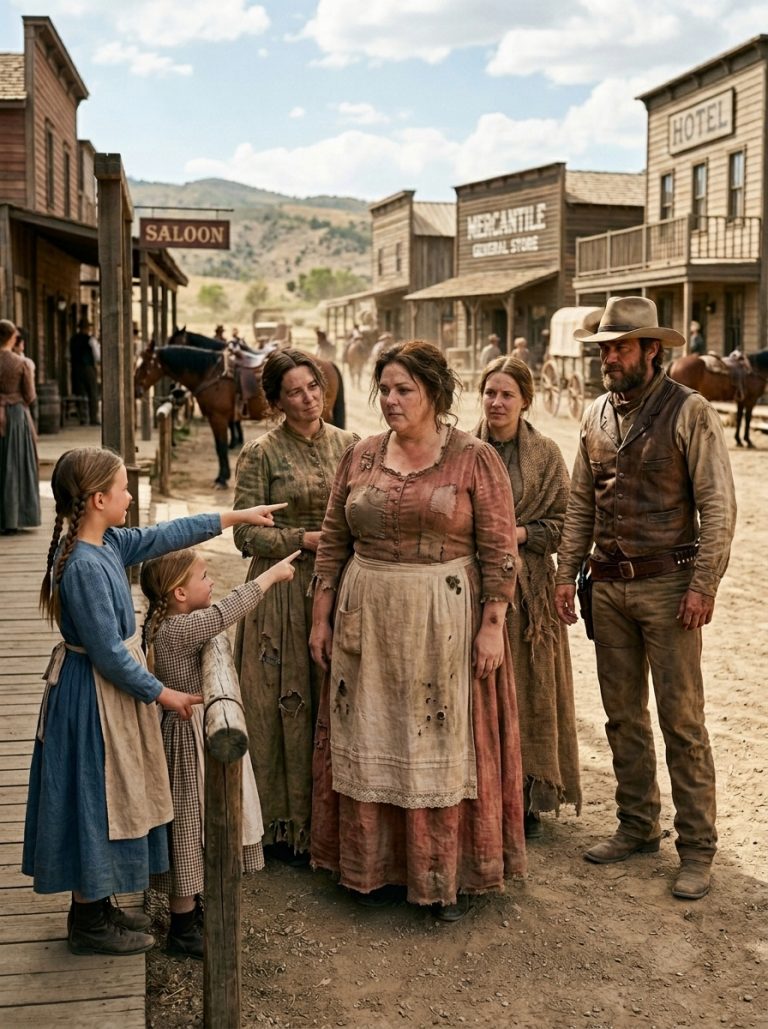
The town of Harmon had always known what Agnes Crane was worth, and the town’s estimate had never been generous.
She was twenty-eight. Large in the way that certain women were large — solidly, without apology, taking up the space her body required with the particular unselfconsciousness of someone who had been too busy working to spend much time being ashamed of herself. She had her father’s dark eyes and her mother’s practical hands, and she could organize a household, manage accounts, read a contract, and identify a bad deal faster than most men in Harmon could saddle a horse. None of this had ever translated into what the town considered value in a woman, which was a smaller body, a quieter voice, and the willingness to reflect credit back onto the man standing nearest to her.
Her father had died four years ago. Her mother two years before that. What remained was Daniel — ten years older, genuinely fond of her in the way of people who loved you in theory and found you inconvenient in practice — and a house that had been emptying of money faster than either of them acknowledged aloud.
Daniel had debts. The kind that accumulated when a man was neither dishonest nor particularly careful, and the years had a way of compounding both qualities. He had borrowed against the farm twice. He had borrowed against their father’s old guarantee on a business note once. The guarantee had been called in by a man named Reeve out in Montana, who had apparently decided he would rather settle the debt through arrangement than through court.
The arrangement: Agnes.
Not sold, Daniel would have insisted if she pressed him — and she didn’t press, because Daniel pressing back would have been worse than the silence. Proposed to was the word he used. Offered a position was another. What it was, stripped of its language, was her brother trading on her future to cover his past.
She had one week before the train.
She spent it the way she spent most difficult things — working. She preserved the last of the root vegetables. She mended every piece of clothing Daniel owned, because old habit died hard and she was furious but she was not mean. She wrote the household accounts in clean columns and left them where he would find them, because no one else in that house had ever bothered with accounts and someone would need to after she was gone.
On the last night she sat on the edge of her bed with her mother’s Bible in her lap and tried to imagine Montana.
She had been told: a ranch. A man named Cole Reeve. Thirty-seven. Widowed. No children. Needed someone capable.
Capable. The word sat differently than beautiful or young or suitable. She turned it over in the dark. In Harmon, her capability had always been noted the way people noted the usefulness of a good mule — with appreciation stripped entirely of admiration. She had wondered, sometimes, what it would feel like to be capable somewhere that didn’t already have a story prepared about what that capability was worth.
By morning she had packed her trunk herself.
Daniel carried it to the wagon without meeting her eyes, which was the closest he came to apology, and she accepted it as such because she was tired and because the train was not going to wait for them to find better words.
The journey west took three days and rewrote the scale of the world.
Iowa gave way to Nebraska, which gave way to Wyoming, which gave way to country that didn’t seem to recognize itself as tame — mountains rising in the distance like thoughts too large for the available sky, plains rolling past the window with an indifference that felt, after Harmon’s suffocating familiarity, almost like welcome. Agnes sat beside the glass and watched it all and felt something she hadn’t felt in years. Not hope exactly. Something quieter. The simple, stubborn possibility that a world this large might contain, somewhere inside its vast geography, one place that hadn’t yet decided who she was.
The wagon from Billings took them onto a road that grew rougher and more honest as it went, and Clearwater Ranch appeared near sundown at the end of a long valley striped with late snow and the first raw green of spring.
It was not a pretty ranch. It was a serious one. The main house ran long and low against the land, built from timber and river stone with the functional beauty of things constructed to outlast fashion. Beyond it: barns, corrals, bunkhouses, and land — so much land it made Agnes realize she had never actually understood the word expanse until this moment.
She climbed out of the wagon before Daniel could offer a hand, because accepting help from him still felt complicated, and stood on Montana dirt and let the wind take her hair.
A man was walking toward them from the direction of the horse barn.
He was not what she expected.
Not that she had permitted herself many expectations — expectations were a form of exposure she’d learned to limit. But she had assembled something in the back of her mind during three days of train travel, and Cole Reeve disassembled it in approximately twelve steps.
He was broad and unhurried, built with the kind of substance that came from years of work done seriously rather than displayed. Dark hair, early gray at the temples, a face that had been lived in rather than decorated. He was not handsome in the way town men were handsome — no smoothness to it, no performance. What his face was, she decided in the moment before he reached them, was honest. Nothing arranged.
He stopped a few feet away and looked at her.
Not past her. Not around her. Not through her with the particular transparency that men in Harmon had always applied to women who didn’t fit their preferred dimensions.
At her.
“Miss Crane.” His voice was low and unhurried, roughened at the edges like good leather. “Cole Reeve. Welcome to Clearwater.”
He extended his hand.
Agnes placed hers in it. His grip was careful and warm, the grip of a man who understood that strength and force were different things.
“Thank you,” she said.
Daniel stepped in immediately, filling the space with transaction. “Mr. Reeve, I want to thank you for—”
“We’ll talk later.” Cole’s gaze moved to Daniel once, briefly, with the efficient economy of a man filing a fact he’d deal with in its proper time. Then he looked back at Agnes. “You’ve had a long journey. Mrs. Petran has supper ready. Your room first.”
Not our arrangement. Not the terms. Not your duties. Her room.
She followed him toward the house with the careful alertness of someone waiting for the other shoe. Inside: thick rugs, lamplight against paneled walls, the smell of pine and bread and wood smoke. A woman in her late fifties with silver-streaked hair looked up from the kitchen doorway and smiled with the directness of someone who had long since stopped pretending.
“You’ll be Agnes. I’m Vera Petran. You’ll eat before any serious decisions get made in this house. That’s how we do things here.”
The words were so matter-of-fact — so completely devoid of the evaluative quality Agnes had grown accustomed to in women’s voices — that she almost forgot to answer.
Cole carried her bag upstairs and opened a door at the end of the hall.
The room had a braided rug, a walnut dresser, two wide windows overlooking the lower pasture, and a brass bed with a quilt the color of winter wheat folded at the foot. On the washstand stood a ceramic pitcher painted with small blue flowers.
Agnes walked in slowly.
“It’s lovely,” she said, and then, because honesty had always been more reliable than politeness: “I didn’t expect this.”
Cole leaned one shoulder against the doorframe with the ease of a man comfortable in his own house. “What did you expect?”
She looked at him. Then at the room. “Something arranged for a transaction.”
The silence that followed had a quality to it — not embarrassed, but alert, the way air changed before weather.
“Miss Crane,” he said carefully, “I was told you agreed to come.”
The room sharpened.
Agnes’s fingers tightened around her father’s account book, which she had carried from Iowa because it was the one object that had always made her feel like she had ground under her feet. “I was told you needed a capable woman in exchange for settling my brother’s debt.”
A muscle moved in his jaw. “I agreed to clear a guarantee note your father once signed for my uncle’s business because your brother wrote saying your family was struggling. I said if you wished to come west, there would be a place here.” He met her eyes directly. “I did not purchase you.”
Downstairs, a door closed. The house shifted around them in the particular way of houses when something important has just been said inside them.
Heat came to Agnes’s face — first humiliation, then anger so clarifying it nearly felt like relief. Daniel had not merely arranged her future. He had warped the arrangement until it looked inevitable, had removed her agency by never confirming she had any.
Cole straightened. “You have my word on this. No one owns anything about you here. If you decide after supper you want to leave, I’ll have you driven to town and your lodging covered until you know your next step.”
Those words — your next step — landed differently than any reassurance Agnes had prepared herself to receive. Freedom offered plainly was somehow more unsettling than constraint, because she had so little practice with it.
She looked out the window at land going gold under the last of the day’s light.
“I’m too tired to choose tonight,” she said.
“Then don’t,” he said, and left her there with the room and the radical fact that nobody had locked the door.
That night, after supper, Daniel found her on the back porch and said the things he had been practicing. She let him say them. When he finished she told him plainly that he had made her smaller so she would fit inside his conscience, and the flinch on his face told her that one had landed true.
She told him to go back to Iowa.
He asked if she would be all right.
She said she didn’t know. But that for once, that answer was hers to find out.
He left at dawn.
She watched the wagon dwindle down the valley road and felt not grief but space — the raw, vertiginous kind that appears when something that was both shelter and constraint removes itself simultaneously.
What happened next, she had not predicted.
PART 2
On the third morning, after two days of restless hovering that she recognized as a form of fear dressed in idleness, Agnes set down her coffee cup and said, “I’d rather be useful than watched.”
Vera, rolling pie crust without looking up, said, “Good. Useful people don’t drive me to drink.”
Cole looked up from the map he’d been studying at the table — she had noticed he was always studying something — and said, “Can you keep accounts?”
“My father taught me.”
“Mine are a disaster.”
“I assumed.”
He blinked. Then, to her moderate surprise, he almost smiled.
That was how it began.
The ranch office was a small room crowded with the evidence of a man who recorded everything and organized nothing. Sales in one ledger, expenses in another, cattle records in loose stacks tied with twine. Agnes spent the first morning sorting, and by noon she had found a duplicate payment to a hay supplier that had been quietly draining Clearwater for two years.
She brought it to Cole where he was working nearby.
He studied the columns, followed her finger, and exhaled a breath that sat between annoyance and respect. “That’s expensive.”
“Only if you let it continue.” She lifted the matching invoices. “Give me two weeks with these books and I can show you every place money has been walking out the door.”
He looked at her for one long moment with the expression of a man revising an estimate he hadn’t known he’d been making.
“All right,” he said.
The days built a rhythm. Mornings for chores, afternoons for books, evenings for supper on the porch when the weather permitted. Agnes learned the ranch — the horses’ names, the temperament of the yellow dog named Biscuit who worshipped Vera and distrusted everyone else, the way Cole’s expression shifted when he was calculating something versus when he was genuinely troubled. She learned, most importantly, what it felt like to live in a place that was not organized around her shame.
Nobody here treated her body as the primary fact about her. Vera cared whether the beans were seasoned correctly. The hands cared whether Friday payroll was accurate. Cole cared whether the books balanced and whether the south fence had been repaired before calving season.
The shift was so quiet on the surface and so complete underneath that it changed her from the inside without her noticing until one afternoon she caught herself humming while tallying feed costs and realized she couldn’t remember the last time she had done that in Harmon.
A month after Daniel left, trouble arrived wearing a good suit and a Harmon smile.
His name was Phillip Sterns.
Agnes recognized him the instant he stepped down from the buggy one warm afternoon in June — not from Harmon specifically, but from the category. A certain kind of man who had been told from birth that the world was arranged in his favor, and had never had sufficient reason to question this. Smooth in the way that concealed rather than revealed. Eyes that measured before they engaged.
He smiled as if they were old friends.
“Agnes Crane,” he said, taking in the ranch, the porch, her. “Word was Montana agreed with you. I confess I expected less.”
Cole was in the north pasture. Vera watched from the kitchen window.
Agnes sat on the porch with a basket of account papers in her lap and every instinct arranged into alertness. “What brings you to Clearwater, Mr. Sterns?”
He removed his hat. A man can’t call on an old acquaintance? Of course he could. But old acquaintances from Harmon did not appear on Montana ranches without a reason connected to what they wanted from you.
He sat without being offered a seat and lowered his voice to the register men used when they wanted to sound like confidants. He was in Montana on business. Land purchases. Railroad interests. Her brother had mentioned where she was.
A chill moved through her despite the afternoon heat.
He looked her over — not with desire but with the clinical interest of someone evaluating an asset. She had improved, he said. Fresh air, hard work, a little confidence. Still, ranch life seemed rather limited for a woman of her intelligence. Callahan — Reeve, he corrected himself smoothly — was respected, but men like him were always one difficult season from exposure. If the railroad changed its route, if water rights shifted, if creditors tightened their expectations simultaneously…
Agnes’s hands went still on the papers.
He watched her face and knew he had landed near something useful.
He had contacts, he said. Opportunities in St. Paul. A woman with the right guidance could build a very different sort of life than this one.
There it was. Dressed in city language and refined manners, but underneath it the same old offer that Harmon had made her her entire life. Become smaller, quieter, more acceptable, and the world might finally consent to reward you for it.
Agnes looked at him steadily. “You mean if I arrange myself to other people’s specifications, they may condescend to include me.”
He chuckled. The world had standards regardless of personal feelings about them.
“And you’ve come all this way,” she said, “to teach me mine.”
He leaned forward, very smooth. Women sometimes mistook gratitude for love and usefulness for belonging. A rancher might value her help. That did not mean society would ever see her as his equal.
Behind him, a shadow moved across the yard.
Cole had returned.
Agnes looked at Sterns and found, to her own quiet astonishment, that the wound his words were aimed at had weakened. Not healed — wounds like hers did not disappear because one good man had entered a room. But it had competition now. Something sturdier had taken up residence in the same space.
“I’m not looking for society,” she said. “I’m building something.”
Sterns rose and smiled the smile of a man who had lost the first hand and was already thinking about the second. He tipped his hat to Cole with polished insolence and drove off.
Cole climbed the porch steps. “Friend of yours?”
“No.”
He watched the road. “I gathered.” Then: “He mentioned the railroad.”
She turned sharply. “You know?”
“There’s been talk for months.” He leaned against the porch post with the expression of a man who had been carrying something alone and was deciding how much of it to put down. “They want better access through this valley. Smaller operations have been selling under pressure. If enough go, the holdouts become inconvenient.”
“Are you at risk of losing Clearwater?”
A corner of his mouth shifted. “I’m at risk of paperwork and men with new suits. That’s not the same as losing.”
But she could see the weight underneath the steadiness.
“Show me,” she said.
That night he spread deeds, surveys, and bank letters across the dining table. Agnes read every page. By midnight a pattern had emerged that made her stomach cold — several neighboring properties had been acquired through companies whose names changed but whose signatures traced back to a single firm in Chicago. Water access on the north creek was the leverage point. If Clearwater lost its claim to the creek bend, the ranch would survive only by contracting to half its current size.
“Someone has been deliberately confusing the boundary language,” she said, tracing one document. “This survey references an old marker, but the old marker was relocated after the ’89 flood. If they use this interpretation, they can argue the creek bend isn’t yours.”
Cole stared at her. “I’ve read those papers three times.”
“They’re written to be half-understood. That’s the point.” She looked up. “Who handles your legal filings?”
His silence was its own answer.
Vera, pouring coffee at midnight without comment, muttered, “That man charges more than he earns.”
From that night forward Agnes’s work at Clearwater deepened from bookkeeping into something closer to defense. She cross-referenced ledgers with land tax notices, compared supply contracts with delivery logs, mapped bank drafts against cattle sale dates. The deeper she went, the less she liked the shape of what she found. Some losses were ordinary. Some were not.
Then she found the signatures.
Wade Kiln, Clearwater’s foreman for nearly a decade, had been approving payments to a fencing contractor whose name existed in exactly one ledger and nowhere else in the county record.
Agnes sat with that discovery in the afternoon light for a long time.
Wade was broad-shouldered and florid-faced, the kind of man whose confidence came from never having been seriously questioned. She had noticed from the beginning the particular way his gaze moved over her — not threatening, just dismissive, the smirk of a man who had decided she was temporary and acted accordingly. Until now that assessment had been merely unpleasant.
She brought the forged receipts to Cole in the barn.
He read them once. Then twice.
“You’re certain.”
“Yes.”
He handed the papers back with the careful precision of someone handling something that had changed the room. “Say nothing to anyone yet.”
“What will you do?”
He tightened the wrap on a horse’s leg, his hands precise, his face controlled. “Find out how deep it goes.”
It went deep enough.
Over the following week Agnes and Cole watched Wade separately, comparing notes in the evenings with the focused efficiency of people who had found themselves on the same side of something without planning it. A pattern surfaced: Wade made unnecessary trips to the eastern boundary twice a week and disappeared into town on vague excuses. Once, from the office window, Agnes watched him speaking with Phillip Sterns near the freight yard.
When she told Cole, his expression did something she hadn’t seen from him before. Not anger exactly. Something colder. More resolved.
By then the emotional topography of the house had shifted in ways neither of them had been noting carefully enough.
He knew she drank peppermint tea when anxious and left the cup half finished when the anxiety passed.
She knew he rubbed the scar across his left knuckle when working through a hard problem.
He knew she read by the west window because the lamplight in the evenings bothered her eyes.
She knew he kept his late wife’s photograph face-down in the desk drawer and never explained why and she never asked.
One evening in July, sitting on the porch steps after a long day moving cattle through heat and dust, with lightning stitching the far ridge and the air smelling of sage and the rain it was withholding, Cole said quietly, “You’re still angry with your brother.”
“Yes,” Agnes said.
“Do you miss him?”
She looked at the darkening valley. “Yes. Which makes it worse.”
He nodded as though he understood something about love that didn’t resolve cleanly, which she suspected he did.
After a while she said, “The first night. You meant it — that I could have left?”
“Yes.”
“Even after you’d paid the debt?”
He was quiet for a moment. “Especially then.”
Something settled in her at that — quiet and permanent, like a foundation stone finding its level.
“What am I to you?” she asked, keeping her voice steady with effort.
He didn’t answer quickly. She had noticed he never said important things quickly.
“You are the best thing that’s happened to this ranch in years,” he said at last. “And to me. But I won’t use that to pressure you into any shape. Not after how you arrived here.” He looked out at the land. “If partnership in work and friendship at my table is what you want, you’ll have it. If one day you want more, I’ll be here. But I won’t be another man who arranges your future without asking.”
Agnes stared at the storm light trembling in the distance and felt, with a clarity that was almost painful, that this was the first time in her life love had come toward her with open hands.
She didn’t kiss him. Neither of them were people built for theatrical speed. But when her fingers shifted beside her skirt, his hand moved and covered them.
It was enough.
Three weeks later, trouble broke open.
Daniel arrived at Clearwater near noon, dust-covered and not quite sober and carrying guilt that had curdled into something closer to fear. Agnes knew before he opened his mouth that it was worse than ordinary trouble.
They sat him at the kitchen table. Vera set coffee in front of him with the expression of a woman prepared to use the pot as a weapon if the situation required.
Daniel rubbed his face. He had made a mess. He had met Phillip Sterns in Iowa months back, had been offered money to make introductions, smooth certain dealings, help identify pressure points on western ranchers who were resistant to selling. He had told himself it was all legal. He had told himself a great many things that were easier than the truth.
Now he knew the difference between legal and clean.
Wade Kiln had been feeding information from inside Clearwater for months — water access details, herd counts, financial strain points, anything useful to the Chicago firm building its case for forcing a default. The plan was to contest the creek rights and call in old obligations simultaneously. If that failed, they intended to manufacture evidence of mismanagement before the county land inspection. Loose fences. A fire in the right place. A stampede that would make the ranch appear to have collapsed under its own weight.
The timing: soon. Tonight or tomorrow. Sterns had stopped sharing details when Daniel started asking questions.
Garrett rose before anyone could speak. “Wade is on the north line right now.”
Everything after that moved at the speed of necessity.
Cole sent riders for the sheriff and moved to get cattle in from the eastern pasture. Vera loaded the wagon with the military efficiency of a woman who had survived difficult things before and knew exactly which supplies mattered. Daniel, pale and shaking, insisted on riding with the hands — which was the closest thing to usefulness he had left available to him.
Agnes did not wait for instructions.
She went to the office and gathered every piece of documentation she had assembled — forged receipts, boundary surveys, duplicate contracts, bank letter sequences — tied them with string, and put them in a leather satchel. If law arrived after disaster, evidence would matter as much as courage.
By dusk the sky had turned the copper color it wore before serious weather, and the first smell of smoke came from the direction of the north creek draw.
PART 3
“Move the breeding stock south,” Cole ordered from the yard, already in motion. “Keep the remuda penned. Nobody rides the outer line alone.”
The smoke thickened.
Agnes caught Cole’s sleeve as he moved toward his horse. “If the fire drives the herd east, they’ll funnel straight into the broken fence line.”
He stopped and looked at her sharply.
“The lower wash,” she said. “It narrows near the cottonwoods. You can turn them there if you get riders to the east flank first.”
One beat. Two. Around them the ranch was coming apart at its ordinary seams — men shouting, horses pulling at their lines, the particular controlled panic of people who knew what they were doing and were doing it as fast as it could be done.
“Stay at the yard,” Cole said.
“No.”
“Agnes—”
“I know these books, these boundaries, and which calves can’t be pushed hard. I know where the weak points are in this land because I spent three months reading every record you had.” She held his gaze. “I am not staying on a porch while my home burns.”
Something crossed his face at the word home — startled and fierce simultaneously — and then he gripped her shoulders once, firmly, the grip of a man who had run out of time for the argument he wanted to have.
“Stay where I can find you,” he said.
She didn’t promise that exactly. But it was the closest thing to yes the situation allowed.
The night became its own weather.
Wind came hard off the ridge. Sparks moved sideways. Somewhere beyond the smoke the cattle had found their fear and were announcing it in the deep-throated chorus that meant the situation had moved past rumor into fact. Agnes helped Vera and two ranch hands push the youngest calves into the stone-walled lower corral. When a gate jammed she threw her shoulder into it until the hinge gave and her arm went briefly white with shock. When a terrified heifer wheeled toward a boy against the rails, Agnes grabbed the lead rope and planted her boots in the mud and held until another hand could reach her.
The fire on the north draw spread, checked where the land turned rocky, spread again.
Then she heard it.
A tremor underfoot first. Then thunder that was not from the sky.
The east herd had blown through a cut fence and was surging down the slope — hundreds of panicked animals pouring dark through darker dark, the sound of them swallowing everything else.
“They’ll hit the lower yard!” someone shouted.
Agnes looked at the terrain in her mind the way she looked at columns in a ledger — finding the logic in it, tracing the direction the numbers wanted to go.
“Not if we open the west gate,” she said. “Pull them toward the wash.”
The men beside her hesitated in the way that fear made everyone briefly stupid.
Agnes took the lantern from the nearest post and ran.
Mud at her boots. Smoke in her eyes. Behind her she could hear Vera’s voice cutting through the chaos with the authority of a woman who had long since decided that volume was less useful than certainty. Agnes reached the west gate and wrestled the chain loose just as the leading edge of the herd came through the haze — a wall of muscle and horn and the particular terror of large animals that have decided to move and cannot be reasoned with.
She swung the lantern wide. She made herself large. She screamed into the smoke and the dark and the thunder of hooves, waving her free arm, becoming the largest obstacle available.
A horse shot past her — Cole, soot-streaked and hard-faced, reading the situation in one glance. He veered to flank the cattle.
“Left!” Agnes shouted. “Drive them left!”
The cry went down the line of riders. Left. Left. Left.
The wash caught them the way she had known it would, narrowing the flood, bending it south. Hooves hammered the muddy earth. The pressure of disaster shifted by feet, then yards, then enough to mean something.
Agnes took one breath of relief precisely too soon.
A fence post, destabilized by the passage of the herd, snapped back under accumulated strain and caught her across the ribs. The world went white. She went to one knee in the mud, and for a moment everything became a high, thin tone.
Then Cole was there — off his horse, one arm under hers, hauling her upright with the controlled urgency of a man who had already assessed the situation and was managing two things simultaneously.
“Can you stand?”
“Yes.” A lie and they both knew it.
He looked at her once with the expression of a man filing a fact he would deal with in its proper moment, because the proper moment was not yet. The last of the cattle were still moving. The fire still needed answering. He got her behind the stone trough with the economy of motion of someone who had learned to prioritize efficiently.
“You should have stayed at the yard,” he said, voice rough.
“You should have hired a proper accountant years ago,” she said back.
For one impossible second, in the middle of smoke and chaos and the sounds of a ranch being tested to its edges, he laughed.
Then a shot broke through the night.
Wade Kiln sat his horse at the outer line with a rifle in one hand and the expression of a man who had run out of plan and was falling back on intimidation. Shame when a man lost control of what he’d built, he called out. By dawn this place would look like it had collapsed under its own weight.
Cole rose before anyone stopped him.
“You’ll hang for this,” he said. Quiet. Absolute.
Wade wheeled his horse. But Daniel came out of the dark at a gallop — and whatever else Daniel Crane had failed at in his life, he had apparently decided that this was the last thing he would fail at, and he put his horse between Wade and the creek track with everything he had.
What followed was less combat than collision. Horses. Men. The rifle going off into the sky. Both of them in the mud. By the time the hands reached them, Daniel was bleeding from the mouth and Wade was cursing under the weight of three men.
Sheriff Alderman rode in with rain behind him and two deputies and the particular expression of a man who had been half-expecting this call for some time.
Agnes handed him the satchel.
He looked at the papers. Looked at her. Looked at the smoking draw, the scattered cattle, the damaged fence lines, the captured foreman, and Cole standing nearby with one hand at the small of Agnes’s back because she had finally stopped pretending the blow to her ribs was something other than what it was.
“You assembled all of this?” the sheriff said.
“Yes.”
He considered the evidence and the woman holding it with the careful attention of a man deciding which of the two told him more.
“Well,” he said. “That simplifies my evening considerably.”
Phillip Sterns was arrested in Billings three days later at the train station, which suggested he had overestimated his ability to leave before the documents arrived.
The county hearing took place the following week in a room that filled past its chairs before the clerk called order. Agnes had spent years being the subject of rooms without being the center of them. She understood the difference now.
She spoke clearly. Not with drama — drama was for people who hadn’t already lived through the event itself. She laid out the forged payments, the boundary manipulations, the simultaneous pressure campaign designed to appear like natural financial collapse. When Sterns’s attorney suggested she had confused ranch accounting with legal evidence, Agnes opened three ledgers and two survey maps in sequence until the man ran out of challenges.
By the end of the hearing the room understood that it was not looking at a woman who had been rescued by fortunate circumstance. It was looking at the person who had seen the threat clearly and named it precisely enough to defend an entire valley.
Clearwater’s water rights were upheld.
Sterns’s purchase claims collapsed.
Wade turned state’s evidence and accepted his arrangement with the court.
Daniel, facing charges of his own, signed a full accounting of his involvement and accepted the scraps of dignity remaining in telling the truth. Afterward he found Agnes alone outside the courthouse in a square of afternoon light.
He was leaving Iowa, he said. There was work in Cheyenne — honest work, he believed. He didn’t ask for forgiveness. He said only that he wanted to become someone who might one day deserve it.
Agnes looked at her brother for a long time. The man in front of her was still flawed, still weak in the precise ways he had always been weak. He was also, for the first time she could recall, looking at himself without the filters he had always kept between himself and the truth.
“I don’t forgive what you did,” she said. “Not yet.”
He nodded. He had not expected otherwise.
“But I hope you tell the truth from here on,” she added. “Even when it costs you.”
His eyes filled. He touched his hat brim and walked away.
She let him go.
Some mercies weren’t softness. Some were simply the decision to stop holding something that the other person was going to have to carry themselves.
Autumn came to Clearwater the way autumn came to country that had earned it — slowly, beautifully, without apology.
The ranch looked different in it, or perhaps Agnes looked at the ranch differently, which amounted to the same thing. The hands brought payroll questions to her before troubling Cole with them. Vera had begun referring to the office as Agnes’s territory in a tone that suggested this was a fact that had always been true and had simply required time to become official. The rebuilt north fence ran straight and stubborn along its proper line. The books balanced. The calves from that brutal spring were strong and growing.
One evening in October Cole asked her to ride up to the ridge above the house.
The valley spread below them under sunset the color of fire and copper, the creek catching the last light between its willows, the cattle dark and peaceful across the lower pasture. Clearwater lay beneath them like something that had been tested and had decided to remain.
Cole dismounted and helped Agnes down. She leaned against the fence rail in her blue shawl and watched the shadows lengthen and thought, without particularly intending to, that this was the most beautiful thing she had ever seen.
He handed her a folded packet.
She opened it. Deeds. Revised county filings. A partnership agreement. Her name, written in clean black ink beside his, as co-owner of Clearwater Ranch.
“What is this?”
“Half the operating interest.” His voice had the same careful seriousness it had carried on the first night when he told her she was free to leave. “The legal portion should belong to the person who saved it.”
She looked up sharply. “Cole—”
“I mean it.” He held her gaze without flinching. “If you stay, I want you here as my equal in every document that matters, not just in the way things feel. And if you don’t stay—” He paused. “Then your share remains yours. You can do with it whatever you choose. But no future of yours is ever arranged over your head again if I can prevent it.”
Agnes looked at the papers in her hands, then at the valley below, then at the man who had said your room on the first night and meant it as the first true thing he offered her.
She laughed through the tears that arrived uninvited. “You have a remarkably unsubtle way of courting a woman, Mr. Reeve.”
“I was aiming for certainty rather than polish.”
“You achieved it.” She folded the papers with the care she gave to things that were both legal documents and something that mattered beyond their legal weight. “That is a yes to staying. A yes to the ranch. A yes to being your partner.” She placed her free hand against his chest, over the steady beat there. “And if you ask the rest of it properly, it may become something more as well.”
The smile that came over his face then was the kind that changed the whole quality of the evening — not triumph, not relief alone, but something closer to wonder. The expression of a man who had offered freedom and found that it came back as choice.
“Agnes Crane,” he said, there on the ridge above the land they had nearly lost and stubbornly kept, and he asked her the way one equal asked another — without transaction, without price, without a single shadow of arrangement.
She said yes with the full weight of a woman who had finally arrived at a place worthy of her actual size.
They married in early spring under the cottonwoods by the creek that had almost been taken from them. Vera cried openly and then denied the evidence with impressive conviction. Sheriff Alderman came in a clean coat that had clearly been pressed for the occasion. Half the valley attended, because respect moved fast in ranch country once it had been publicly established, and Agnes had established it in the most legible terms available — by saving everyone’s water rights in a packed courthouse while a lawyer ran out of objections.
Daniel sent a letter from Cheyenne with no request in it. Only good wishes, written in the careful hand of a man trying to mean what he said. Agnes folded it and put it away. Not forgiveness yet. But not nothing. People who were willing to tell the truth deserved at least the possibility of a different story eventually.
In the years that followed, Clearwater expanded beyond its previous edges. The books balanced every season. The north fence held. The creek ran clean and uncontested through its proper bend. Agnes’s name on the deeds stopped being a point of interest and became simply a fact, the way useful facts had a way of eventually becoming unremarkable.
Men still looked at her in certain ways when she walked into town. Women still whispered occasionally, because the world never ran entirely out of small minds, and small minds required an occupation. But those sounds no longer reached her center. They were simply weather — and Agnes Crane had grown up in Iowa, where weather was something you noted and then worked around.
She had a home. Work that mattered. A name on the documents. A man who had understood from the first night that the path to her trust was not praise or persuasion but respect made concrete.
She had chosen and been chosen — not despite the full scope of who she was, but in complete knowledge of it.
On some evenings she stood on the porch with Cole beside her and watched the valley burn gold under the last of the light, and thought about Harmon and the years spent making herself smaller to fit into spaces not built for her, and felt something that was not quite gratitude and not quite triumph but was somewhere between them. A quiet satisfaction. The particular peace of a person who has stopped living inside other people’s estimations.
The world, she had learned, contained vastly more room than Harmon had ever suggested.
You simply had to be willing to travel far enough to find it.
And once you did — once you arrived in the place that looked at you and said capable and meant it as the highest praise available — you stopped apologizing for the space you occupied.
You filled it.
Fully, unapologetically, completely.
As you had always deserved to.